Denial of U.S. Passports: President Obama and Congress Pass Law that will Require Department of State to Deny a U.S. Passport for a “Seriously Delinquent Taxpayer”
Entry in and out of the U.S. has just gotten more problematic under a new law for those U.S. citizens who the IRS asserts owes taxes. A new statutory concept has been added to the tax law called “seriously delinquent tax debt”; which is defined by new IRC Section 7345 as a tax that has been assessed, is greater than US$50,000, and where a notice of lien has been filed or levy made. 
Prior posts have addressed current legal requirements surrounding social security numbers for U.S. federal tax compliance purposes. See, USCs without a Social Security Number (and a Passport) “Cannot?” Travel to the U.S., posted on May 17, 2015.
Other posts have focused on the dilemma facing U.S. citizens (USCs) who have no social security number (“SSN”). See an older post (23 July 2014) – Why do I have to get a Social Security Number to file a U.S. income tax return (USCs)?
The Joint Explanatory Statement of the Committee of the Conference provides the key provisions summary of the law as follows:
Present Law
The administration of passports is the responsibility of the Department of State. [“Passport Act of 1926,” 22 U.S.C. sec. 211a et seq.] The Secretary of State may refuse to issue or renew a passport if the applicant owes child support in excess of $2,500 or owes certain types of Federal debts. The scope of this authority does not extend to rejection or revocation of a passport on the basis of delinquent Federal taxes. Although issuance of a passport does not require a social security number or taxpayer identification number (“TIN”), the applicant is required under the Code to provide such number. Failure to provide a TIN is reported by the State Department to the Internal Revenue Service (“IRS”) and may result in a $500 fine.
***
Senate Amendment
Under the Senate Amendment, the Secretary of State is required to deny a passport (or renewal
of a passport) to a seriously delinquent taxpayer and is permitted to revoke any passport
previously issued to such person. In addition to the revocation or denial of passports to delinquent taxpayers, the Secretary of State is authorized to deny an application for a passport if the applicant fails to provide a social security number or provides an incorrect or invalid social security number. With respect to an incorrect or invalid number, the inclusion of an erroneous number is a basis for rejection of the application only if the erroneous number was provided willfully, intentionally, recklessly or negligently. Exceptions to these rules are permitted for emergency or humanitarian circumstances, including the issuance of a passport for short-term use to return to the United States by the delinquent taxpayer.
The provision authorizes limited sharing of information between the Secretary of State and
Secretary of the Treasury. If the Commissioner of Internal Revenue certifies to the Secretary of
the Treasury the identity of persons who have seriously delinquent Federal tax debts as defined
in this provision, the Secretary of the Treasury or his delegate is authorized to transmit such
certification to the Secretary of State for use in determining whether to issue, renew, or revoke a
passport. Applicants whose names are included on the certifications provided to the Secretary of
State are ineligible for a passport. The Secretary of State and Secretary of the Treasury are held
harmless with respect to any certification issued pursuant to this provision.
Part II: U.S. Department of State has Allowed (Starting in at least 2013) USCs to Keep their U.S. Passports After Oath and Prior to Receiving CLN
See the first post on this topic: U.S. Department of State has Allowed (Starting in at least 2013) USCs to Keep their U.S. Passports After Oath and Prior to Receiving CLN, Posted on March 17, 2015
A U.S. citizen is required to have a U.S. passport to enter the U.S., according to the immigration law regulations 22 CFR § 53.1 require that a U.S. citizen have a U.S. passport to enter or depart the United States. The relevant part of the regulations is § 53.1(a) which provides as follows:
Passport requirement; definitions.
(a) It is unlawful for a citizen of the United States, unless excepted under 22 CFR 53.2, to enter or depart, or attempt to enter or depart, the United States, without a valid U.S. passport.
***
These regulations were first published in 2006, and rely in part on a Presidential Executive Order made by President Bush (Jr.). See a prior post,
USCs without a . . . Passport . . . Cannot Travel to the U.S., Posted on May 17, 2015. In that post and a later post, I explained how a social security number is currently not an indispensable requirement for U.S. citizens who wish to travel to the U.S. and need to apply for a passport.
*
*
This background is relevant for U.S. citizens who take the oath of renunciation. Previously, many U.S. embassies and U.S. Consulates around the world would physically take the U.S. passport of the individual upon taking the oath of renunciation and completing U.S. Department of State
Form DS-4080. See, a prior post,
Documents to Request the Consular Officer When Renouncing U.S. Citizenship, Posted on May 28, 2014, which provides as follows:
*
The U.S. Department of State does not always provide any specific document, e.g., a certified copy of any of the following documents, after you take the oath of renunciation:
Will 2015 Be a Record Year for Citizenship Renunciations?
U.S. Department of State has Allowed (Starting in at least 2013) USCs to Keep their U.S. Passports After Oath and Prior to Receiving CLN
 Washington Post journalist, Ms. Colby Itkowitz had an interesting article on March 3, 2015, titled Yes, the State Department can jump on a problem and fix it in record time.
The focus of the article was that the U.S. Department of State can indeed fix a problem (in this case how and when U.S. passports are taken from U.S. citizens who take the oath of renunciation).
The article was a bit of a surprise to me, as I have had experience with several clients where the Consulate offices have indeed allowed the U.S. citizen to physically maintain their U.S. passport after taking the Oath of Renunciation (Form DS-4080, Oath of Renunciation of the Nationality of the United States) but prior to actually receiving the “Certificate of Loss of Nationality” (“CLN”).
After a U.S. citizen has formally renounced (or relinquished) their U.S. citizenship, the U.S. Department of State provides a CLN. This form can be located here at – Certificate of Loss of Nationality of the United States, Form DS-4083 (CLN)
You can go to the page “U.S. Department of State” under “Resources” for further U.S. Department of State Documents related to loss of nationality.
Sometimes, the U.S. Department of State will take several months to process the file in Washington D.C., before they actually issue the CLN. I have had cases (worst case scenarios) that take upwards of 9-10 months. See, The IRS does not give a “Certificate of Expatriation” or similar tax document . . .
However, my experience on several cases is that consular officer will generally allow t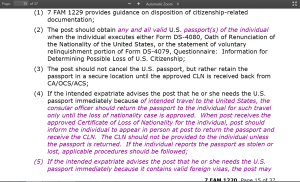 he individual to physically keep the U.S. passport until the CLN is actually issued and received by the individual in exchange for their passport. This has been the case for some 2 +/- years.
This procedure has been formalized in the Foreign Affairs Manual which added the additional key language in paragraph (4) regarding U.S. citizens who need their passport for travel to the U.S.
Part II: U.S. Department of State Communications to USCs overseas Regarding Tax Obligations with IRS
A recent post discussed a rather surprising development of how the – U.S. Department of State, Starts Communicating with U.S. Citizens Overseas Regarding Tax Obligations with the IRS
There are several observations to be made about this approach.
First, some USCs living overseas will find this a welcome development, as it provides a method of  basic education of how U.S. tax laws work. The newer U.S. passports do have an obscure reference to U.S. tax obligations of USCs. In the past, there was generally no communications from the U.S. Department of State to USCs, including newly naturalized U.S. citizens about their U.S. tax obligations.
Second, there is much helpful information provided in the U.S. Department of State’s explanation. The key tax forms that are most relevant for USCs and LPRs residing overseas are explained in the government e-mail. See, USCs and LPRs Living Outside the U.S. – Key Tax and BSA Forms
All of the following forms are identified by the U.S. Department of State:
- Substantive Income Tax Forms (Affecting Tax Liability)
- Information Tax Forms (Not Affecting Tax Liability, but with Substantial Penalties for Failure to File)
These are the most relevant forms for the majority of USCs and LPRs; although there are numerous other forms and calculations that may be required depending upon the particular circumstances, income, assets, employment, etc. for each individual
The third observation, relates to how employees of the U.S. Department of State will use this information and communicate with USCs? Will they begin asking (even if infrequently) whether a U.S. citizen overseas is in compliance with their U.S. federal tax requirements? What are the consequences to the U.S. citizen if they state yes, no or refuse to answer? What can happen to an individual if they provide a false statement to a federal employee or file a false document? See What could be the focal point of IRS Criminal Investigations of Former U.S. Citizens and Lawful Permanent Residents?
The fourth and last observation, is whether the IRS will begin providing USC taxpayer information on a regular basis to the U.S. Department of State? The law provides limitations upon how the IRS can disclose and provide taxpayer information. See, 26 U.S. Code § 6103 – Confidentiality and disclosure of returns and return information
However, there are significant exceptions in the law, that do allow disclosure of taxpayer financial and taxpayer information to other agencies (particularly “Intelligence Agencies,” which presumably includes the U.S. Department of State). See, for instance, IRC Section 6103(i)(7). The statutory requirements of 6103(i)(7) are not particularly rigid.