“Expatriation” Implies Leaving the U.S., But Many More Want to Come to the U.S.: Tax Consequences
U.S. citizens and long-term residents who are considering renouncing their citizenship or abandoning their lawful permanent residency (“LPR”) are increasingly undertaking more sophisticated life and tax planning before “taking the plunge”!
Many (in my experience – all) of these “expatriates” eventually want to be able to visit the U.S. and in some cases possibly come back to live permanently. Many simply apply for and obtain a B1/B2 visa.
To appreciate how many more persons want to immigrate to the U.S. compared to emmigrate from it, see an earlier post: The Number of Citizens Leaving (Renouncing) Versus Coming (Naturalizing) is Just a Speck
This is the other “side of the coin” so to speak, since individuals contemplating coming to the U.S. often should undertake pre-immigration tax planning. One means for non-U.S. citizens to become LPRs and eventually U.S. citizens, is through the EB-5 visa program.
Immigration attorney Ms. Teodora Purcell has written prior guest posts, including: When is the loss of US nationality effective? [Guest Post from Immigration Lawyer]
The next post on this site will be a complete article by Ms. Teodora Purcell explaining in more detail the EB-5 visa program and recent developments.
As to the tax implications of immigration to the U.S. (as opposed to emigration from it), I wrote the tax chapter in the latest edition of the American Immigration Lawyers Association (“AILA’s) treatise – Immigration Options for Investors & Entrepreneurs US$199.
That treatise is heavily focused on “EB-5 investors” and the tax discussion is titled: Key U.S. Tax Considerations for EB-5 (& Other) Visa Applicants.
Ms. Teodora Purcell’s contact information is set out below:
Teodora Purcell | Attorney at Law
FRAGOMAN
11238 El Camino Real, Suite 100, San Diego, CA 92130, USA
Direct: +1 (858) 793-1600 ext. 52424 | Fax: +1 (858) 793-1600
TPurcell@Fragomen.com
Does the IRS have access to the USCIS immigration data for former lawful permanent residents (LPRs)?
Information about former LPRs, such as the individuals names, is not published under the statute, IRC Section 6039G, which only covers former U.S. citizens. 
This raises the question of whether the Department of Homeland Security tracks former LPRs – names and addresses overseas and provides that information to the Internal Revenue Service?
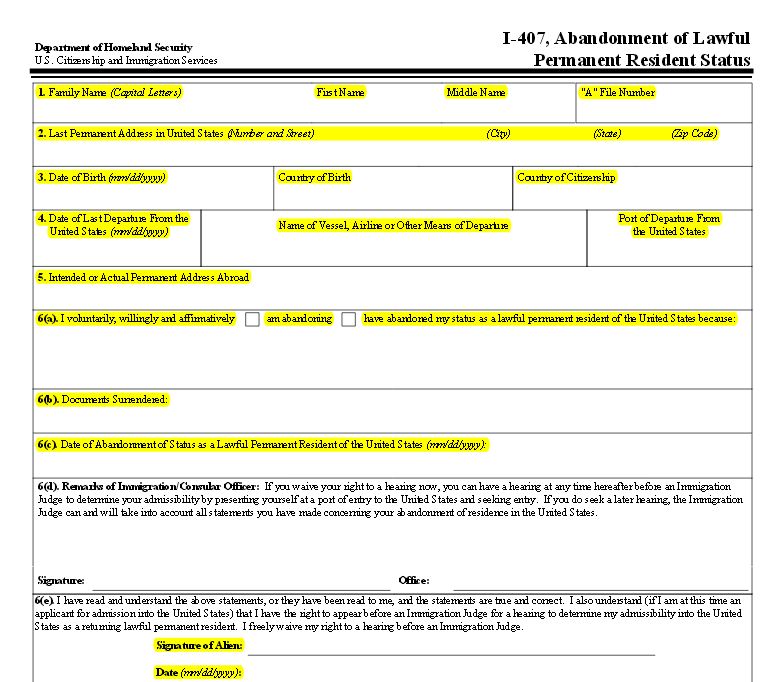
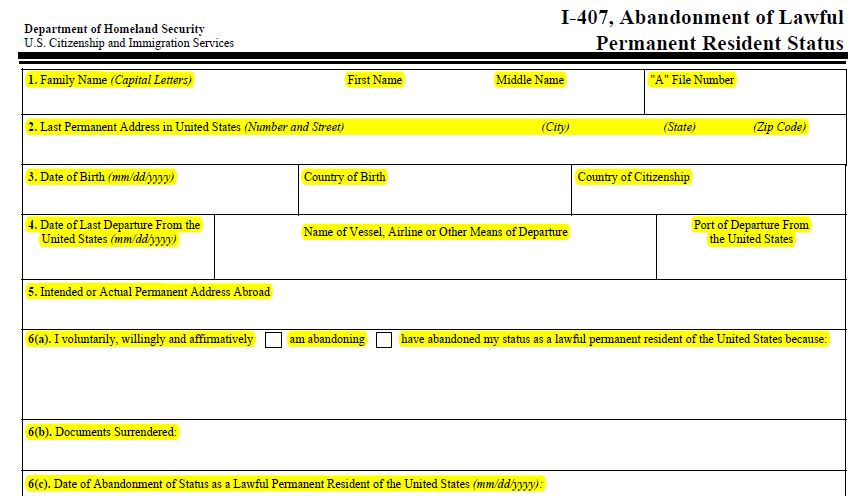
A prior post discussed the newly published USCIS immigration form I-407 for LPRs who must now use it when formally abandoning LPR status. See, More Information and More Information: USCIS Creates New Form for Abandonment of Lawful Permanent Residency
The new I-407 Form requires much more information and is 2 pages in length. The old form had only 6 lines and was less than 1/2 of a page in length. These forms  are set forth here. The new form requires the address overseas of the individual.
As readers here know, the names of former U.S. citizens are published quarterly by the U.S. federal government for the world to see. See a prior post, The 2014 Third Quarter Renunciations Is probably the New Norm –
The complete set of lists going back to the mid-1990s can be reviewed here. Quarterly Publications.
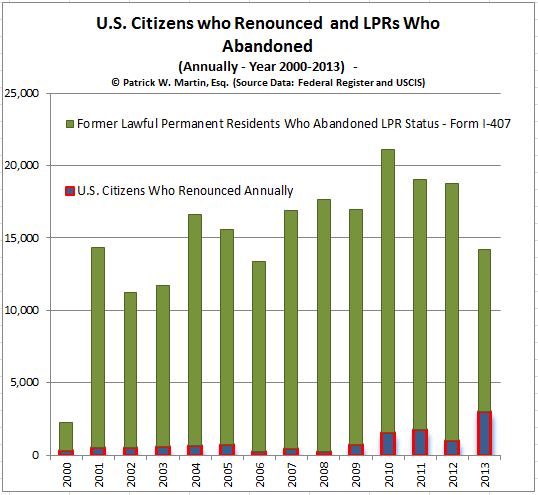
Of course, the IRS can easily select and identify individuals for audit, by simply drawing from the published names of former U.S. citizens, which is currently tracking at an average of about 850 former USCs quarterly. In contrast, the number of former LPRs who have filed USCIS Form I-407 is tracking at an average of about 4,000 to 5,000 individuals quarterly. 
While citizens are often the focus of the public press and Congress regarding “expatriation taxation”; the statute also wraps in so-called “long-term residents.” These are individuals who had or continue to have “lawful permanent residency status.” There are numerous technical considerations in this area, but needless to say, the number of former lawful permanent residents who have simply filed Form I-407 – Abandonment is far in excess of those U.S. citizens who have filed for and received a Certificate of Loss of Nationality (“CLN”) – Form DS-4083 (CLN). The graph reflects the enormous difference.
See, earlier post The Number of LPRs “Leaving” the U.S. is 16X Greater than the Number of U.S. Citizens Renouncing Citizenship
On a related post, the question was raised –What are the Number of LPRs who Leave U.S. Annually without filing Form I-407 – Abandonment?
This is important, since many LPR individuals will have “expatriated” without actually having filed USCIS Form I-407. See, Oops…Did I “Expatriate” and Never Know It: Lawful Permanent Residents Beware! International Tax Journal, CCH Wolters Kluwer, Jan.-Feb. 2014, Vol. 40 Issue 1, p9 
While the IRS has specific information about U.S. citizens, it is not clear whether the Department of Homeland Security via the USCIS provides data to the IRS regarding lawful permanent residents who have filed Form I-407? If such an individual becomes a “covered expatriate” under the U.S. tax law, the range of adverse tax consequences can follow them and their future beneficiaries and heirs, including as follows:
- “mark to market” taxation on their worldwide assets,
- 40% inheritance tax to U.S. beneficiaries,
- 40% tax on gifts to U.S. beneficiaries,
- etc.
It seems fairly easy, from a legal perspective, that the IRS can request the names, addresses (and indeed the newly completed form) from the USCIS of all individuals who have filed USCIS Form I-407. From the USCIS records, the IRS will be able to determine if the individual was a “long term resident” based upon the number of years the individual had such status.
Assuming the IRS determines the individual is a long term resident, they can then simply check to see if the they have received IRS Form 8854 from the former LPR; in order to determine if she or he satisfied the certification requirement of Section 877(a)(2)(C). If not, the IRS will necessarily know the individual is a “covered expatriate.”
The Information in DHS/USCIS Database (A-Files, EMDS, CIS, PII, eCISCOR, PCQS, Midas, etc.) on Individuals is Extensive and Can be Shared with Internal Revenue Service
A prior post discussed the new USCIS Form I-407 that must be filed by a lawful permanent resident (LPR) who wishes to formally create a record of their abandonment of LPR status. See, More Information and More Information: USCIS Creates New Form for Abandonment of Lawful Permanent Residency
Page 1 of 2 of this form is replicated here.
This raises many questions regarding how information maintained by the Department of Homeland Security (DHS) and the United States Customs and Immigration Service (USCIS) can be shared with
and provided to the IRS.
Former “long-term residents” have extensive U.S. tax compliance obligations, including certification requirements under Section 877(a)(2)(C) to avoid “covered expatriate” status and the various adverse tax consequences.
Importantly many LPR individuals will have “expatriated” without actually having filed USCIS Form I-407. See, Oops…Did I “Expatriate” and Never Know It: Lawful Permanent Residents Beware! International Tax Journal, CCH Wolters Kluwer, Jan.-Feb. 2014, Vol. 40 Issue 1, p9
Some of the important records that are maintained by DHS/USCIS, include the following, much of which can be helpful in the enforcement of U.S. federal tax obligations.
System location:
Alien Files (A-Files) are maintained in electronic and paper format throughout DHS. Digitized A-Files are located in the Enterprise Document Management System (EDMS). The Central Index System (CIS) maintains an index of the key personally identifiable information (PII) in the A-File, which can be used to retrieve additional information through such applications as Enterprise Citizenship and Immigrations Services Centralized Operational Repository (eCISCOR), the Person Centric Query Service (PCQS) and the Microfilm Digitization Application System (MiDAS). The National File Tracking System (NFTS) provides a tracking system of where the A-Files are physically located, including whether the file has been digitized.
The databases maintaining the above information are located within the DHS data center in the Washington, DC metropolitan area as well as throughout the country. Computer terminals providing electronic access are located at U.S. Citizenship and Immigration Services (USCIS) sites at Headquarters and in the Field throughout the United States and at appropriate facilities under the jurisdiction of the U.S. Department of Homeland Security (DHS) and other locations at which officers of DHS component agencies may be posted or operate to facilitate DHS’s mission of homeland security.
* * *
Categories of records in this system include:
A. The hardcopy paper A-File, which contains the official record material about each individual for whom DHS has created a record under the INA such as: naturalization certificates; various documents and attachments (e.g., birth and marriage certificates); applications and petitions for benefits under the immigration and nationality laws; reports of arrests and investigations; statements; other reports; records of proceedings before or filings made with the U.S. immigration courts and any administrative or federal district court or court of appeal; correspondence; and memoranda. Specific data elements may include:
- Alien Registration Number(s) (A-Numbers);
- Receipt file number(s);
- Full name and any aliases used;
- Physical and mailing addresses;
- Phone numbers and email addresses;
- Social Security Number (SSN);
- Date of birth;
- Place of birth (city, state, and country);
- Countries of citizenship;
- Gender;
- Physical characteristics (height, weight, race, eye and hair color, photographs, fingerprints);
- Government-issued identification information (i.e., passport, driver’s license):
? Document type,
? issuing organization,
? document number, and
? expiration date;
- Military membership;
- Arrival/Departure information (record number, expiration date, class of admission, etc.);
- Federal Bureau of Investigation (FBI) Identification Number;
- Fingerprint Identification Number;
- Immigration enforcement history, including arrests and charges, immigration proceedings and appeals, and dispositions including removals or voluntary departures;
- Immigration status;
- Family history;
- Travel history;
- Education history;
- Employment history;
- Criminal history;
- Professional accreditation information;
- Medical information relevant to an individual’s application for benefits under the INA before DHS or the immigration court, an individual’s removability from and/or admissibility to the United States, or an individual’s competency before the immigration court;
- Specific benefit eligibility information as required by the benefit being sought; and
- Video or transcript of immigration interview
Subsequent posts will discuss how and when the law allows the IRS to access these records.
More Information and More Information: USCIS Creates New Form for Abandonment of Lawful Permanent Residency
The U.S. Customs and Immigration Service (USCIS) just announced on 23 March 2015, that a new Form I-407 is available and is to be used, per the USCIS website announcement, which announcment provides in part as follows:
New Version of Form I-407 Now Available
USCIS has published a new edition of USCIS Form I-407, Record of Abandonment of Lawful Permanent Status (OMB No. 1615-0130). You can download the form on our website.
You may begin using the revised Form I-407, Record of Abandonment of Lawful Permanent Resident Status today. The current edition is dated 02/26/2015, and we will not accept previous form editions
The new form has additional information compared to the prior form. Specifically, the Alien Registration Number and USCIS ELIS Account Number is required to be included.
Now, the individual is required to state the reasons for abandoning lawful permanent residency status.
Responses to  each of these questions will have important legal consequences, including potential tax implications under IRC Sections 877, 877A, et. seq. See, for instance a prior post: What could be the focal point of IRS Criminal Investigations of Former U.S. Citizens and Lawful Permanent Residents?
One of the important enforcement and practical questions raised, is: Will the IRS be able to better track former “long-term residents” (certain former lawful permanent residents) for purposes of the “expatriation tax” under the new reporting form and system?
As has been explained, if an individual fails to certify under the tax law, they will necessarily be a “covered expatriate”; even if they do not meet the asset or income tax liability thresholds. See a prior post, Certification Requirement of Section 877(a)(2)(C) – (5 Years of Tax Compliance) and Important Timing Considerations per the Statute.
The Number of LPRs “Leaving” the U.S. is 16X Greater than the Number of U.S. Citizens Renouncing Citizenship
The focus of Tax-Expatriation is to discuss legal matters of U.S. citizenship renunciation-relinquishment and lawful permanent residency abandonment.
There have been a great deal of resources discussing the number of USCs residing outside the U.S. and those who ultimately renounce citizenship.
See prior posts related to this topic –
The 2014 Third Quarter Renunciations Is probably the New Norm –
Wow, the number of 2,999 U.S. citizens who renounced in the year 2013 shattered the prior record set in 2011 of 1,782 renunciations. Why so many renunciations?
The List is Out – and Its 1,001 Former U.S. Citizens for the 1st Quarter 2014
There has not been any detailed discussion of the number of LPRs who leave the U.S. annually. The data provided by the U.S. Citizenship and Immigration Services reflects about 16 times more LPRs formally abandon their lawful permanent residency status by filing Form I-407 compared to U.S. citizens who renounce. The chart here shows a comparison for the years 2000 through 2013 of the total (i) USCs who have renounced compared to (ii) LPRs who have formally abandoned that status.
Note that for the year 2013, it is only through May 2013, so the total abandoned for the entire calendar year 2013 could well exceed 20,000.
Of course, this statistic does NOT identify the number of total current 13.3+ million LPRs who leave the U.S. to live elsewhere in another country without completing Form I-407 and formally abandoning. The estimated number of LPRs was 13.3 million for the year 2012 as reported by the Office of Statistics of the DHS. See, Estimates of the Legal Permanent Resident Population in 2012
See also The Foreign-Born Population of the United States: Multi-National Families and “Tax Expatriation”
“Covered Expatriate” Status is a “Scarlet Letter”
Throughout Tax-Expatriation, I have tried to emphasize the importance of avoiding “covered expatriate” status, if at all possible – and at all costs. It is a technical term defined in the tax law.
“Covered Expatriate” status is a “Scarlet Letter”.
There is much misunderstanding about how the tax expatriation provisions of the law apply. Many people think they only apply to wealthy individuals. This is not the case.
See various posts explaining the importance of the Certification Requirement of Section 877(a)(2)(C):
Why “covered expat” (“covered expatriate”) status matters, even if you have no assets! The “Forever Taint”!
Certification Requirement of Section 877(a)(2)(C) – (5 Years of Tax Compliance) and Important Timing Considerations per the Statute
Avoiding the Lobster Pot: Why becoming a Naturalized Citizen or LPR can be the proverbial “Lobster [Tax] Pot”
Why a Naturalized Citizen cannot avoid “Covered Expatriate” status under IRC Section 877A(g)(1)(B)
Can the Certification Requirement of Section 877(a)(2)(C) be Satisfied “After the Fact”?
As explained throughout, there are many ways for individuals to fall into the “covered expatriate” category. I liken it here to the “Scarlet Letter”. The fictional protagonist in Nathaniel Hawthorne book, could never shed herself of the consequences of her infidelity and wore the Scarlet Letter for life. It had devastating consequences to her, her loved ones around her and especially her daughter.
This is also true for “covered expatriate” status; but it is not fictional. Covered expatriate status can never be shed and can have disastrous consequences not only for the former USC or LPR; but also to the friends and family of the individual who carries around the “covered expatriate” status for life. See, The dangers of becoming a “covered expatriate” by not complying with Section 877(a)(2)(C).
Revisiting the consequences of becoming a “covered expatriate” for failing to comply with Section 877(a)(2)(C).
In the book, the protagonist took the Scarlet Letter to her grave and had it on her tombstone. “Covered expatriate” status extends beyond the grave and beyond the tombstone. Any loved one who is a U.S. person of a “covered expatriate” who receives a gift or inheritance, will be subject to a tax; even if the inheritance occurs many years after the death of the covered expatriate. In this case, the Scarlet Letter transfers to the loved one who receives property in the future and continues on for another generation. At least in Nathaniel Hawthorne’s book, the daughter Pearl received an inheritance not tainted by the Scarlet Letter.
Avoiding the Lobster Pot: Why becoming a Naturalized Citizen or LPR can be the proverbial “Lobster [Tax] Pot”
Two famous tax professors coined a wonderful analogy that can largely be applicable to any non-U.S. citizen who is considering either becoming a (1) lawful permanent resident (LPR), or (2) a naturalized citizen.
Tax professors Boris I. Bittker (Yale) and James S. Eustice (NYU), both of whom are now deceased, wrote –
- “[Under the tax laws] a corporation is like a lobster pot: it is easy to enter, difficult to live in, and painful to get out of.”
I think the same analogy is very much appropriate to a non-U.S. citizen who becomes a LPR or a naturalized citizen, without fully understanding the U.S. federal tax consequences of such a decision. The word “corporation” merely should be changed with “lawful permanent resident” or “naturalized citizen” in the quote from Bittker and Eustice when considering the potential long-term application of the “expatriation tax” rules.
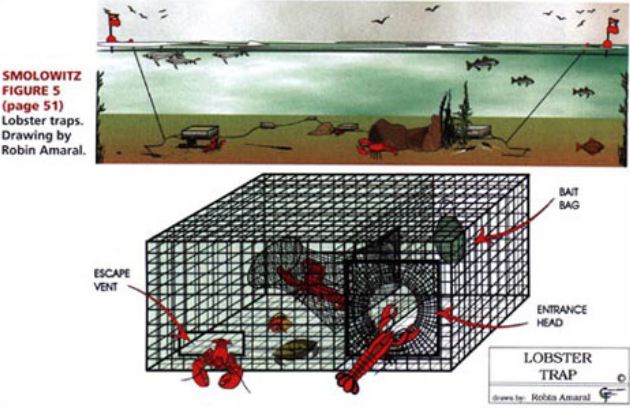
The analogy is particularly applicable for two reasons. First, individuals are usually less sophisticated and, often times, simply unaware of complex tax laws. Corporate taxpayers often can have a better understanding of complex U.S. tax laws – i.e., the “lobster trap” via sophisticated tax advisers.
Second, some lobster traps have an “escape vent” for small lobsters. Similarly, the tax laws on expatriation can treat individuals with smaller amounts of assets or U.S. tax liabilities, very differently and more favorably under the law. See, Certification Requirement of Section 877(a)(2)(C) – (5 Years of Tax Compliance) and Important Timing Considerations per the Statute,
Non-U.S. citizens who are not certain they will spend the rest of their lives in the U.S., should carefully consider if they indeed wish to obtain LPR or become a naturalized citizen. This is because of the long-term tax consequences of Sections 877, 877A, 2801, etc. for those who later abandon their LPR status or renounce their U.S. citizenship.
Of course, this blog, is dedicated to shedding light on the income tax, estate and gift tax, and “covered gift” and “covered” inheritance tax consequences to those who enter the “lobster trap.”
Many more may wish to simply shy far away from the lobster trap to begin with.
Why a “long-term” LPR can NEVER avoid “Covered Expatriate” status under IRC Section 877A(g)(1)(B) if Asset or Tax Liability Test is Satisfied!
There have been multiple posts explaining the importance of the certification requirement of Section 877(a)(2)(C).
See for instance, Certification Requirement of Section 877(a)(2)(C) – (5 Years of Tax Compliance) and Important Timing Considerations per the Statute, also see Can the Certification Requirement of Section 877(a)(2)(C) be Satisfied “After the Fact”?
This specific act of “certifying” is a requirement under the law, that requires all individuals (whether U.S. citizens or LPRs) to satisfy the elements of the certification, in order to avoid “covered expatriate” status.
Also, there is an important exception to “covered expatriate” status set forth in IRC Section 877A(g)(1)(B). Only certain individuals may be able to satisfy this important requirement, which provides as follows:
(B) Exceptions
An individual shall not be treated as meeting the requirements of subparagraph (A) or (B) of section 877 (a)(2) if—
(i) the individual—
(I) became at birth a citizen of the United States and a citizen of another country and, as of the expatriation date, continues to be a citizen of, and is taxed as a resident of, such other country, and
(II) has been a resident of the United States (as defined in section 7701 (b)(1)(A)(ii)) for not more than 10 taxable years during the 15-taxable year period ending with the taxable year during which the expatriation date occurs, or . . .
***
Importantly, the elements of the statute apply only to persons who “became at birth a citizen of the United States”; and in the case of lawful permanent residents (LPRs), they be definition will not have become at birth a citizen of the United States.
***
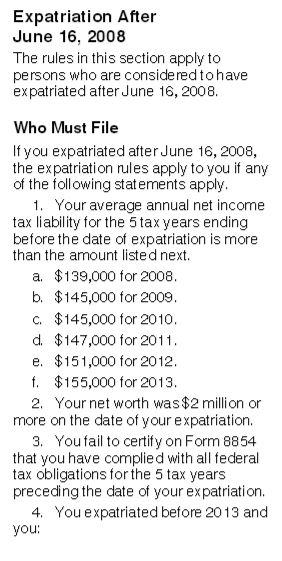
Accordingly, a “long term” LPR who meets either the US$2M asset test, or average income tax liability test (currently

US$157,000 for the year 2014), will necessarily become a “covered expatriate” even if they can satisfy the
Certification Requirement of Section 877(a)(2)(C).
**
**
**
Accordingly, it is important for each “long-term” LPR to understand clearly the current and future U.S. tax consequences to (i) them – the “mark-to market” tax, and (2) tax on “covered gifts” and “covered bequests” to U.S. persons. Importantly, understanding these consequences should be long before the LPR ceases to be a LPR for tax purposes; irrespective of the immigration law consequences.
Who is a “long-term” lawful permanent resident (“LPR”) and why does it matter?
The answer to the above question will only matter, for purposes of “tax expatriation” if the LPR plans on living and moving outside the U.S. The law defines a “’long-term resident’ as any individual (other than a citizen of the United States) who is a lawful permanent resident of the United States in at least 8 taxable years during the period of 15 taxable years.” See, IRC Section 877 (e)(2.
Importantly, there are key concepts of who satisfies these requirements, which is not as simple as it seems on its face. See, for instance Section 7701(b)(6) with specific rules for individuals who live in a country with a U.S. income tax treaty. Importantly, the definition of a lawful permanent resident for tax purposes (as defined in Section 7701(b) ) is not identical to the definition for immigration law purposes.
The importance of LPR status for tax purposes in the expatriation context is crucial. Its the saying “black or white” or “night or day” when thinking about the U.S. “expatriation” tax consequences to LPRs. In short, a LPR who never becomes a “long-term resident” as that technical term is defined in IRC Section 877 (e)(2) can avoid the various taxes that arise from otherwise being a “covered expatriate”. The future heirs and beneficiaries who receive assets from this LPR (who never was a “long-term resident?) can also avoid a major tax; currently 40% of the value of the gift or bequest. See, Revisiting the consequences of becoming a “covered expatriate” for failing to comply with Section 877(a)(2)(C).
The reason it is so important, is that if a LPR never becomes a “long-term resident”, he or she can never cause themselves to “expatriate” as that term is defined in IRC Section 877A(g)(2).
If a LPR never can “expatriate” under the tax law, he or she can never become subject to a range of adverse (some would say draconian) tax consequences that apply. See the following post for a further explanation of the various adverse tax consequences: Why “covered expat” (“covered expatriate”) status matters, even if you have no assets! The “Forever Taint”!
If there is no way in these circumstances for the LPR to “expatriate” there can be no “mark to market” tax and no future tax on covered gifts or covered bequests. See, Oops…Did I “Expatriate” and Never Know It: Lawful Permanent Residents Beware! International Tax Journal, CCH Wolters Kluwer, Jan.-Feb. 2014, Vol. 40 Issue 1, p9
Obviously, this is a very good result for a LPR to never become a “long-term resident”. Planning for it is another task; particularly given the personal living arrangements of each particular individual.
The determination of if or when one becomes a “long-term resident” is highly complex, due to different cross-provisions in the tax law. Specifically, Section 7701(b)(6) has a provision that can have unintended consequences for the unwary LPR. See, for instance, LPR status can be abandoned for tax purposes (since 2008 tax law changes) by merely leaving and moving outside the U.S. in some cases?
The dangers of becoming a “covered expatriate” by not complying with Section 877(a)(2)(C).
Probably the most misunderstood concept in the U.S. tax expatriation law provisions is Section 877(a)(2)(C) for several reasons.
1. People of modest means with modest to little income and little to no assets can fall into this category.
2. Most individuals think the mark-to-market tax upon expatriation is only applicable to rich, wealthy or otherwise individuals with high levels of income. See, Accidental Americans” – Rush to Renounce U.S. Citizenship to Avoid the Ugly U.S. Tax Web” International Tax Journal,CCH Wolters Kluwer, Nov./Dec. 2012, Vol. 38 Issue 6, p45
3. Lawful permanent residents (“LPRs”) can inadvertently fall into this category without doing anything, other than living principally in a country outside the U.S., which has a U.S. income tax treaty. See, Oops…Did I “Expatriate” and Never Know It: Lawful Permanent Residents Beware! International Tax Journal, CCH Wolters Kluwer, Jan.-Feb. 2014, Vol. 40 Issue 1, p9. At the end of this post is a list of the countries with U.S. income tax treaties.
4. Few individuals understand exactly what must be included and reported in IRS Form 8854 to be able to satisfy the certification requirement above. For more details, see What are the consequences of becoming a “covered expatriate” for failing to comply with Section 877(a)(2)(C)?
The relevant provisions of Section 877(a)(2)(C) are highlighted below:
- This section shall apply to any individual if—
- (A) the average annual net income tax . . . is greater than $124,000,
- (B) the net worth of the individual as of such date is $2,000,000 or more, or
- (C) such individual fails to certify under penalty of perjury that he has met the requirements of this title for the 5 preceding taxable years or fails to submit such evidence of such compliance as the Secretary may require.
Failure to certify truthfully about compliance with U.S. tax law for 5 years, as set forth above in the statute, means the individual necessarily will be a “covered expatriate.” Does this mean that if a U.S. citizen who renounces citizenship or a LPR who abandons their green card, will necessarily be a “covered expatriate” if they fail to follow IRS Notice 2009-45 “Guidance for Expatriates Under Section 877A”?
What steps will the IRS take if someone intentionally does not comply with the certification requirement? Will they become a target of a criminal investigation, and under what circumstances? What could be the focal point of IRS Criminal Investigations of Former U.S. Citizens and Lawful Permanent Residents?
There are many pending and open questions not answered by current law, as the U.S. Treasury has yet to publish regulations under Section 877A, 877 or 2801.
APPENDIX – Countries with Income Tax Treaties with the United States