Is the new government focus on U.S. citizens living outside the U.S. misguided or a glimpse at the new future?
Senators on the Permanent Subcommittee on Investigations have recently focused extensively on U.S. nationals living outside the U.S. who have Swiss accounts. The full report can be read REPORT: Offshore Tax Evasion:The Effort to Collect Unpaid Taxes on Billions in Hidden Offshore Accounts (February 26, 2014)
There are millions of U.S. citizens living in all parts of the world, many of whom I have identified as “Accidental Americans.” See the detailed tax article Accidental Americans” – Rush to Renounce U.S. Citizenship to Avoid the Ugly U.S. Tax Web” International Tax Journal,CCH Wolters Kluwer, Nov./Dec. 2012, Vol. 38 Issue 6, p45; Martin, P.
During the past century U.S. Citizens living permanently or nearly permanently outside the U.S. have been “de facto” non-residents for U.S. income tax purposes. Not because the law provided they were not residents, but simply because there was little awareness of the unique system of U.S. citizenship based taxation (or those cases where individuals purposefully chose not to comply with U.S. tax laws). The U.S. Supreme Court in Cook vs. Tait found it Constitutional nearly 100 years ago. See . “Tax Simplification: The Need for Consistent Tax Treatment of All Individuals (Citizens, Lawful Permanent Residents and Non-Citizens Regardless of Immigration Status) Residing Overseas, Including the Repeal of U.S. Citizenship Based Taxation,” by Patrick W. Martin and Professor Reuven Avi-Yonah, 2013.
This “de facto” non-residency for U.S. citizens is rapidly changing for several reasons:
First, the UBS scandal of U.S. citizens with undeclared accounts broke in 2008 and 2009.
Second the legal struggle between the U.S. Justice Department and the Swiss government and Swiss financial institutions during these past years.
Third, the adoption of FATCA by the Congress and President Obama in 2010.
Fourth, the current day technology which makes collecting, sending, sorting and identifying taxpayers and their assets through the worldwide financial sector now feasible.
Fifth, the implementation of FATCA by the U.S. in 2014 and the 20 plus FATCA Intergovernmental Agreements entered into with various countries.
Sixth, the OECD plan for a worldwide multilateral FATCA like system to be implemented shortly.
Seventh, the high profile IRS offshore voluntarily disclosure programs in 2009, 2011 and the current program launched in 2012.
Eighth, the on-going deferred prosecution agreements that have been entered into with more than 100 Swiss banks and the U.S. Justice Department.
Ninth, on-going criminal indictments by the U.S. Justice department of various taxpayers, foreign bankers, foreign lawyers and other so-called enablers for tax evasion, filing fraudulent documents and aiding and abetting the same.
Tenth, the Senate bi-partisan hearings that have and keep focusing and pushing these issues publicly at multiple levels.
Eleventh, the internet and current methods of communications and intern ational media that have brought worldwide awareness to all of the above. This awareness has arrived to many of the corners of the world about these efforts and the concept of U.S. citizenship based worldwide taxation.
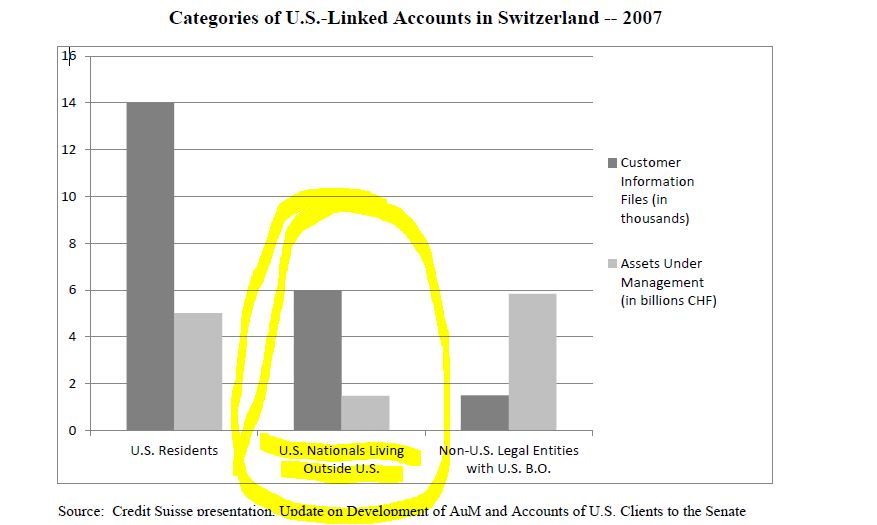
A large portion of the Senate committee report is dedicated to U.S. citizens who live outside the U.S. and are not compliant with U.S. tax laws. The following chart from the report highlights this focus as to the approximately 6,000 U.S. citizen accounts at Credit Suisse who were/do not live in the U.S:
For further observations on this topic, see an earlier post – Key Take Aways from Senate Investigations re: Foreign Banks and “Offshore Tax Evasion”: U.S. Citizens Residing Overseas have Become a Focus of the Government.; Posted on March 4, 2014
???????????????? ?Please click here to view the above in Chinese.?
Key Take Aways from Senate Investigations re: Foreign Banks and “Offshore Tax Evasion”: U.S. Citizens Residing Overseas have Become a Focus of the Government.
Instead of the government finding U.S. citizens living outside of the United States, as a low priority, the Senate Permanent Subcommittee on Investigations focused extensively on Swiss accounts opened by these individuals. The full report can be read REPORT: Offshore Tax Evasion:The Effort to Collect Unpaid Taxes on Billions in Hidden Offshore Accounts (February 26, 2014)
Some key excerpts of that report are as follows (at page 4):
. . . focused primarily on Swiss accounts held by U.S. residents, ignoring the over 6,000 accounts opened by U.S. nationals living outside of the United States. . . . It was not until 2012, that the bank expanded the Exit Projects to include a review of the thousands of Swiss accounts opened by U.S. nationals living outside of the United States.. . .
In addition, the report is replete with statistical data of accounts held by U.S. nationals living outside the U.S., such as the following:
Instead of concluding that the complex U.S. laws are leading to non-compliance by U.S. citizens residing outside the U.S. (per the Taxpayer’s Advocate Report), it seems to conclude to the contrary and the report highlights the virtues of the OVD program in non-compliance as generally willful with millions of U.S. citizens living outside the U.S. who are not in compliance, per the following statement (at page 22):
“The OVDP continues to provide valuable information for the United States in its efforts
to combat offshore tax abuse, although it is far from clear that effective use is being made of the
information generated. For taxpayers, it continues to offer a useful alternative to report
undeclared offshore accounts that, potentially, number in the millions. According to the Taxpayer Advocate, “While 7.6 million U.S. citizens reside abroad and many more U.S. residents have FBAR filing requirements, the IRS received only 807,040 FBAR submissions in 2012,” signaling “significant information reporting noncompliance.”69 2013 Annual Report to Congress — Volume One, Taxpayer Advocate Service, “OFFSHORE VOLUNTARY DISCLOSURE: The IRS Offshore Voluntary Disclosure Program Disproportionately Burdens Those Who Made Honest Mistakes,” at 229.
This report seems to get off track by not distinguishing between normal U.S. citizens who are living out their lives in their country of residence, as opposed to U.S. nationals who are intentionally attempting to evade taxes, filing false documents, not filing returns, or otherwise intentionally violating U.S. law. All of these 7.6 million U.S. nationals living around the world are being lumped together by the government with U.S. resident citizens, irrespective of the facts of each individual and family.
Hearings – Permanent Subcommittee on Investigations – re: Offshore Tax Evasion: The Effort to Collect Unpaid Taxes on Billions in Hidden Offshore Accounts – February 26, 2014
Should the IRS modify its offshore voluntary disclosure program for U.S. citizens residing overseas? IRS is reconsidering the effectiveness of its offshore voluntary disclosure program. Should it be modified?
Should the IRS modify its offshore voluntary disclosure program for U.S. citizens residing overseas? IRS is reconsidering the effectiveness of its offshore voluntary disclosure program. Should it be modified?
According to Tax Analyst’s “The IRS is reexamining its offshore voluntary disclosure program and considering making modifications to it, according to Michael Danilack, deputy commissioner (international), IRS Large Business and International Division.”
U.S. citizens who have lived most all of their lives overseas should not be subject to the same scrutiny and inflexibility that currently exists for U.S. taxpayers residing in the U.S. Important differences exist, mostly because of the lack of U.S. citizens residing overseas to understand the complex U.S. tax law system applicable to them; in addition to the country’s tax laws and requirements in their country of residence.
The de-facto U.S. income tax residency regime is a residence based regime for several reasons. First, the National Taxpayer Advocate estimates there are between 5-7 million U.S. citizens residing overseas. Second, only a small portion of these taxpayers apparently even file U.S. income tax returns. The IRS taxpayer statistics office showed that only 334,851 U.S. taxpayers filed a foreign earned income exclusions (for the year 2006, which is the latest year available from the IRS office of tax statistics). How many of these taxpayers are not even U.S. citizens? The details of U.S. tax returns filed with foreign earned income exclusions can be read here.
Each country’s filings are set out below (notice only 6,112 returns were filed from Mexico, where the largest number of U.S. citizens reside in any particular country; with Canada as the second most populated with U.S. citizens):
| All geographic areas |
334,851 |
| North America, total |
36,179 |
| Canada |
30,067 |
| Greenland |
0 |
| Mexico |
6,112 |
| Latin/South America, total |
13,911 |
| Argentina |
751 |
| Brazil |
2,696 |
| Chile |
902 |
| Colombia |
1,870 |
| Costa Rica |
1,662 |
| Panama |
1,032 |
| Peru |
419 |
| Venezuela |
705 |
| Other Latin and South American countries |
3,876 |
| Caribbean, total |
7,323 |
| Bahamas |
1,089 |
| Bermuda |
1,758 |
| Cayman Islands |
970 |
| Dominican Republic |
1,093 |
| Other Caribbean countries |
2,414 |
| Europe, total |
99,732 |
| Austria |
1,361 |
| Belgium |
1,881 |
| Czech Republic |
1,091 |
| Denmark |
1,754 |
| Finland |
354 |
| France |
9,653 |
| Germany |
21,513 |
| Greece |
1,484 |
| Hungary |
604 |
| Ireland |
1,896 |
| Italy |
5,199 |
| Luxembourg |
219 |
| Netherlands |
3,263 |
| Norway |
1,215 |
| Poland |
735 |
| Portugal |
387 |
| Russia |
2,495 |
| Spain |
2,453 |
| Sweden |
1,399 |
| Switzerland |
7,093 |
| Turkey |
1,199 |
| United Kingdom |
28,409 |
| Other European countries |
4,078 |
| Africa, total |
9,697 |
| Algeria |
* 241 |
| Angola |
398 |
| Egypt |
1,658 |
| Kenya |
992 |
| Nigeria |
906 |
| South Africa |
923 |
| Other African countries |
4,576 |
| Asia, total |
138,795 |
| Afghanistan |
5,912 |
| China |
12,430 |
| Hong Kong |
10,792 |
| India |
4,214 |
| Indonesia |
1,786 |
| Iraq |
18,325 |
| Israel |
8,986 |
| Japan |
23,529 |
| Malaysia |
1,160 |
| Philippines |
2,313 |
| Saudi Arabia |
5,109 |
| Singapore |
3,636 |
| South Korea |
6,668 |
| Taiwan |
6,588 |
| Thailand |
3,643 |
| United Arab Emirates |
7,423 |
| Other Asian countries |
16,284 |
| Oceania, total |
9,724 |
| Australia |
6,420 |
| New Zealand |
2,518 |
| Other Oceania countries |
787 |
| All other countries |
19,490 |
???????????????? ?Please click here to view the above in Chinese.?
Taxpayer Advocate Report on Burdens of Benign Taxpayers who Make Mistakes
2014 Taxpayer Advocate Report – Re: Expanded Reporting Obligations and IRS Form 8938 (FATCA – specified foreign financial assets)

 ational media that have brought worldwide awareness to all of the above. This awareness has arrived to many of the corners of the world about these efforts and the concept of U.S. citizenship based worldwide taxation.