I have argued for years that the IRS has neglected to identify the unique circumstances of USCs and LPRs residing outside the U.S.; and how the OVD programs in particular threw both resident and non-resident U.S. taxpayers into the same big bucket.
There is much to be said about the new “Streamlined” procedure just announced. Particular focus has been made for USCs and LPRs living outside the U.S., and the IRS rules specific to these individuals are set forth in – U.S. Taxpayers Residing Outside the United States.
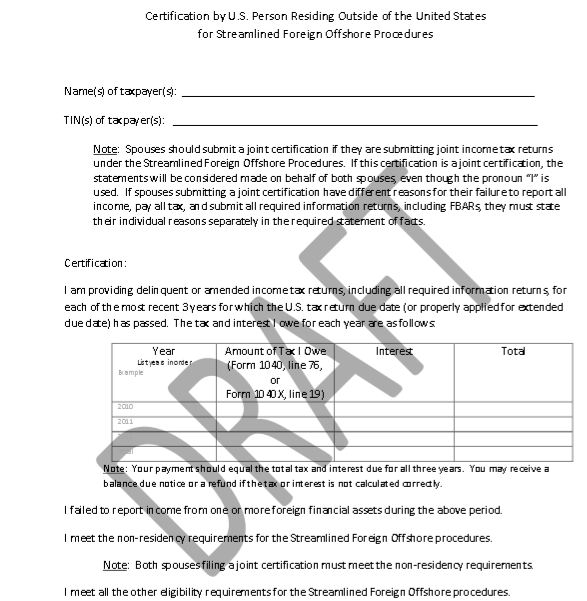
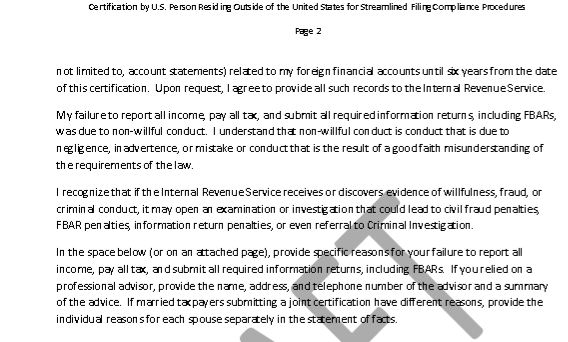
Importantly, a certification must be signed by the taxpayer, subject to the penalties of perjury under U.S. law. The sample IRS certification document, Certification by U.S. Person Residing Outside of the U.S., is set forth in part in this blog –
The summary of the steps regarding certification are explained in the IRS website, and include most importantly the following requirement:
3. Complete and sign a statement on the Certification by U.S. Person Residing Outside of the U.S. certifying (1) that you are eligible for the Streamlined Foreign Offshore Procedures; (2) that all required FBARs have now been filed (see instruction 8 below); and (3) that the failure to file tax returns, report all income, pay all tax, and submit all required information returns, including FBARs, resulted from non-willful conduct.
It’s the last item that carries with it a host of legal responsibilities when certifying under penalty of perjury that ” . . . failure to file tax returns, report all income, pay all tax, and submit all required information returns, including FBARs, resulted from non-willful conduct. . . “
He summarizes it – As courts have noted, the word “willful” is a “chameleon” which changes in tone and color according to the Code section involved and the circumstance. See e.g., former Justice Souter’s opinion in United States v. Marshall, 2014 U.S. App. LEXIS 10415 (1st Cir. 2014), discussed in More On Willfulness (Federal Tax Crimes Blog 6/13/14), here. But, I think it is clear that, in both the income tax context and the FBAR context, willful means “voluntary intentional violation of a known legal duty.” Readers will recognize this as the Cheek standard.
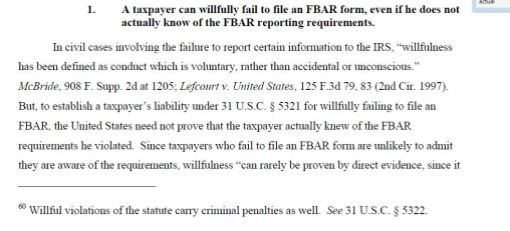
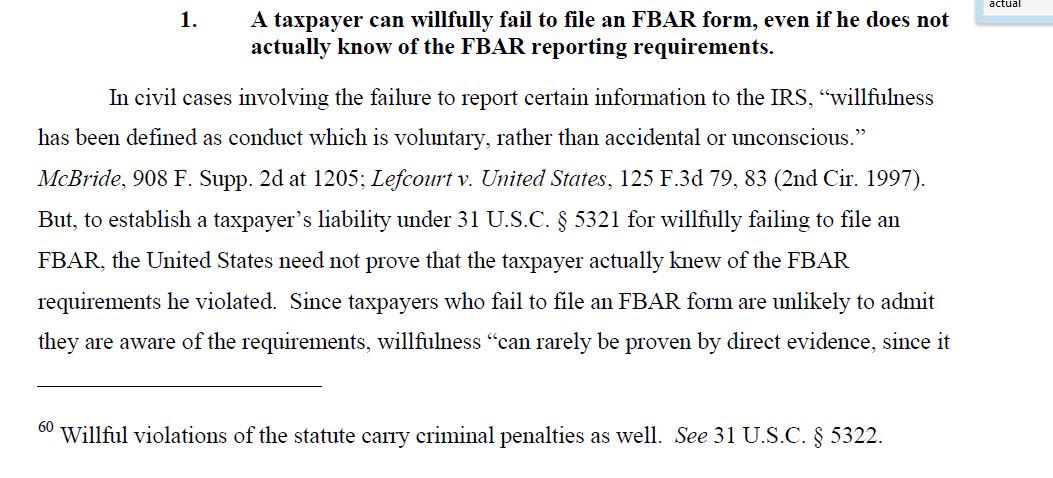
Finally, maybe the most troubling for USCs and LPRs who live outside the U.S., is the government’s assertion that an individual can be liable for the willfulness penalty, for “willfully failing to file a FBAR” – ” . . . even if the person does not actually know of the FBAR reporting requirements.” See, page 4 of the government’s motion for Summary Judgment in the Zwerner case. This is a position they have argued consistently in at least three different cases.
Why will the government not argue in those cases it selectively chooses to prosecute the following argument:
Worldwide press about UBS, Credit-Suisse and other foreign accounts held by U.S. persons has made virtually all individuals generally aware of U.S. tax and reporting requirements.
Any individual with a most basic level of sophistication must have known of these requirements, if they ever read a paper or the Internet (or should have known).
FATCA news throughout the world since its passing into law in 2010, has been impossible to ignore.
Ergo – Unless you have been living on a remote island or the rain forest, without access to the Internet, you can be liable for willful FBAR penalties, for the USC or LPR living overseas for their “willful blindness” – ” . . . even if the person does not actually know of the FBAR reporting requirements.”
Should such an argument prevail? Most private practitioners would say “no”; but the Zwerner case was illustrative of the strategies and approach taken by the government in a 150% FBAR penalty it obtained at a jury trial.
“IRS Makes Changes to Offshore Programs; Revisions Ease Burden and Help More Taxpayers Come into Compliance” – How Will These Changes Affect USCs and LPRs Living Outside the U.S.?
I will take time to reflect upon these policy changes at the IRS. More posts will follow. They appear to be significant. The consequences to taxpayers, including USCs and LPRs residing overseas, will be significant.
One of the more important parts of the announcement to USCs and LPRs living outside the U.S. is set out below:
“Through our enforcement efforts and implementation of FATCA, taxpayers are more aware of their obligations, and we believe want to come into compliance,” Koskinen said. “In this rapidly changing environment, we listened to feedback from the tax community as well as the National Taxpayer Advocate about our voluntary programs. We have made important adjustments to provide opportunities for all U.S. taxpayers to come in, including those who are not willfully hiding assets.”
Streamlined Procedures Expanded
The changes announced today make key expansions in the streamlined procedures to accommodate a wider group of U.S. taxpayers who have unreported foreign financial accounts.
The original streamlined procedures announced in 2012 were available only to non-resident, non-filers. Taxpayer submissions were subject to different degrees of review based on the amount of the tax due and the taxpayer’s response to a “risk” questionnaire.
The expanded streamlined procedures are available to a wider population of U.S. taxpayers living outside the country and, for the first time, to certain U.S. taxpayers residing in the United States. The changes include:
Eliminating a requirement that the taxpayer have $1,500 or less of unpaid tax per year;
Eliminating the required risk questionnaire;
Requiring the taxpayer to certify that previous failures to comply were due to non-willful conduct.
For eligible U.S. taxpayers residing outside the United States, all penalties will be waived. For eligible U.S. taxpayers residing in the United States, the only penalty will be a miscellaneous offshore penalty equal to 5 percent of the foreign financial assets that gave rise to the tax compliance issue.
Mr. Zwerner did not disclose his account for many decades and had both untaxed and pre-taxed income in that account. He kept this Swiss account secret from the government and even his own lawyer of 40 years. He only had told his wife. He also answered “no” to his CPA regarding having any foreign accounts. These were all bad facts for him in his case.
He always lived in the U.S., born and raised, but also had international business operations from the glass industry in which he was a leader.
The apparent success of the government, raises the question of whether such “success” at trial will backfire with how USCs and LPRs residing overseas will handle their U.S. tax and FBAR affairs. How will USCs and LPRs residing overseas respond and understand the impact of the Zwerner decision?
Will it be a significant victory (or a Pyrrhic Victory), considering the impact it may have on USCs and LPRs residing overseas?
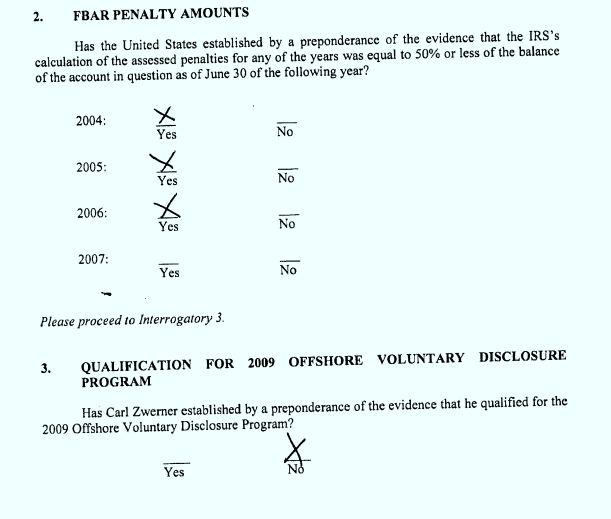
First, the taxpayer did come forward and disclose the unreported foreign accounts, and received a letter from the IRS CI issued a letter on February 17, 2009, stating that ” . . . based upon the information provided a criminal investigation will not be initiated at this time. . . ” Nevertheless, the government pursued 50% civil willfulness penalty assessments for multiple years (4 years). The Tax Division of the Justice Department pursued this case through trial, incurring the time and costs of government resources, arguing Mr. Zwerner owed a total of $3,630,119.29 (on an account with a maximum value during the years at issue of apparently no more than US$1.69M) in their Motion for Summary Judgement.
See Paragraph 57 of the government’s Motion for Summary Judgement:
The jury verdict found that based upon a “preponderance” of the evidence, the taxpayer did not qualify for the 2009 offshore voluntary disclosure program. Importantly, this OVD program was not announced until after Mr. Zwerner had taken steps to disclose and report his foreign accounts under a specific letter his lawyer had received by IRS CI. It appears that Mr. Zwerner was following the rules of the program that existed at the time he came forward.
Second, why was Mr. Zwerner not criminally prosecuted for tax evasion? Was it because he had a letter from the IRS CI that they would not criminally prosecute him? Was it because the government wanted to assess multiple FBAR penalties, in lieu of a criminal prosecution against an 87 year old man? Did the government want to demonstrate they would extract more financial pain from a civil action, prosecuted under a “preponderance of the evidence” standard, instead of a criminal action that would be harder to convict under a “beyond a reasonable doubt” standard?
Third, why has the government insisted on pursuing a civil penalty that was more than the entire asset value of the account(s)? Is the government’s view that the more onerous the penalties, the greater likelihood of compliance for others with unreported accounts? Is there an incentive on the part of the government to collect large FBAR penalties and forgo the costs and time of a criminal case, potential sentencing and prison time?
Fourth, why did the government reach a settlement with Mr. Zwerner, just days after what was apparently a huge victory for the government? Does the government think these FBAR penalties will be overturned or found to be unconstitutional by an Appeals Court? This is probably the most interesting legal question, because if the law is ultimately found to be unconstitutional, it would change the dynamic and approach of taxpayers and the government.
Fifth, will the government pursue a similar strategy (e.g., multiple year 50% willfulness penalties) against USCs and LPRs who reside outside the U.S.? Will this be their approach instead of considering any type of criminal prosecution to extract more financial pain from a civil action, prosecuted under a “preponderance of the evidence” standard, instead of a criminal action that would be harder to convict under a “beyond a reasonable doubt” standard?
Sixth, will the government not pursue USCs and LPRs living overseas who do not report their accounts? Will they selectively enforce the law (e.g., treating U.S. resident individuals different from non-U.S. resident USCs and LPRs)?
Unfortunately, the message for many USCs and LPRs residing overseas who have not filed U.S. income tax returns or FBARs for many years or for many decades, is a very mixed message. If the government will pursue a 200% FBAR penalty against an 87-year-old man, who was a philanthropic leader and ultimately fully disclosed his account through what he believed as the OVD program that existed at the time he participated; why will they not similarly pursue such FBAR penalties against USCs and LPRs living outside the U.S.?
For these reasons, the Zwerner decision may well be a Pyrrhic Victory for the government, IF USCs and LPRs overseas consider such an approach excessive and unreasonable, to the point, they feel more comfortable in receding into the shadows and not filing FBARs. Hopefully, this will not be the effect and end result; but again, it appears the focus of the government has neglected to consider the unique circumstances of millions of USCs and LPRs residing outside the U.S.
Zwerner is yet another important chapter of a multi-prong approach of the U.S. government in identifying assets located outside the U.S.
The question remains: “What will be the takeaway to the ordinary USC and LPR population residing overseas?” Will they think that by filing FBARs, they will simply run the risk of the government assessing multiple year 50% willfulness penalties? Will they feel even greater fear of trying to come into compliance under the U.S. tax and FBAR laws – and try to comply at all costs? Or instead, will they take steps to stay in the shadows and not report (a Pyrrhic Victory for the government)?
Why the Zwerner FBAR Case is Probably a Pyrrhic Victory for the Government – for USCs and LPRs Living Outside the U.S. (Part I)
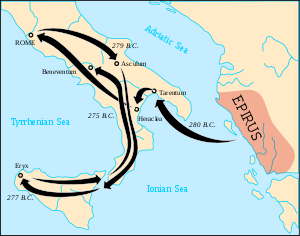
King Pyrrhus of Epirus, sustained staggering losses in defeating the Romans in Southern Italy in the years 280-275BC; so says the origin of the phrase “Pyrrhic Victory”.
The government was on its face, very “successful” in the Zwerner case in convincing a jury they should render a verdict for 3 years of FBAR 50% willfulness penalties (150% of the account balance in total). The government tried to assert 4 years of willfulness penalties, which would have been 200% of the account balance; all under a civil penalty provision in the statute, that looks like a criminal penalty on its face and via its outcome.
The key facts of Zwerner are these:
He was 87 years old when the FBAR civil claims were litigated;
He was living in the U.S. and had studied at Robinson College of Business at George State University – and was a major philanthropist to GSU, where he pledged $5M to build a Business and Law Complex Auditorium in 2007 and previously funded the Carl R. Zwerner Chair in Family Owned Business;
He had apparently had a Swiss bank account opened in the 1960s (prior to the adoption of the BSA law that created FBAR reporting – which was passed in 1970), that he had not reported on his U.S. income tax return;
The accounts were in the names of two different foundations Mr. Zwerner created;
He had hired legal counsel to assist him with professional advice prior to the IRS publishing their initial “offshore voluntary disclosure” program/initiative;
He apparently filled out the tax organized provided by his accountant, every year, and answered “no” to questions about having an interest in foreign financial accounts;
His legal counsel had apparently contacted the IRS Criminal Investigation Division (“CI”) about his voluntary disclosure on February 10, 2009, without providing his name;
The CI then issued a letter on February 17, 2009, stating that ” . . . based upon the information provided a criminal investigation will not be initiated at this time. . . ” (see letter from IRS with this date reflected as Exhibit 4 in the ) – ;
The IRS did not announce the first offshore voluntary disclosure program until afterwards on March 26, 2009; and
Mr. Zwerner then filed amended tax returns for the years 2004, 2005 and 2006 along with late filed FBARs.
A highly regarded criminal tax law firm in Beverly Hills, California, Hochman, Salkin et al, provided the following conclusion in their analysis of the Zwerner case:
This is a significant win for the government in their efforts to encourage certain US persons having undisclosed interests in foreign financial accounts to come into compliance with the applicable filing and reporting requirements . . .
Along the same lines, the Department of Justice issued a press release on May 28, 2014, with the following highlights:
JURY FINDS MIAMI MAN OWES CIVIL PENALTIES FOR FAILING TO REPORT SWISS BANK ACCOUNT
WASHINGTON – Today, a jury in Miami found Carl R. Zwerner responsible for civil penalties for willfully failing to file required Reports of Foreign Bank and Financial Accounts (FBARs) for tax years 2004 through 2006 with respect to a secret Swiss bank account he controlled. According to evidence introduced at trial, the balance of the bank account during each of the years at issue exceeded $1.4 million, and the jury found Zwerner should be liable for penalties for 2004 through 2006. Zwerner faces a maximum 50 percent penalty of the balance in his unreported bank account for each of the three years . . .
“As this jury verdict shows, the cost of not coming forward and fully disclosing a secret offshore bank account to the IRS can be quite high,” said Assistant Attorney General Kathryn Keneally for the Justice Department’s Tax Division. “Those who still think they can hide their assets offshore need to rethink their strategy.” . . .
The evidence at trial showed that Zwerner opened an account in Switzerland in the 1960s, which he maintained in the name of two different foundations he created. Zwerner was able to use the proceeds of the account whenever he wanted and used it for personal expenses, including European vacations . . .
Herein lies some key inconsistencies in the approach of the government. Will it be a significant victory, considering the impact it may have on USCs and LPRs residing overseas?
What will be the affect to USCs and LPRs residing overseas? A follow-up post will discuss.
Finally! The IRS seems to be listening to the travails of Accidental Americans with “law-abiding instincts”!?
The IRS Commissioner just announced, on June 3rd, a set of common sense statements about “U.S. citizens” who want to comply with their tax obligations. Commissioner John Koskinen said the IRS will likely modify “in the very near future” (according to an article written by Jaime Arora and William Hoffman of TaxAnalysts) its offshore voluntary disclosure program for U.S. citizens residing overseas.
The full remarks are set out in the paper presented at the OECD international tax conference:
– OECD – INTERNATIONAL TAX CONFERENCE WASHINGTON, D.C., JUNE 3, 2014
***
Some key excerpts are as follows:
**
Now, while the 2012 OVDP and its predecessors have operated successfully, we are currently considering making further program modifications to accomplish even more. We are considering whether our voluntary programs have been too focused on those willfully evading their tax obligations and are not accommodating enough to others who don’t necessarily need protection from criminal prosecution because their compliance failures have been of the non-willful variety.
For example, we are well aware that there are many U.S. citizens who have resided abroad for many years, perhaps even the vast majority of their lives. We have been considering whether individuals should have an opportunity to come into compliance that doesn’t involve the type of penalties that are appropriate for U.S.- resident taxpayers who were willfully hiding their investments overseas.We are also aware that there may be U.S. – resident taxpayers with unreported offshore accounts whose prior non-compliance clearly did not constitute willful tax evasion but who, to date, have not had a clear way of coming into compliance that doesn’t involve the threat of substantial penalties.
We are close to completing our deliberations on these respects and expect that we will soon put forward modifications to the programs currently in place. Our goal is to ensure we have struck the right balance between emphasis on aggressive enforcement and focus on the law – abiding instincts of most U.S. citizens who, given the proper chance, will voluntarily come into compliance and willingly remedy past mistakes.
***
For years, some of us have argued vociferously that the approach taken by the IRS on offshore assets of USCs and LPRs residing outside the U.S. has been misguided; as a large group of persons with “law-abiding instincts” were caught up in the same net as those USC individuals who had been taking steps to evade U.S. taxation on hidden foreign assets.
Mixed Messages:IRS Commissioner Shulman vs. U.S. Ambassador
to Canada Jacobson
**
The principle message made by the Commissioner was and is that the IRS is tracking down U.S. individual taxpayers with foreign assets. The Commissioner’s message is not nuanced to distinguish between the“ordinary” taxpayer residing overseas with foreign assets and those who take steps to hide assets and evade taxes. Specifically, the Commissioner made the following statement to the Senate Finance Committee in 2009:
**
IRS Enforcement: Tightening the Net
Mr. Chairman, I am also pleased to be here today to describe the unprecedented focus that the Internal Revenue Service has placed on detecting and bringing to justice those who unlawfully hide assets overseas to avoid paying tax … My advice to those taxpayers is very simple. The IRS has been steadily increasing the pressure on offshore financial institutions that facilitate concealment of taxable income by US citizens.
**
That pressure will only increase under my watch. Those who are unlawfully hiding assets should come and get right with their government through our voluntary disclosure process.
**
More recently on December 15, 2011, the Commissioner provided the following prepared remarks to the IRS/GWU 24th Annual Institute on Current Issues in International Taxation:
**
… Before I get to our overall strategic approach to international issues, let me begin with our multi-pronged and integrated approach to combating individual offshore non-compliance and how we’re turning up the pressure on those not paying taxes on overseas assets.
**
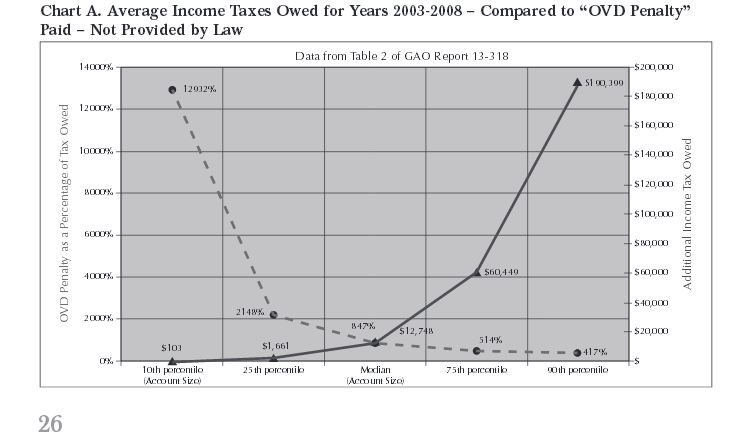
In addition, I published an article that showed the problems with the current program, based upon the government’s own data. That article is titled – The 2013 GAO Report of the IRS Offshore Voluntary Disclosure Program, International Tax Journal, CCH Wolters Kluwer, January-February 2014. PDF version here.
There have been other valuable arguments and information previously provided by other groups and professionals. Specifically, the National Taxpayer Advocate, Ms. Nina Olson and her office has written extensively about these problems. See, See, 2014 Taxpayer Advocate Report – Re: Expanded Reporting Obligations and IRS Form 8938 (FATCA – specified foreign financial assets). Also, see, Taxpayer Advocate Report on Burdens of Benign Taxpayers who Make Mistakes
Hopefully, the current Commissioner will provide meaningful modifications to the OVDP for those good faith individuals residing around the world.
POLL: Is the U.S. “whistleblower law” to catch non-compliant taxpayers good policy?
The U.S. federal government has an “informant award” program that pays private individuals who provide information about other taxpayers. USCs and LPRs who live outside the U.S. are subject to being reported upon by private persons throughout the world.
The payment is mandatory by the government if the statutory requirements are satisfied. The IRS summary of the law can be found on their website – here – and provides –
“The IRS Whistleblower Office pays money to people who blow the whistle on persons who fail to pay the tax that they owe. If the IRS uses information provided by the whistleblower, it can award the whistleblower up to 30 percent of the additional tax, penalty and other amounts it collects.”
How is the offshore voluntary disclosure program really working? Not well for USCs and LPRs living overseas.
The authors have taken the taxpayer information that was finally made, at least partially public, via the following GAO report, to identify the amount of actual estimated taxes collected: Offshore Tax Evasion: IRS Has Collected Billions of Dollars, but May be Missing Continued Evasion (GAO-13-318): March 2013, (referred to as “GAO Report”). Table 3 provides that the total “offshore penalty” collected was $2.81 Billion and “total collected” out of a total US$4.4 Billion collected. Accordingly, the “offshore penalty” represented 64% of all sums collected under the program out of the 10,543 taxpayers analyzed.
Fortunately, some revenue agents handling OVD cases in the IRS are now getting a better understanding that USCs and LPRs who live outside the U.S., are typically in a very different category than U.S. resident taxpayers who have taken steps to hide their foreign assets. Many of these individuals should be opting out of the OVD program, depending upon the facts of their case.
This report was highlighted earlier in the year in Jack Townsend’s blog as follows:
In a comment, a reader directed me and other readers to a recent article that is quite good, so I decided to elevate the article to a separate blog entry. The article is Patrick W.Martin & Michelle Ferreira, The 2013 GAO Report of the IRS Offshore Voluntary Disclosure Program (1/10/14). The web version is here, and the pdf is here. The authors’ bios are here and here.
As the authors note, “the GAO Report indicates [that] taxpayers with little or no criminal or civil fraud exposure were punished proportionately in higher amounts than those who participated and had true criminal tax exposure.” The authors break these categories into Bad Actors and other actors, referred to as Benign Actors. That Bad Actors would be treated better than Benign Actors is a counter-intuitive result.”
“One key question that the GAO Report raises is why would so many taxpayers enter into the Offshore Voluntary Disclosure Program if they were not at least as liable for income taxes or penalties under the law? The authors think the answer to this question can be simply answered. Neither taxpayers nor many of their tax advisers understand how tax penalties actually apply under the law, particularly because some penalties are not in the Internal Revenue Code. Instead of understanding what the requirements are under the law, taxpayers simply relied upon the IRS to inadequately explain how penalties could apply in and outside of the program. Based upon only the Frequently Asked Questions (which were published subsequent to the program’s announcement), taxpayers and their advisers had to make swift and uneducated determinations as to whether a taxpayer should participate in the Offshore Program at all and many feared all would be criminally prosecuted, as the IRS continuously led them to believe.”
This is occurring while the Senate investigations of undisclosed foreign accounts has now started to focus on USCs living overseas.
A large portion of the Senate committee report is dedicated to U.S. citizens who live outside the U.S. and are not compliant with U.S. tax laws. The . . . chart from the report highlights this focus as to the approximately 6,000 U.S. citizen accounts at Credit Suisse who were/do not live in the U.S:
?????????????????Please click here to view the above in Chinese.?
This announcement is now talked about among many tax return preparers as if it creates some sort of special rights or benefits to a particular type of U.S. citizen residing overseas. The IRS announcement is neither the law, nor purports to be the law. It also does not modify the statute of limitations period or otherwise bar the IRS from commencing an audit against a USC residing overseas who has never filed U.S. income tax returns. See, When the U.S. Tax Law has no Statute of Limitations against the IRS; i.e., for the U.S. citizen and LPR residing outside the U.S. (Posted on March 24, 2014)
The “new filing compliance procedures” is simply a statement of what has always been the practice of the IRS. U.S. income tax returns that are filed are examined under whatever procedure the IRS chooses as part of its audit and review practices. Income tax returns with modest assets, modest income or little to no U.S. income tax liability garner less attention and resources of the IRS than those with lots of assets, lots of income, etc. See, IRS summary of IRS audits.
Some of the key concepts in the 2012 announcement are set out below:
Compliance risk determination:
The IRS will determine the level of compliance risk presented by the submission based on certain information provided on the returns filed, and based on certain additional information that will be required as part of the submission. Low risk will be predicated on simple returns with little or no U.S. tax due. Absent high risk factors, if the submitted returns and application show less than $1,500 in tax due in each of the years, they will be treated as low risk. In general, the risk level will rise as the income and assets of the taxpayer rise, if there are indications of sophisticated tax planning or avoidance, or if there is material economic activity in the United States.
* * *
How taxpayers will be able to take advantage of the new procedure:
Taxpayers wishing to use the new procedure will be required to submit: (1) delinquent tax returns, with appropriate related information returns, for the past three years, (2) delinquent FBARs for the past six years, and (3) any additional information regarding compliance risk factors required by future instructions. Payment of any federal tax and interest due must accompany the submission. More information about the application process including where submissions should be sent, will be provided prior to the effective date.
Any taxpayer claiming reasonable cause for failure to file tax returns, information returns, or FBARs will be required to submit a dated statement, signed under penalties of perjury, explaining why there is reasonable cause for previous failures to file. See IRS Fact Sheet FS-2011-13 (December 2011) for examples of reasonable cause.
Does any of the above protect the USC residing outside the U.S. from an audit for any year a U.S. federal income tax return was not filed? The short answer is – NO!
Does any of the above statements in the IRS announcement mean that a USC residing overseas could not be subject to late payment or late filing penalties for not previously filing U.S. tax returns. The short answer is – NO!
Does any of the above statements in the IRS announcement mean that a USC residing overseas can never be subject to penalties for not filing information returns regarding their non-U.S. international assets and “specified foreign financial assets”? The short answer is – NO! See, USCs and LPRs residing outside the U.S. – and IRS Form 8938
Why then, did the IRS issue such an announcement? Was it an attempt to present a softer message than the IRS announcement in 2011 (IRS Fact Sheet FS-2011-13 – which enumerates various penalty concepts such as –2. Penalties imposed for failure to file income tax returns or to pay tax; 3. Possible additional penalties that may apply in particular cases; 6. Possible penalties for failure to file FBAR; etc.)?
This is another mixed message from the IRS, which is nothing more than how tax returns have been processed by the IRS over the decades; i.e., a taxpayer files a late tax return and it gets processed by the IRS (and the IRS may elect to audit any particular return, late filed or otherwise).
Will the Justice Department and Criminal Investigation Division of the IRS Turn Their Sights on USCs or LPRs living Overseas?
To date, there have been numerous indictments of non-U.S. resident persons in the “offshore financial account world” which has been a great focus of the U.S. federal government starting in 2008. An updated list of indictments of these persons can be found at Jack Townsend’s federal tax crimes blog here where he keeps a spreadsheet of cases.
To date, the author is not aware of any tax indictments (solely based upon a tax crime) of any United States Citizens or LPRs who have lived most all of their lives overseas. Is this an anomaly? Will the government be interested in bringing criminal charges against non-resident USCs or LPRs in the future?
Those persons living outside the U.S. who have been indicted (typically for conspiracy/aiding and abetting charges) have been so-called enablers; non-U.S. bankers, lawyers and accountants. Some of these cases can also be reviewed at at the federal tax crimes blog of Jack Townsend, which is the most comprehensive source of this information.
?????????????????Please click here to view the above in Chinese.?
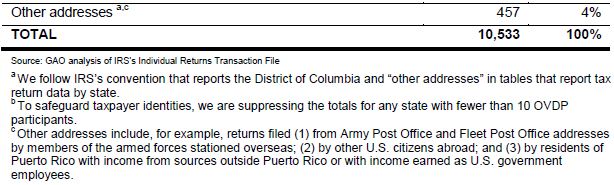
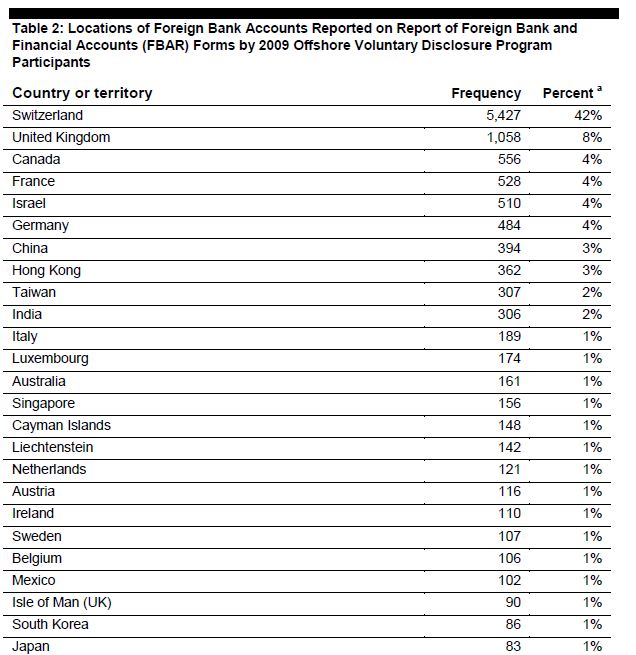
The extensive March 2013 GAO Report was followed by this year’s January 2014 GAO Report of 10,533 taxpayers analyzed; all of which participated in the 2009 OVD program. Interestingly, the report identifies the countries where the accounts were located; with Switzerland being the predominant country. See Table II below from the report –
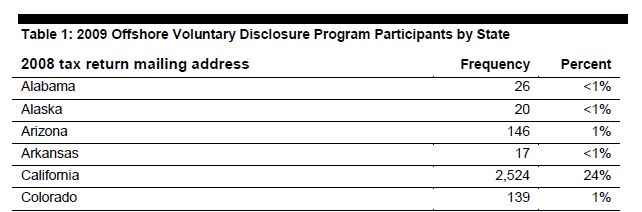
In addition, the report identified the location of the taxpayers. Not surprisingly, the states with the greatest populations, such as California, New York and Florida had the states with the greatest number of taxpayers participating in the OVD program. There is, however, no direct correlation to the population in those states and the number of OVD filers.
Most interesting for U.S. citizens and LPRs living outside the U.S., are the 457 addresses identified as “other addresses”. These “other addresses” include P.O. addresses, such as from Army Post Offices, residents of Puerto Rico, income earned by U.S. government employees and “other U.S. citizens abroad.”
How many of these 457 addresses are U.S. citizens living permanently outside the U.S. who are “Accidental Americans”? How many (if any) are LPRs living permanently outside the U.S.?
A more comprehensive list of the countries where the accounts were located is listed in Table 2 from this report.
The UK is number two on the list with 1,058 accounts. Interestingly, Canada is number three on the list with 4%, presumably due to many dual nationals living in Canada.
In addition, the Criminal Investigation office of the IRS in Northern California reported at the Annual California Tax Bars meeting in October 2013 in San Jose, California, that their office had just received a number of cases from India regarding unreported foreign accounts (part of a nationwide distribution of cases centered in India).
?????????????????Please click here to view the above in Chinese.?