Will the IRS treat a USC or LPR residing outside the U.S. who purposefully refuses to file U.S. income tax returns and information returns the same as “tax protesters”?
What is a “tax protester”? What is the significance for USCs and LPRs residing overseas?
What if the U.S. tax and its applicability to USCs and LPRs living overseas, specifically including the tax on expatriation seems unfair, unjust, overreaching, burdensome, etc.? Is that a legal basis for defying the law’s application and reach?
The author has consistency argued, that from a tax policy perspective, U.S. citizenship based taxation of worldwide income for those who live outside the U.S. needs to be repealed as it is unique in the world, dates to the 19th Century Civil War and is inappropriate for the global world we live in. See, “Tax Simplification: The Need for Consistent Tax Treatment of All Individuals (Citizens, Lawful Permanent Residents and Non-Citizens Regardless of Immigration Status) Residing Overseas, Including the Repeal of U.S. Citizenship Based Taxation,” by Patrick W. Martin and Professor Reuven Avi-Yonah, 2013.
“Tax protesters” and their frivolous arguments generally assert, somehow the U.S. federal tax laws are against the U.S. Constitution; i.e., unconstitutional. The U.S. Supreme Court has already ruled that U.S. citizenship based taxation is indeed Constitutional when it upheld as Constitutional the concept of citizenship based taxation in 1924 in Cook v. Tait. In that case, the U.S. citizen resided permanently and was domiciled in Mexico City with his Mexican citizen wife. See, Supreme Court’s Decision in Cook vs. Tait and Notification Requirement of Section 7701(a)(50)
These Constitutional arguments are not looked well upon by any branch of the U.S. federal government. The IRS and Tax Division of the Department of Justice regularly prosecute these cases. The Courts regularly uphold the government’s position; and the Congress has passed increasingly harsh penalties, including as late as in 2007 (See IRC section 6702 – Frivolous Tax Submissions).
The term “tax protester” became somewhat taboo after Congress passed a law designed at protecting taxpayer’s rights. The current, more politically correct terminology comes from the National Tax Defier Initiative, also known as the “TAXDEF Initiative” which was launched by the Tax Division of the DOJ.
In short, the Courts, specifically including the U.S. Supreme Court have consistently rejected a range of arguments that the tax law is unconstitutional. Those individuals who advance such arguments, which have consistently been upheld as frivolous legal arguments, are commonly referred to as “tax defiers” or “tax protesters.”
A classic quote from the 7th Circuit is apropos – Coleman v. Commissioner, 791 F.2d 68, 69 (7th Cir. 1986) –
- Some people believe with great fervor preposterous things that just happen to coincide with their self-interest. “Tax protesters” have convinced themselves that wages are not income, that only gold is money, that the Sixteenth Amendment is unconstitutional, and so on. These beliefs all lead—so tax protesters think—to the elimination of their obligation to pay taxes.
Hoards of taxpayers have been found liable for civil penalties, civil fraud penalties and criminal liability (in the most egregious of cases – with prison sentences) over the years as they have asserted a range of arguments found to be frivolous.
Will the IRS or the Tax Division of the DOJ take a similar position against UCS or LPRs who have resided overseas who argue the U.S. tax law should not apply to them? See an earlier post, Tracking U.S. Citizens and LPRs in and Out of the Country – Tracking Taxpayers (Entry/Exit System)
Who in the government will test the limits of enforcement overseas? Will the long-arm of the U.S. federal government, and its enforcement, grow even longer? Will information collected by the IRS via FATCA enable the government to compile and pursue such cases? See, U.S. Enforcement/Collection of Taxes Overseas against USCs and LPRs – Legal Limitations
Read Wikipedia for a colorful overview of – Tax protester history in the United States
Part I: Then and Now: Certificates of Loss of Nationality (CLNs)
How the world has changed since the 1960s; or rather how the world has remained the same and we humans have changed it so!?!
Imagine the shock and fear one might have if they learn they are a U.S. citizen while at the same time learning about U.S. citizenship based taxation of worldwide income regardless of where one lives. I use these terms purposefully, because a U.S. citizen who has spent almost all of their lives in the U.S., will likely have the sam reaction if they were born in another country and they were just told they should have been filing tax returns and detailed bank account reports for the last several decades under the law of that country (e.g., France, Canada, Libya, Mexico, South Africa, Germany, Eritrea, etc.). That person would probably be shocked and would also have some “fear” – depending upon which country is identified.
See, Why Section 7701(a)(50) is so important for those who “relinquished” citizenship years ago (without a CLN). . . This “shock and fear” was recently on display with a client who realized (rather should I say – “thought”) he was a U.S. citizen and therefore a U.S. income tax resident. For more background on U.S. citizenship and taxation, see – Sometimes Old is as Good as New – 1998 Treasury Department Report on Citizens and LPRs.
Ironically, the CLNs issued by the then U.S. Department of Sate versus the CLNs issued today are surprisingly similar in format and content. See Wide Window of Wait Times for CLN: One Month to 9 Months (or More?)
Imagine you have lived all of your life in your home country, for decades and decades. You were raised, educated and built your business or profession in your home country. Indeed you have become quite successful in your own country after a long life dedicated to your work.
However, by a pure act of arbitrariness (at least as far as you are concerned – since it was your mother who gave birth – without any input from you), you were born on U.S. soil. For those of us who live along the international border, this is a common occurrence.
Here in San Diego, the border crossing is one of the busiest land crossing in the world (if not the busiest). The U.S. federal government has reported (in the year 2000, which was presumably much less busier than today) it “ . . . processed over 41.5 million northbound passengers in personal vehicles and 8 million northbound pedestrians.” That is nearly 50 million going northbound, not counting the border crossing going southbound to Mexico.
The United States Department of Transportation reported that ” . . . Personal vehicles entered the United States nearly 96 million times in 2012, 33.1 million from Canada, and 62.7 million from Mexico, according to the U.S. Department of Transportation’s Bureau of Transportation Statistics’ (BTS). Border crossings also included 10.7 million trucks, 320 thousand buses, and 37 thousand trains in 2012 (Table 1).. . . ”
Needless to say lots of Canadians and Mexicans are born in the U.S. as part of the transit to and from the U.S., just along the borders.
This gentleman was born in the border town of Brownsville, Texas, many decades ago, where thousands of Mexicans are born to this day. He took an oath of allegiance to the Mexican government in the 1960s as was required at that time pursuant to the Mexican Constitution, so as not to lose Mexican citizenship. See, the 1997 article by Paula Gutierrez in the LMU of LA International and Comparative Law Review, Mexico’s Dual Nationality Amendments: They Do Not Undermine U.S. Citizens’ Allegiance and Loyalty or U.S. Political Sovereignty.
Recently, his U.S. citizenship and tax journey began after some 40+ years.
The redacted CLN from the 1970s is part of the story.
Subsequent posts will discuss the tax and other legal implications of this CLN, when it was issued, how and why;
- what the tax law said then versus now;
- what the immigration law said then versus now;
- what it meant (under U.S. immigration law) to take an oath of allegiance to a foreign country;
- the timing of when and what date is used for “renunciation” (how many years back in time?);
- what penalties (if any) he might have vis-à-vis U.S. law?
In this case, the basic fact that he never remembered taking these specific steps back when he was a teenager of 18 years of age and shortly thereafter as a young man.
He never notified the IRS of his USC renunciation (or maybe you prefer to call it relinquishment – though there is no clear legal distinction between these two terms) pursuant to Section 7701(a)(50). – See, Why Section 7701(a)(50) is so important for those who “relinquished” citizenship years ago (without a CLN). . .
His story, fortunately has a very happy ending considering the application of Section 877, et. seq.
To be continued . . .
More on “PFICs” and their Complications for USCs and LPRs Living Outside the U.S. -(What if there are No Records?)
More on “PFICs” and their Complications for USCs and LPRs Living Outside the U.S. – -(What if there are No Records?)
The statutory rules of PFICs are set forth in 26 U.S. Code § 1297 – Passive foreign investment company. The U.S. Treasury and IRS also published new regulations in January 2014 on PFICs.
For an overview, see “PFICs” – What is a PFIC – and their Complications for USCs and LPRs Living Outside the U.S.
United States Citizens living overseas, whether or not they are “Accidental Americans”, as well as lawful permanent  residents (LPRs) living outside the U.S. generally have the burden of proof under U.S. tax law to show they complied with U.S. law. Indeed, when the Internal Revenue Service (IRS – the U.S. revenue authority) makes a tax assessment against an individual, the law generally carries with it a “presumption of correctness” in favor of the IRS.
This presumption of correctness was confirmed by the U.S. Supreme Court and therefore imposes the burden on the taxpayer of proving that the assessment made by the IRS is erroneous. During my career, I have seen plenty of erroneous assessments made by the IRS, and an increasing number of assessments made against taxpayers residing in countries throughout the world, be it France, Australia, Canada, Russia, Germany, Mexico, Thailand, Japan, Hong Kong, etc.
Why is this presumption of correctness relevant, when PFICs are explained and discussed here? The law of PFICs is complex, to the point that very few IRS revenue agents really have any detailed understanding of how PFICs work, when they apply and how taxpayers are to report their investments in PFICs. Very few U.S. tax practitioners understand PFICs.
Accordingly, I regularly see errors made by the IRS in proposed tax assessments, including PFIC calculations. Unfortunately for the individual taxpayer, they must prove the IRS is wrong in its tax assessment.
PFICs create a real burden on individual taxpayers who have shares in a PFIC in different locations around the world, since it is rare that foreign companies, investment funds, mutual funds and the like ever provide any detailed accounting of (a) asset, or (b) income information (per U.S. tax rules) that are required to be reported by PFIC investors who are USCs or LPRs.
Unlike a controlled foreign corporation (CFC), a PFIC has no ownership threshold. If a USC owns just 1,000 shares/units out of 20M issued shares in a foreign mutual fund, the U.S. citizen will nevertheless need to report this 1,000 share/unit interest (even though this is only 0.0005% of the fund) on his or her individual income tax return if the foreign mutual fund meets – the income test or asset test. Virtually all mutual and investments funds will satisfy these tests, since by definition the funds are making investments in other companies or other passive income items, such as bonds, stocks, futures, ETFs, etc.
The income test is met when at least 75% of the income is passive income as defined under the law. The asset test is satisfied when at least 50% of the foreign corporation’s average assets produce such passive income.
The practical problem arises when the individual taxpayer needs information from the fund (or other foreign entity) that reflects information such as –
- the pro-rata share of the “ordinary” earnings (in the example above, just 1,000 share/20M shares – 0.0005% of the fund);
- the pro-rata share of the “net capital gain”;
- the total cash or property distributed;
- the total cash or property “deemed” distributed (which means there was actually no distribution – but the law “deems” there to have been a distribution); and
- many other complex calculations that require basic information to be provided by the PFIC in the first place.
What foreign fund or investment company around the world (located in whatever country – catering to customers commonly in their own country) even tracks or accounts for income and gains for U.S. tax law purposes; i.e. “ordinary” earnings versus “capital gains” – specifically including the netting of “capital gains” and “capital losses” as required by U.S. law? I certainly do not see such accounting records provided in the marketplace of investment funds, hedge funds and companies that cater to persons residing outside the U.S.
Most foreign companies around the world (unless they are controlled and managed by USCs who are aware of these U.S. tax obligations) never maintain such accounting records or the detailed information necessary to even provide it to their USC or LPR investors. Hence, USCs/LPR investors may never be able to accurate make these PFIC calculations.
Also, the ownership of shares/units of the fund might always be changing throughout the year. In other words, even if the “ordinary income” and “net capital gain” is available for a particular fund/PFIC, the total number of outstanding shares/units has to be stable or known for the USC or LPR to calculate their pro-rata share. In the above example, if there are 20M outstanding shares/units at the beginning of the year, but by the end of the year there are 22M outstanding shares/units, how is the USC or LPR investor ever going to be able to calculate their pro-rata share, assuming they have the “ordinary” earnings and “capital gains” amounts for the entire calendar year? Its not simply the “ordinary” earnings and “capital gains” multiplied by 0.0005%.
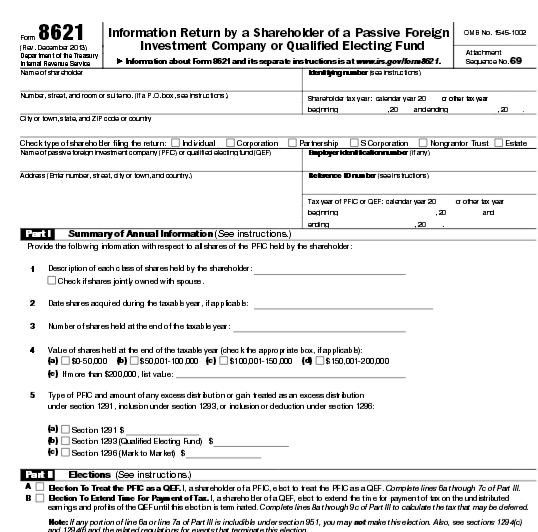
The only “good news” in this explanation of PFICs, is that there is not an automatic US$10,000 penalty for failure to file their investments in a PFIC on IRS Form 8621, Information Return by a Shareholder of a Passive Foreign Investment Company or Qualified Electing Fund.
This is a departure from the normal rule of a minimum US$10,000 penalty for failure to file information returns regarding international (i.e., non-U.S. assets and investments). See, USCs and LPRs Living Outside the U.S. – Key Tax and BSA Forms.
All of these tax compliance rules begs a very important question for a USC who is considering renouncing their U.S. citizenship. The issue arises if they have had investments in PFICs during the last five years. If the USC has not been complying with IRC Section 1297 regarding PFICs, how can the taxpayer ever certify under penalty of perjury ” . . . that he has met the requirements of this title for the 5 preceding taxable years. . . [for purposes of Section 877(a)(2)(C)]”?
See, Certification Requirement of Section 877(a)(2)(C) – (5 Years of Tax Compliance) and Important Timing Considerations per the Statute
More details about PFICs to come in later posts.
Russia Joins the FATCA Group – On the Last Day? Complete List of Countries to Date (Very Few Notable Absences)
According to The Moscow Times, Putin Signs Last-Minute Law to Satisfy FATCA
With China and Russia as prior major holdouts, the recent news from both countries probably assures the long-term success of FATCA.
See, HUGE NEWS – China has “Reached an Agreement in Substance” for a FATCA Intergovernmental Agreement (IGA) – its Affect on USCs and LPRs Living in China and Hong Kong
There are very few notable “hold-outs” on FATCA IGAs. The following list reflects those countries of note (from my perspective) who have not signed or “reached an agreement in substance”:
Kenya
Nigeria
Egypt
Pakistan
Bahrain
Philippines
Malaysia
Guatemala
Uruguay
El Salvador
Nicaragua
Ecuador
Argentina
Venezuela
Lots of other countries with less commercial and financial ties to the U.S., did not – including – countries such as Kazakhstan, Uzbekistan and Cambodia.
There are currently 90 countries identified by the U.S. Treasury as having an IGA or “reaching an agreement in substance” as follows (note there are fewer signed IGAs than unsigned):
Countries that have signed agreements:
Model 1 IGA
1) Australia (4-28-2014)
2) Belgium (4-23-2014)
3) Canada (2-5-2014)
4) Cayman Islands (11-29-2013)
5) Costa Rica (11-26-2013)
6) Denmark (11-19-2012)
7) Estonia (4-11-2014)
8) Finland (3-5-2014)
9) France (11-14-2013)
10) Germany (5-31-2013)
11) Gibraltar (5-8-2014)
12) Guernsey (12-13-2013)
13) Hungary (2-4-2014)
14) Honduras (3-31-2014)
15) Ireland (1-23-2013)
16) Isle of Man (12-13-2013)
17) Italy (1-10-2014)
18) Jamaica (5-1-2014)
19) Jersey (12-13-2013)
20) Latvia (6-27-2014)
21) Liechtenstein (5-19-2014)
22) Luxembourg (3-28-2014)
23) Malta (12-16-2013)
24) Mauritius (12-27-2013)
25) Mexico (4-9-2014)
26) Netherlands (12-18-2013)
27) New Zealand (6-12-2014)
28) Norway (4-15-2013)
29) South Africa (6-9-2014)
30) Spain (5-14-2013)
31) Slovenia (6-2-2014)
32) United Kingdom (9-12-2012)
Model 2 IGA (signed agreements)
33) Austria (4-29-2014)
34) Bermuda (12-19-2013)
35) Chile (3-5-2014)
36) Japan (6-11-2013)
37) Switzerland (2-14-2013)
And those countries which are deemed to have “reached agreement in substance” –
Model 1 IGA
38) Algeria (6-30-2014)
39) Antigua and Barbuda (6-3-2014)
40) Azerbaijan (5-16-2014)
41) Bahamas (4-17-2014)
42) Barbados (5-27-2014)
43) Belarus (6-6-2014)
44) Brazil (4-2-2014)
45) British Virgin Islands (4-2-2014)
46) Bulgaria (4-23-2014)
47) China (6-26-2014)
48) Colombia (4-23-2014)
49) Croatia (4-2-2014)
50) Curaçao (4-30-2014)
51) Czech Republic (4-2-2014)
52) Cyprus (4-22-2014)
53) Dominica (6-19-2014)
54) Dominican Republic (6-30-2014)
55) Georgia (6-12-201)
56) Greenland (6-29-2014)
57) Grenada (6-16-2014)
58) Guyana (6-24-2014)
59) India (4-11-2014)
60) Indonesia (5-4-2014)
61) Israel (4-28-2014)
62) Kosovo (4-2-2014)
63) Kuwait (5-1-2014)
64) Lithuania (4-2-2014)
65) Panama (5-1-2014)
66) Peru (5-1-2014)
67) Poland (4-2-2014)
68) Portugal (4-2-2014)
69) Qatar (4-2-2014)
70) Romania (4-2-2014)
71) St. Kitts and Nevis (6-4-2014)
72) St. Lucia (6-12-2014)
73) St. Vincent and the Grenadines (6-2-2014)
74) Saudi Arabia (6-24-2014)
75) Seychelles (5-28-2014)
76) Singapore (5-5-2014)
77) Slovak Republic (4-11-2014)
78) South Korea (4-2-2014)
79) Sweden (4-24-2014)
80) Thailand (6-24-2014)
81) Turkey (6-3-2014)
82) Turkmenistan (6-3-2014)
83) Turks and Caicos Islands (5-12-2014)
84) Ukraine (6-26-2014)
85) United Arab Emirates (5-21-2014)
Model 2 IGA
86) Armenia (5-8-2014)
87) Hong Kong (5-9-2014)
88) Moldova (6-30-2014)
89) Paraguay (6-6-2014)
90) Taiwan (6-23-2014)*
Supreme Court’s Decision in Cook vs. Tait and Notification Requirement of Section 7701(a)(50)
The U.S. Supreme Court upheld as Constitutional the concept of citizenship based taxation in 1924 in Cook v. Tait. In that case, the U.S. citizen resided permanently and was domiciled in Mexico City with his Mexican citizen wife.
In those years, the Revenue Act of 1921 imposed a top income tax rate of 8%. The IRS made a demand against Mr. Cook to pay his tax. Mr. Cook paid it and sued for refund of the US$1,193 paid. That amount represents about  US$16,893 in 2014 inflation adjusted dollars. Neither amounts are significant in current actions taken by the IRS.
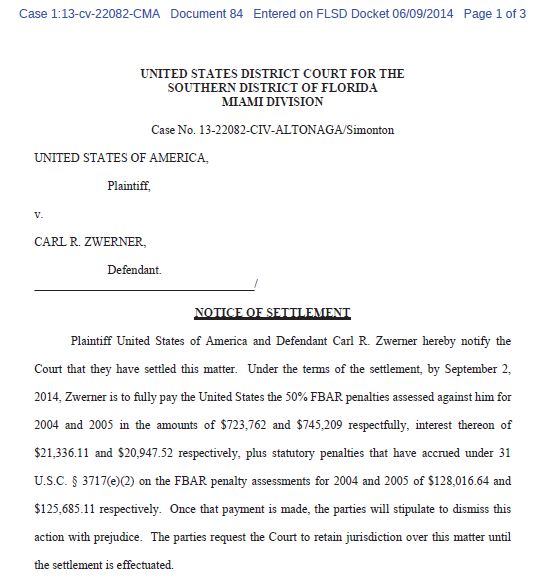
As a point of reference, Mr. Zwerner was alleged to owe US$3,630,119 (on an account with a maximum value during the years at issue of apparently no more than US$1.69M) and ultimately paid about US$ 1.75M (more than he even had in his account?) per the Notice of Settlement filed with the Court referenced here:
Even in 1922 dollars when Mr. Cook was living in Mexico City, the payment by Zwerner of about US$ 1.75M in current dollars, would represent about $123,581 in those dollars. See, Why the Zwerner FBAR Case is Probably a Pyrrhic Victory for the Government – for USCs and LPRs Living Outside the U.S. (Part II)
There was no Foreign Account Tax Compliance Act (“FATCA”) in the days of Cook in Mexico City, so it would be interesting to know how and why the audit and tax assessment collection was commenced. This was long before e-mails and internet, and there was a very different system of international travel. Communication and technology in 2014 is quite different from technology nearly 100 years ago when the first transcontinental (not transnational) telephone call was made in 1915 a few years before the tax issue arose in the case of Mr. Cook.
Now to the key point of this post. The Supreme Court in Cook vs. Tait framed the question before the Court as follows:
- The question in the case . . . as expressed by plaintiff [Mr. Cook], whether Congress has power to impose a tax upon income received by a native citizen of the United States who, at the time the income was received, was permanently resident and domiciled in the city of Mexico, the income being from real and personal property located in Mexico.
Can the United States impose worldwide taxation on U.S. citizens who permanently live overseas and who only have income from property or services outside the U.S.? Of course, the Supreme Court, said, that such a citizenship based rule was Constitutional. The rationale of the Court was explained in the opinion as follows, specific to the rights of citizenship:
- . . . the scope and extent of the sovereign power of the United States as a nation and its relations to its citizens and their relation to it.’ And that power in its scope and extent, it was decided, is based on the presumption that government by its very nature benefits the citizen and his property wherever found, and that opposition to it holds on to citizenship while it ‘belittles and destroys its advantages and blessings by denying the possession by government of an essential power required to make citizenship completely beneficial.’ In other words, the principle was declared that the government, by its very nature, benefits the citizen and his property wherever found, and therefore has the power to make the benefit complete. Or, to express it another way, the basis of the power to tax was not and cannot be made dependent upon the situs of the property in all cases, it being in or out of the United States, nor was not and cannot be made dependent upon the domicile of the citizen, that being in or out of the United States, but upon his relation as citizen to the United States and the relation of the latter to him as citizen. [emphasis added]
The Supreme Court emphasizes at several points that it is because of the benefits of citizenship and the rights conferred to the citizen of the United States, that the United States government has the Constitutional power to impose worldwide taxation.
What is the difference, if someone is NOT a U.S. citizen? How can the U.S. federal government impose worldwide taxation on property outside the U..S. when the individual is not a citizen, has no right to even enter the United States and generally has no benefits or protections afforded to a U.S. citizen? Indeed, a recent interpretation of the U.S. government in a Justice Department memo spells out the rights of certain U.S. citizens. See New York Times recent article, Court Releases Large Parts of Memo Approving Killing of American in Yemen Targeting Anwar al-Awlaki Was Legal, Justice Department Said
Back on topic, the rationale in Cook v. Tait did not extend to someone who was not a citizen. For example, the Internal Revenue in the 1920s was of course not attempting to impose taxation on Mr. Cook’s Mexican national wife who lived exclusively in Mexico.
Herein, is a most interesting problematic and possibly (maybe – probably?) unconstitutional aspect of current law under the provisions off IRC Section 7701(a)(5)(if the loss of nationality is retroactive to a date long ago in the past but the tax code/IRS is not recognizing that past date as the expatriation date.
See, Why Section 7701(a)(50) is so important for those who “relinquished” citizenship years ago (without a CLN)
If someone has lost all rights to U.S. citizenship years or decades ago, how can the U.S. federal government continue to impose worldwide income taxation for all of the intervening years?
How can the tax law impose a “Constitutional fiction” that a person continues to be “. . . treated as a United States citizen . . . ” simply because they did not file a paper notification with the U.S. federal government. See, Section 7701(a)(50) was adopted and has a very clear timing rule about when a person “. . . cease[s] to be treated as a United States citizen. . . ” It is not the same as for immigration law purposes. It’s a fiction in the tax law as to when one ““. . . cease[s] to be . . . a United States citizen. . . ”
The statute says ” . . . An individual shall not cease to be treated as a United States citizen before the date on which the individual’s citizenship is treated as relinquished under section 877A (g)(4). . .”
How can the U.S. federal government continue to impose U.S. worldwide income taxation on former U.S. citizens because of the provisions under Section 7701(a)(50) and 877A (g)(4)?
The U.S. Supreme Court in Cook vs. Tait found the U.S. citizenship based taxation system as Constitutional since ” . . . government by its very nature benefits the citizen and his property wherever found . . .” and because of “ . . . his relation as citizen to the United States and the relation of the latter to him as citizen. . . . ” [emphasis added]
A person who is not a citizen, obviously does not receive these benefits from the government as does a United States citizen.
In practice, the only body that can determine whether a law is Constitutional or not, is the U.S. Supreme Court. It’s not likely that this question will reach the Supreme Court any time soon; if ever. Meanwhile, the IRS generally has the duty to enforce the law as currently written.
Why vested Social Security Retirement Benefits are not lost when a USC or LPR sheds their citizenship or immigration status. The Answer to: What happens to social security benefits to former USCs and LPRS including a “covered expatriate”?
The law of the Social Security Act is a bit obscure for persons who are not (i..e, no longer are) U.S. citizens. It is “obscure” because the law is silent as to former U.S. citizens. For basic background, see, Social Security Retirement Benefits – for former USCs and LPRs (Intersection of U.S. Tax and Social Security Law)
While USCs have broad, largely unfettered rights to social security (including when they reside exclusively outside the United States), former USCs and LPRs fall into a different category, specifically including the tax treatment of those benefits.
Also, the U.S. Congress has imposed limitations, first under the so-called Illegal Immigration Reform and Immigrant Responsibility Act of 1996 and later by the Social Security Protection Act of 2004.
For the “Accidental American” who has spent virtually all of their lives outside the U.S. (and has never been employed by a U.S. employer), this discussion will largely be irrelevant to you as you will probably have no rights to Social Security Retirement Benefits.
However, for the former USC or LPR who falls into any of the following categories, and worked full-time for the requisite 40 quarters, they should have Social Security Retirement Benefits that are due and payable when they meet the age requirements:
- self-employed (and paid and filed self-employment tax returns – paying social security); or
- employed within the United States (even by a foreign employer); or
- employed outside the United States by a U.S. employer.
For a detailed discussion of how and when these federal employment taxes apply (including at what rates), please see “Comparative Overview of U.S. and Mexican Federal Employment Taxes,” CCH International Tax Journal, November–December 2009. Current Social Security Tax Rates, and the taxable base – contribution base (which adjusts annually) can be reviewed on the Social Security Website.
The 1996 and 2004 statutory amendments reflected above, do not modify the rights of former USCs or LPRs. They do affect the rights of individuals who were not USCs or LPRs; namely who did not have legal immigration status while working and living in the U.S.
For a detailed discussion of this part of the law, please see the Congressional Research Report of 2010 titled Social Security Benefits for Noncitizens.
The final conclusion about whether the Social Security Act restricts social security retirement benefits to “covered expatriates”, can NOT be expressly found in the statute or the regulations themselves. There is no affirmative answer in Title 42 or the regulations thereunder, regarding “covered expatriates.” It is silent on the issue and not expressly addressed.
Most importantly, throughout the Social Security Act and regulations thereunder, because of the “silence” of the statute, there are no restrictions expressly imposed on “covered expatriates” or any other former USCs or LPRs. This category of persons, “covered expatriates” is not somehow identified or segregated in the law for disparate treatment. The law provides generally that Social Security Retirement Benefits are available to non-citizens and those who no longer have LPR status; provided they meet the previous work and eligibility requirements. Shedding USC or LPR does not strip these individuals of these benefits.
While it is always hard (impossible) to “prove a negative”; our office has also received telephonic confirmation from technical support personnel of the Social Security Administration, that the above conclusion is a correct interpretation of the law.
Stay tuned to another post about how the U.S. imposes income and withholding taxes on Social Security benefits to “covered expatriates”; which is indeed different than for current USCs (and some LPRs) residing overseas.
???????????????? ?Please click here to view the above in Chinese.?
Collateral Affects of Renouncing U.S. Citizenship & LPR status – U.S. Driver’s License
Renouncing USC or formally abandoning your LPR can have consequences that you may not have contemplated. For instance, many States in the United States will not issue or renew a driver’s license to a non-USC who has a certain immigration status.
As an example, Delaware will not issue a driver’s license to someone who has an A-1, A-2, B-2, B-1, or WB visa holder.
Other States, such as Texas have extensive requirements, depending upon the immigration status of the former USC or LPR.
California laws restrict many non-citizens from having a driver’s license. California does accept a Canadian passport or birth certificate as a valid document and proof of eligibility. Also a valid Mexican border crossing card (aka “laser visa”) with a valid I-94 is acceptable in California. See, California DMV.
Almost every State has a different set of unique rules. See, for instance, New Hampshire, New York, Florida, Washington State, Illinois and Washington, D.C. Illinois, for instance, has a law passed in 2013 that allows a driver’s license to be issued to an “undocumented” temporary visitor.
Washington State currently has one of the most liberal set of rules for obtaining a license; including acceptance of “multiple documents issued by: Mexican government [&] Guatemalan government”
Of course, if you are living almost exclusively outside the U.S., a driver’s license from a State within the United States, will certainly not be necessary. However, some U.S. insurance companies will not provide certain insurance coverage for non-citizens without a U.S. driver’s license. Losing your U.S. driver’s license may be little more than an inconvenience.
???????????????? ?Please click here to view the above in Chinese.?
How will USCs and LPRs living overseas be affected? Credit Suisse is reportedly in talks to pay well over $ 1 billion to resolve tax transgressions with the U.S. Department of Justice
UBS paid US$780M to resolve its issues with the US DOJ and IRS in 2009. It’s deferred prosecution agreement seemed harsh to many at the time. However, if recent news reports are correct, Credit Suisse will be paying well over $1 Billion to settle allegations of tax misconduct, including possible criminal indictments?
See Bloomberg, Credit Suisse Said Near U.S. Tax Deal for Over $1 Billion, By Tom Schoenberg, David Voreacos and Elena Logutenkova
Also, Jack Townsend issued a report on his blog about the possibilities of such a settlement – Credit Suisse Reports (5/6/14; 5/7/14)
How will USCs and LPRs living overseas be affected?
This is a question of great importance to many of the millions of USCs and LPRs residing outside the U.S. Certainly, USC and LPR individuals with accounts at Credit Suisse are bound to be directly affected.
According to the Senate report, there were some 6,000 USCs residing outside the U.S. with accounts at Credit Suisse. For further observations on this topic, see an earlier post – Key Take Aways from Senate Investigations re: Foreign Banks and “Offshore Tax Evasion”: U.S. Citizens Residing Overseas have Become a Focus of the Government.; Posted on March 4, 2014
Will an agreement with Credit Suisse regarding USC accounts, specifically including those who live outside the U.S. bring greater attention by the IRS and DOJ to the tax compliance of USCs and LPRs residing outside the U.S.?
See, Is the new government focus on U.S. citizens living outside the U.S. misguided or a glimpse at the new future?
Only time will tell, what type of USCs and LPRs are of most interest to the IRS and DOJ. Will they include large numbers of individuals living outside the U.S.? Will it go beyond USC accounts at Credit Suisse to Canadian resident account holders at Royal Bank of Canada; to British resident account holders at Barclays Bank; to Mexican resident account holders at Banamex; French resident account holders at Banpais, etc. etc. etc.?
Millions of USCs reside around the world. See, Coming to America. . . Accidental Americans Beware – The Law Requires a U.S. Passport!
Technology (with the help of FATCA) has enabled the U.S. government to now readily access information of financial accounts of USCs and LPRs residing throughout the world. See, The Catch 22 of Opening a Bank Account in Your Own Country – for USCs and LPRs (Posted on April 30, 2014)
???????????????? ?Please click here to view the above in Chinese.?
Why Section 7701(a)(50) is so important for those who “relinquished” citizenship years ago (without a CLN). . .
So you relinquished your citizenship years ago and therefore you think you somehow escape the current expatriation tax provisions? The U.S. federal government views their hands are tied in what the statute says.
Is it Constitutional?
Practitioners and indeed IRS attorneys struggle with the various “expatriation” tax provisions that have been added by Congress. First, there were the rules from 1966. The first “expatriation tax” law was not adopted until 1966 as part of the The Foreign Investors Tax Act of 1966 (“FITA”) – The Origin of U.S. Tax Expatriation Law (Posted on April 6, 2014).
Next, 1996 amendments kept the basic regime but added a number of key concepts. The changes in the law in 2004 made significant changes. See, Timeline Summary of Changes in Tax Expatriation Provisions Since 1996, (Posted on April 9, 2014)
Finally the 2008 revisions made wholesale changes and introduced a completely new set of taxes under Section 2801. See, Joint Committee Reports – 2008 Report re: HEROES Act – Mark to Market Regime – New Section 877A
I have recently presented a set of proposed rules (via the International Tax Committee of the State Bar of California, Taxation Section) to the IRS and Treasury regarding Section 2801 and the inheritance tax and tax on gifts from “covered expatriates.” Those comments will be published soon by TaxAnalysts.
The reason this issue is so important, are the adverse long-term consequences of not satisfying Section 877(a)(2)(C), which include the “forever taint” of Section 2801 (covered gifts and covered bequests). See, The “Hidden Tax” of Expatriation – Section 2801 and its “Forever Taint.”, (Posted on April 10, 2014).
In addition if there are unrealized gains that get triggered from the “mark to market” rules, they will come due; all tied to the date of expatriation.
The sad consequence of the revisions in 2008, is that Section 7701(a)(50) was adopted and has a very clear timing rule about when a person “. . . cease[s] to be treated as a United States citizen. . . ” It is not the same as for immigration law purposes.
The plain reading of the language of the statute is quite clear and provides in its entirety as follows:
- (50) Termination of United States citizenship
- An individual shall not cease to be treated as a United States citizen before the date on which the individual’s citizenship is treated as relinquished under section 877A (g)(4).
- Under regulations prescribed by the Secretary, subparagraph (A) shall not apply to an individual who became at birth a citizen of the United States and a citizen of another country.
Section 7701(a)(50)(A) is clear as it references 877A(g)(4) that clearly states that the term “relinquishment of citizenship” (at least for tax purposes – Title 26 purposes) does not have the same meaning as “relinquishment” for immigration law purposes.
Rather, each of the dates set forth in the tax statute to determine “relinquishment” are dates that are not retroactive to the actual loss of citizenship date for immigration law purposes. The tax law defines the “ . . . citizen shall be treated as relinquishing his United States citizenship on the earliest of—
- (A) the date the individual renounces his United States nationality before a diplomatic or consular officer of the United States pursuant to paragraph (5) of section 349(a) of the Immigration and Nationality Act (8 U.S.C. 1481 (a)(5)),
- (B) the date the individual furnishes to the United States Department of State a signed statement of voluntary relinquishment of United States nationality confirming the performance of an act of expatriation specified in paragraph (1), (2), (3), or (4) of section 349(a) of the Immigration and Nationality Act (8 U.S.C. 1481 (a)(1)–(4)),
- (C) the date the United States Department of State issues to the individual a certificate of loss of nationality, or
- (D) the date a court of the United States cancels a naturalized citizen’s certificate of naturalization.?
To put this statute in practice, let us assume a dual national living in Country X, goes to the U.S. Embassy or Consulate in Country X in the year 2014 (May 4, 2014, to be exact) to request a relinquishment of citizenship back in time, i.e., to the “relinquishing act” for immigration law purposes. He or she is able to convince the U.S. Department of State that the relinquishing act was in December of 1989. The CLN that is later issued, reflects the December 1989 date. Unfortunately, the tax statutes referenced above, clearly state the earliest date of “relinquishment of citizenship” occurs on the date the dual national went to the U.S. Department of State, i.e., on May 4, 2014.
Not a day earlier than 4 May 2014.
Section 7701(a)(50)(B) allows the Treasury to adopt regulations modifying this rule, for a limited class of “expatriates” who were dual nationals from birth. To date, no regulations were issued, although proposed regulations under section 2801 are forthcoming.
This is what some have called an “absurd result”; but is indeed a plain reading of the statute. The Treasury Department generally feels their hands are tied, because of the plain language of the statute.
Is such a provision even Constitutional under the principles articulated by the U.S. Supreme Court in Cook vs. Tait? In that case, at least the individual was a U.S. citizen. In the hypothetical set out above, the individual lost their U.S. citizenship in 1989. How can Congress hence impose U.S. taxation and reporting requirements on such an individual from the year 1989 through the May, 2014?
See the summary of current law below:
U.S. taxation of citizens has a long history going back to 1861 and the Civil War.4 The concept of citizenship based taxation was upheld by the U.S. Supreme Court in the 1920s.5 See Cook v. Tait,6 where a U.S. citizen resided permanently and was domiciled in Mexico City with his Mexican citizen wife and the Court found that U.S. taxation of his Mexican source income was indeed constitutional. Notwithstanding the long history of U.S. citizenship based taxation, the authors view it as an anachronism in the 21st century since it is particularly difficult to administer and cannot be enforced effectively overseas.7
The complete proposal can be read at “Tax Simplification: The Need for Consistent Tax Treatment of All Individuals (Citizens, Lawful Permanent Residents and Non-Citizens Regardless of Immigration Status) Residing Overseas, Including the Repeal of U.S. Citizenship Based Taxation,” by Patrick W. Martin and Professor Reuven Avi-Yonah, 2013.
The Catch 22 of Opening a Bank Account in Your Own Country – for USCs and LPRs
The Foreign Account Tax Compliance Act (“FATCA“) has begun in force in the year 2014. There are lots of consequences of FATCA, including the obligation of financial institutions throughout the world (“FFIs”) to identify “U.S. account” holders under various circumstances. New accounts that are opened by a FFI, such as a bank in London, a branch in Sao Paulo, Paris, Toronto, Mexico City, Riyadh, Johannesburg, Singapore, Beijing, Vienna, Hong Kong, Geneva, Panama City, Dublin, and the tiniest towns and villages throughout the world, will have to identify the U.S. account holder. A “U.S. account” includes an account opened by a United States Citizen who has lived, all or almost all, of his or her life in a country outside the U.S.
The U.S. Treasury has summarized what FATCA does as a policy and how it generally functions:
- FATCA seeks to obtain information on accounts held by U.S. taxpayers in other countries. It generally requires U.S. financial institutions to withhold a portion of certain payments made to certain foreign financial institutions (FFIs) that do not agree to identify and report information on U.S. account holders. This withholding regime acts as a backstop to the main focus of FATCA, which is to obtain the information about accounts held by U.S. persons and by certain foreign entities with substantial U.S. owners that is needed to detect and deter offshore tax evasion.
The details and complexity of FATCA are mind-numbing, including the hundreds of pages of regulations, which can be accessed at the IRS website here. 
One practical problem that a USC or LPR (some LPRs) living overseas will have when they attempt to open an account, is that they will be required to provide a U.S. taxpayer identification number (“TIN”).
Of course, a USC who has spent virtually none of their lives living in the U.S., will typically have no TIN. Herein lies the Catch 22. The bank will ask the USC who wishes to open a new account to provide them with a completed IRS Form W-9, supplying the TIN of the USC or LPR.
Moreover, a U.S. citizen (e.g., someone who was born in the U.S. or obtained it through a U.S. citizen parent – via derivative citizenship) has no choice but to obtain a U.S. Social Security Number (“SSN”) as their TIN, in accordance with U.S. tax law.
Herein lies another Catch 22 (within a Catch 22); since someone who has lived virtually all (or all) of their lives outside the U.S. will almost certainly have no SSN. The process of obtaining a SSN for someone living outside the U.S. is particularly complex and will be left for another post.