International Tax · Citizenship Renunciation · LPR Abandonment
International Tax Shareholder
Countries From Which Viewers Read Posts – Tax-Expatriation.com – First Week of 2024 (Which Ones are Tax Treaty Countries?) – Applying the “Escape Hatch”
The whole idea of the “escape hatch” for tax treaties is an excellent way of explaining how and when tax treaty law applies in different circumstances. Importantly, the U.S. federal government cannot deny an individual (or presumably a company either) from properly applying the law of a tax treaty – even if they “gave [an] untimely notice of his treaty position “. See further comments at the end of this post and the District Court’s opinion here – Aroeste v United States – Order (Nov 2023). Meanwhile, see below the 22 countries from where global readers viewed Tax-Expatriation.comduring the first full week of 2024.
Below is the list of 22 countries (including the United States) from where readers hailed, who read Tax-Expatriation.comduring the first week of 2024. All, but Brazil, Croatia, Nigeria, the United Arab Emirates, Colombia, Kenya and Bermuda have income tax treaties with the United States.
This means that all other individuals are connected with the following 14 countries that have tax treaties with the United States:
Mexico
India
Canada
United Kingdom
Switzerland
Australia
China
Spain
Turkey
Germany
Japan
Romania
Portugal
Netherlands
Further, all individuals who might have never formally abandoned their lawful permanent residency (“green card”), maybe never filed specific IRS tax forms, and yet reside in one of these fourteen (14) treaty countries could be eligible for the application and the specific benefits of international income tax treaty law. This, along the lines of the decision in Aroeste v United States (Nov. 2023). In addition, there could be other tax treaty benefits applicable to those individuals in these fourteen countries depending upon where are their assets, what type of income they have, where does the income come from, and where do they reside.
The tax treaty rights discussed here are established by law, as elucidated by the Federal District Court in Aroeste v United States (Nov. 2023). The Court determined that the IRS cannot simply assert an individual’s ineligibility for treaty law provisions based solely on the failure to file specific IRS forms within the government-defined “timely” period. The Court emphasized that there is no automatic waiver of treaty benefits as a matter of law, while acknowledging: “. . . Aroeste gave untimely notice of his treaty position. . .” For specific excerpts from the opinion, please refer to the highlighted portions below. To access the complete opinion, please consult Aroeste v United States – Order (Nov 2023).
* * * * * * * * *
B. Whether Aroeste Did Not Waive the Benefits of the Treaty Applicable to Residents of Mexico and Notified the Secretary of Commencement of Such Treatment.
To establish Mexican residency under the Treaty, and thus avoid the reporting requirements of “United States persons,” Aroeste must have filed a timely income tax return as a non-resident (Form 1040NR) with a Form 8833, Treaty-Based Return Position Case 3:22-cv-00682-AJB-KSC Document 90 Filed 11/20/23 PageID.2722 Page 8 of 17 9 22-cv-00682-AJB-KSC Disclosure Under Section 6114 or 7701(b). Indeed, Aroeste did not submit Form 8833 to notify the IRS of his desired treaty position for the years 2012 and 2013 until October 12, 2016, when he submitted an amended tax return for both years at issue. (Id.) The Government asserts that because Aroeste did not timely submit these forms, he cannot establish that he notified the IRS of his desire to be treated solely as a resident of Mexico and not waive the benefits of the Treaty. (Id. at 4.) The Government relies upon United States v. Little, 828 Fed. App’x 34 (2d Cir. 2020) (“Little II”), a criminal appeal in which the court held a lawful permanent resident of a foreign country was a “‘resident alien’ or ‘person subject to the jurisdiction of the United States’ with an obligation to file an FBAR.” Id. at 38 (quoting 31 C.F.R. § 1010.350(a), (b)(2)).
In response, Aroeste asserts that while he agrees with the Government that I.R.C. § 6114 requires disclosure of a treaty position, he disagrees as to the consequences for a taxpayer’s failure to timely file the disclosure. (Doc. No. 75-1 at 6.) While the Government asserts the failure to timely file Forms 1040NR and 8833 deprives individuals of the Treaty benefits provided, Aroeste argues instead that I.R.C. § 6712 provides explicit consequences for failure to comply with § 6114. Specifically, § 6712 states that “[i]f a taxpayer fails to meet the requirements of section 6114, there is hereby imposed a penalty equal to $1,000 . . . on each such failure.” I.R.C. § 6712(a). Based on the foregoing, Aroeste argues the taxpayer does not lose the benefits or application of the treaty law.1 (Doc. No. 75-1 at 6.) In United States v. Little, 12-cr-647 (PKC), 2017 WL 1743837, at *5 (S.D. N.Y. 1 Aroeste further asserts that published agency guidance, letter rulings, and technical advice support his position. (Doc. No. 75-1 at 7.) For example, in 2007, an IRS agent sought advice from IRS Counsel asking, “Do we have legal authority to deny a tax treaty because Form 8833 is not attached or the treaty is claimed on the wrong Form (1040EZ or 1040)?” Legal Advice Issued to Program Managers During 2007 Document Number 2007-01188, IRS. IRS Counsel responded, “No, you cannot deny treaty benefits if the taxpayer is entitled to them. You may impose a penalty of $1,000 under section 6712 of the Code on an individual who is obligated to file and does not.” Id. As to this, the Court finds it has no precedential value under I.R.C. § 6110(k)(3), which states that “a written determination may not be used or cited as precedent.” See Amtel, Inc. v. United States, 31 Fed. Cl. 598, 602 (1994) (“The [Internal Revenue] Code specifically precludes [plaintiff] and the court from using or citing a technical advice memorandum as precedent.”) Case 3:22-cv-00682-AJB-KSC Document 90 Filed 11/20/23 PageID.2723 Page 9 of 17 10 22-cv-00682-AJB-KSC May 3, 2017) (“Little I”), a criminal case for the plaintiff’s willful failure to file tax returns, the court stated the plaintiff’s same argument “that the failure to take a Treaty position can result only in a financial penalty also lacks merit. 26 U.S.C. § 6712(c) expressly states that ‘[t]he penalty imposed by this section shall be in addition to any other penalty imposed by law.’” (emphasis added).
I have been consulted over the years by other taxpayers which are cited now as published decisions by the government and the Federal District Court (Southern District of California). These cases are referenced and cited in my own most recent case of Aroeste v United States (Nov. 2023).
However, in Little I, the plaintiff never attempted to take a treaty position. Next, in Shnier v. United States, 151 Fed. Cl. 1, 21 (2020), the court denied the plaintiffs’ claims for relief based on tax treaties because they failed to disclose a treaty based position on their tax returns pursuant to I.R.C. § 6114 “and did not attempt to cure this omission in their briefing[.]” Although the plaintiffs in Shnier were naturalized U.S. citizens who attempted to recover their income taxes under I.R.C § 1297, the court’s brief discussion of I.R.C. § 6114 in relation to a treaty-based position is instructive that an untimely notice of a treaty position does not bar the individual from taking such position. Moreover, in Pekar v. C.I.R., 113 T.C. 158 (1999), the court noted that a taxpayer who fails to disclose a treaty-based position as required by § 6114 is subject to the $1,000 penalty, but stated “there is no indication that this failure estops a taxpayer from taking such a position.” Id. at 161 n.5.2 The Court agrees with Aroeste.
Although Aroeste gave untimely notice of his treaty position, the Court finds this does not waive the benefits of the Treaty as asserted by the Government. Rather, I.R.C. § 6712 provides the consequences for failure to comply with I.R.C. § 6114, namely a penalty of $1,000 for each failure to meet § 6114’s requirements of disclosing a treaty position.
* * * * * * * * *
For individuals living in any of these 14 tax treaty countries (or any of the total 67 income tax treaty countries), the key takeaway is that, based on their specific circumstances, they might be eligible to leverage the international tax treaty principles outlined in the Aroeste v United States case (Nov. 2023). The forthcoming post will pose questions for consideration by the potentially millions of individuals affected by these rules of law.
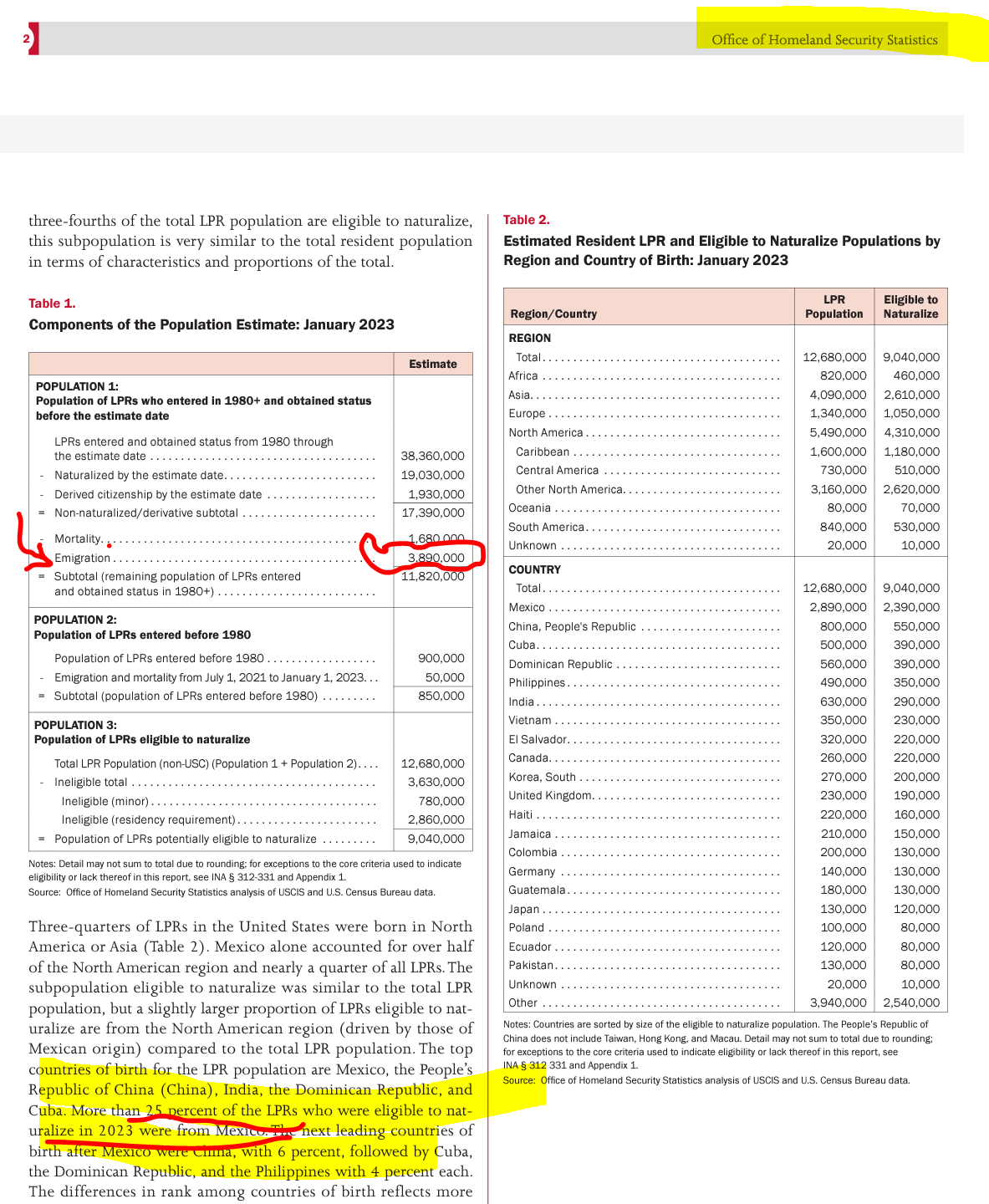
DHS Report: 3.89M Emigrated LPRs — Who Falls Under the Tax Treaty Escape Hatch?
Clear U.S. tax and legal relief now exists for a significant portion of the 3.89 million Lawful Permanent Residents (LPRs) who never formally abandoned their U.S. immigration status. This relief stems from two sources in the law:
(i) Tax treaty laws that apply to individuals residing in one of the 67 income tax treaty countries with the United States, recently including Chile.
(ii) Legal principles, recently confirmed by the Federal Court in Aroeste v. United States, that establish that individuals can apply tax treaty laws (when applicable) even if they missed certain filing deadlines set by the Internal Revenue Service. The Court termed this provision an “escape hatch,” allowing individuals, depending on specific circumstances, to be considered non-residents of the United States (not “United States persons”). This can be true under the relevant treaty, even if they never formally abandoned their LPR status.
The 2023 DHS report estimates that nearly 4 million individuals have emigrated from and left the United States and are now living somewhere around the world. Notably, Mexico constitutes the largest share at about 25% of the total LPR population who have left the United States.
The DHS report allows the reader to extrapolate that around 1 million individuals, similar to Mr. Aroeste, are living in Mexico and did not formally abandon their LPR status by filing Form I-407, Record of Abandonment of Lawful Permanent Resident.
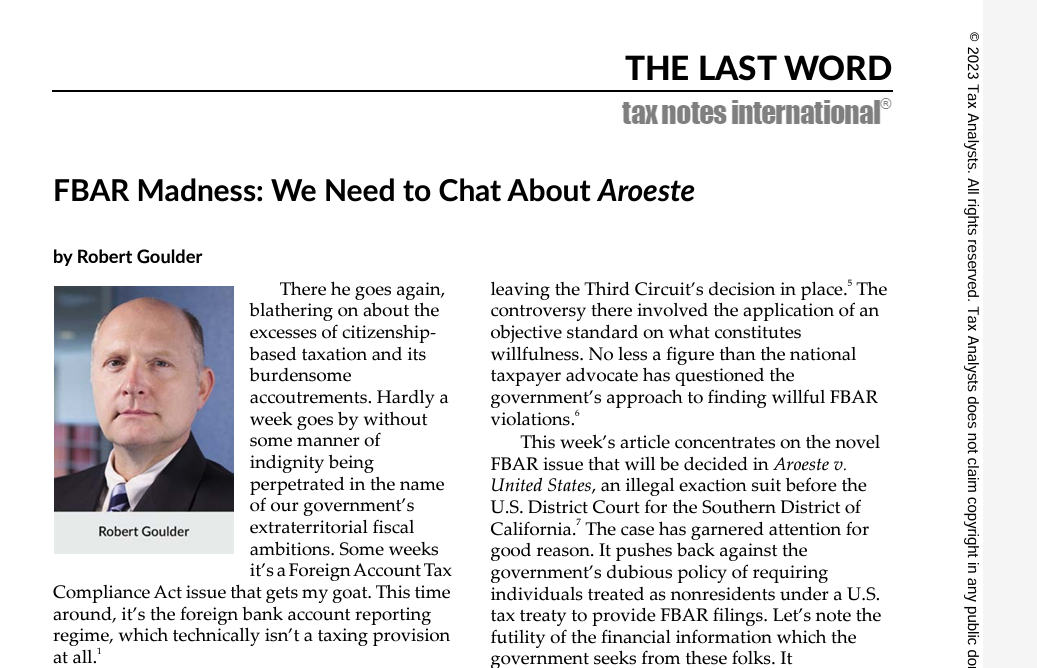
Aroeste v. United States is the third case I’ve litigated, examining whether individuals with a “green card” residing outside the United States in a tax treaty country are considered U.S. income tax residents. The previous two cases (involving Mexican and German citizens) didn’t progress to the oral argument stage; as the government conceded both before trial. See, IRS Chief Counsel Concedes Tax Treaty Residency Position for LPR German Taxpayer in Tax Court
A FOIA response yielded surprising information; the government records indicate that only 46,364 Forms I-407 were filed from 2013 to 2015.
(Source: Federal Government Response to FOIA Request: Office of Performance and Quality (OPQ), Performance Analysis and External Reporting (PAER), JJ)
SOURCE: Federal Government Response to FOIA Request: Office of Performance and Quality (OPQ), Performance Analysis and External Reporting (PAER), JJ
What can we glean from the DHS report and the LPR – I-407 information obtained through the FOIA response? There is a substantial gap in the millions; millions of individuals who have physically left the U.S. to reside elsewhere globally, compared to the relatively smaller number of tens of thousands who have officially filed Form I-407, Record of Abandonment of Lawful Permanent Resident.
Conclusion
Importantly, now under the legal principles established in Aroeste v. United States, individuals residing in one of the 67 countries covered by an income tax treaty have specific legal relief from the worldwide reporting of income to the United States government.
Mérida – the Place to be in February (19th and 20th)
The implications of the Aroeste v United States – Order (Nov 2023) particularly for millions of taxpayers globally and “U.S.” taxpayers affected by pertinent tax treaty provisions, will be a focal point of discussion at the upcoming international tax conference in February.
The University of San Diego School of Law – Chamberlain International Tax Institute will take place on February 19th and 20th, 2024, at the International Convention Center in Mérida, Yucatán, México. You can register for the conference – HERE –
Among the courses offered, there will be a detailed examination of- Aroeste v. the United States: Limits on Government Authority Re: Tax Treaty Law ++– along with other international tax topics and sessions featuring much Moore:
United States Supreme Court – Tax Decisions & Moore
International Tax Reporting: New Reporting of International Partnerships – K-2s & K-3s
United States-based Cross-Border Real Estate Investments (Advanced)
U.S. Investor Visa Options and Limitations
California, Texas & Florida Probate Proceedings of Cross-Border Estates
Federal District Court Rules in Favor of Mexican Citizen – Aroeste vs. United States (LPR) – Tax Treaty Applies: Government’s Motion for Summary Judgment is Denied
Last week (Nov. 20, 2023), Judge Battaglia in the Southern District of California (San Diego) ruled in favor of our client Mr. Alberto Aroeste regarding the application of the U.S.-Mexico Tax Treaty. The DOJ, Tax Division arguments on behalf of the Internal Revenue Service in the case (and their Motion for Summary Judgment – MSJ) were largely rejected by the Court.
A thorough read of the Order from the Court is recommended to understand the substantial legal findings and legal analysis made by the Court relevant to those who possess a “green card” referred to as “lawfully admitted for permanent residence” in Title 8, § 1101(a)(13) [Immigration and Nationality Act]. Key to this case, Title 26, § 7701(b)(6) [Federal Tax Code] then rather contorts the concept by saying an individual is a “lawful permanent resident” in accordance with immigration laws; but then goes on to put conditions on who apparently is a “lawful permanent resident” for federal tax purposes. While immigration law requires the individual be ” . . . accorded the privilege of residing permanently in the United States as an immigrant in accordance with the immigration laws, such status not having changed”; the tax definition seems to ignore that status (i.e., has it changed and is the personal no longer accorded the privilege of residing permanently in the U.S.?).
The Board of Immigration Appeals (the “Board”), has long recognized that an alien’s status may change by operation of law, such that an alien may abandon his LPR status without a finding of removability (or, formerly, deportability or excludability) after a formal adjudicatory process. See United States v. Yakou, 428 F.3d 241, 247 (D.C. Cir. 2005); at 247-51 (discussing case law regarding abandonment and holding that an alien may abandon LPR status without formal administrative action); see also Matter of Quijencio, 15 I. & N. Dec. 95 (B.I.A. 1974); Matter of Kane, 15 I. & N. Dec. 258 (B.I.A. 1975); Matter of Muller, 16 I. & N. Dec. 637 (B.I.A. 1978); Matter of Abdoulin, 17 I. & N. Dec. 458, 460 (B.I.A. 1980); Matter of Huang, 19 I. & N. Dec. 749 (B.I.A. 1988).
The Court did not need to get into the nuances of immigration law to rule against the government in this case.
Some of the substantial takeaways from the decision are:
Waiver of the Tax Treaty: The government cannot assert an individual waived the treaty law because she initially filed the wrong IRS forms (1040) instead of the non-resident form (1040NR) and IRS Form 8833.
The Court agrees with Aroeste. Although Aroeste gave untimely notice of his treaty position, the Court finds this does not waive the benefits of the Treaty as asserted by the Government. Rather, I.R.C. § 6712 provides the consequences for failure to comply with I.R.C. § 6114, namely a penalty of $1,000 for each failure to meet § 6114’s requirements of disclosing a treaty position.
Aroeste v United States – Order 20 Nov 2023 (p. 17)
Expatriation Tax form – IRS Form 8854: Validity and its Failure to Comply with the Administrative Procedure Act (“APA”)
C. Whether Aroeste Was Required to File Form 8854 The Government next argues that even if the IRS had accepted Aroeste’s amended returns, neither amended return would have properly notified the IRS of a commencement of treaty benefits because both failed to attach Form 8854, as required by IRS Notice 2009-85. (Doc. No. 76-1 at 4–5.) The Government concedes Aroeste attached Form 8833 to both amended forms. (Id.) Aroeste responds that Notice 2009-85 is not binding authority as it fails to comply with the Administrative Procedures Act (“APA”). (Doc. No. 78-1 at 8 (citing Green Valley Investors, LLC v. Comm’r of Internal Revenue, 159 T.C. No. 5, at *4 (Nov. 9, 2022)) (under the APA, agencies must follow a three-step procedure for “notice-and-comment” rulemaking, but this requirement does
not apply to “interpretive rules, general statements of policy, or rules of agency organization, procedure, or practice.”).) The Court agrees. In Mann Construction, Inc. v. United States, 27 F.4th 1138 (6th Cir. 2022), the court found that Notice 2007-83 failed to comply with the APA’s notice-and-comment procedure. Similarly here, because Notice 2009-85 has not been subject to a notice-and-comment procedure, it does not comply with the APA and thus is not binding. As such, Aroeste was not required to file Form 8854 with his amended returns.
Aroeste v United States – Order 20 Nov 2023 (p. 11)
Tax Treaty Law Applies – Article 4 Regarding Tax Residency
Various detailed analysis and discussions from the Court –
Aroeste v United States – Order 20 Nov 2023 (p. 11-14)
The Preamble to the FBAR Regulations is Not the Law –
. . . the Government points to the preamble to the 31 C.F.R. Part 1010 regulations, providing that “[a] legal permanent resident who elects under a tax treaty to be treated as a non-resident for tax purposes must still file the FBAR.” Amendment to the Bank Secrecy Act Regulations—Reports of Foreign Financial Accounts, 76 Fed. Reg. 10234-01 (Feb. 24, 2011). The Court finds this unavailing. The Government’s argument does not refute the plain language of the FBAR regulations, which explicitly invoke provisions of Title 26, including the provision that requires consideration of an individual’s status under an applicable tax treaty for the purpose of determining whether an individual is a “United States person” subject to FBAR filing. Specifically, Title 31 C.F.R. § 1010.350, which governs reporting of FBARs, subsection (b)(2) states that a “resident of the United States is an individual who is a resident alien under 26 U.S.C. 7701(b) and the regulations thereunder . . . .” The Government fails to cite to any case law or statue indicating otherwise, and the Court finds none. As such, because the Court finds the Treaty applicable to Aroeste, then the residence provisions of the Treaty, or the “tie breaker rules” dictates whether Aroeste may be treated as a nonresident alien.
Aroeste v United States – Order 20 Nov 2023 (p. 14)
This is the third court case (the other two were in U.S. Tax Court) I have had over the last several years where the IRS tried to assess substantial penalties and taxes against LPRs who resided substantially outside the United States. The other two cases were conceded by the IRS prior to going to trial. One case had over US$40M at stake as assessed by the IRS. This case, in federal district court, was pushed all the way to this favorable (to Mr. Aroeste and those around the world in similar circumstances) outcome by the government. We were successful with all of these non-U.S. citizen cases (two brothers from Mexico and an individual from Germany).
Three Precedent Setting Cases in International Information Reporting (“IIR”) in 6 Weeks: * Aroeste, * Bittner, and * Farhy: all Interconnected via Title 26, Title 31 and U.S. Income Tax Treaties
In just over six weeks, there have been three key judicial precedents favorable to international individuals. These cases have helped clarify the requirements of individuals and the limitations on the powers of the IRS in assessing IIR penalties. Please see the full article on tax notes. These IIR decisions relate to:
Title 31 penalties for Foreign Bank Account Reports (“FBARs”),
How these two federal statutory regimes of Title 31 and 26 crossover into international law as set forth in U.S. income tax treaties negotiated with different countries around the world.
Each of these three cases are interconnected and have significant impact to individuals with global lives, global assets, multi-national family members and those who have businesses or accounts in different parts of the world.
Aroeste v. United States
First, on February 13th, 2023, the Southern District of California District Court (the “District Court”) made a key determination in a Joint Discovery Motion decision in Aroeste.[2] The District Court concluded in Aroeste that the IRS/DOJ[3] could not ignore the U.S.-Mexico income tax treaty (“Treaty”) and its application to a Mexican national who has resided almost all of his life in Mexico City and has maintained a “green card” for immigration purposes in the United States. It is a non-willful FBAR case. The District Court applied the interconnected statutes and regulations of Titles 31 and 26 to help determine who qualifies as a “United States person”; specifically with reference to international law and obligations set forth in the Treaty. The key question in that case that remains to be answered is who (specifically Mr. Aroeste and by extension to a pool of millions of green card individuals residing outside the United States who are not citizens[4]) must file FBARs?
Second, on February 28th, 2023, the Supreme Court of the United States (“SCOTUS”) resolved in Bittner[5], that the applicable non-willful FBAR penalty is not measured by every foreign account of the individual as the Service has argued for years. That case also dealt with non-willful filing of FBARs and the SCOTUS concluded the IRS cannot impose penalties of $10,000 on each and every account held; but rather the penalty is “per report” that was not correctly filed. Hence, the total maximum penalty per year is $10,000. A maximum penalty of $50,000 (x5 years) applied per the SCOTUS versus the IRS determined amount of US$2.7M+.
Farhy v. Commissioner
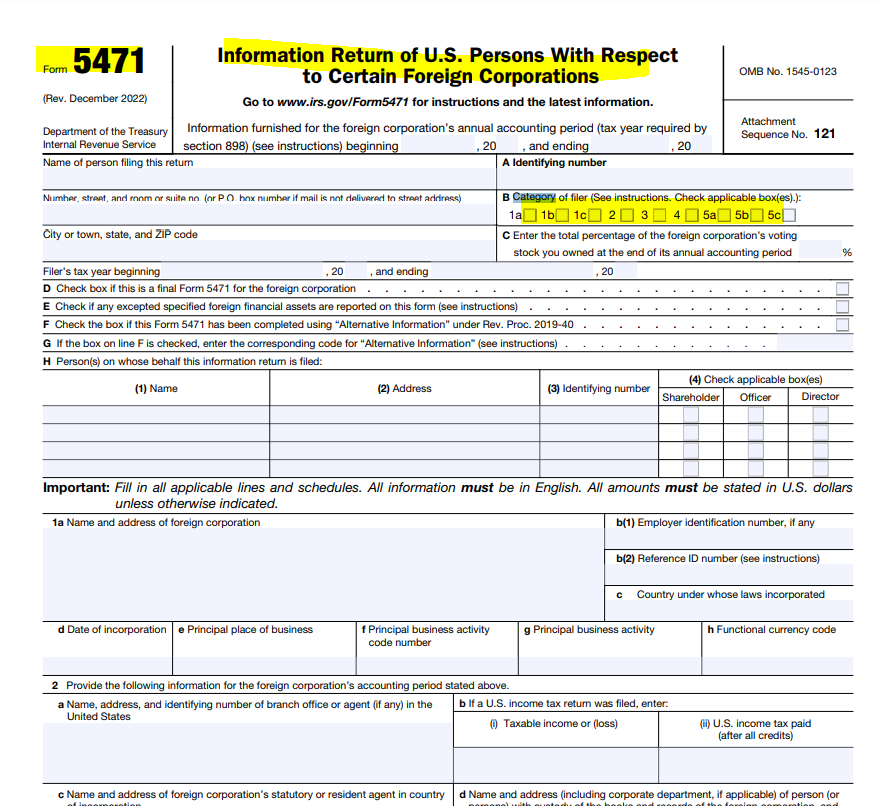
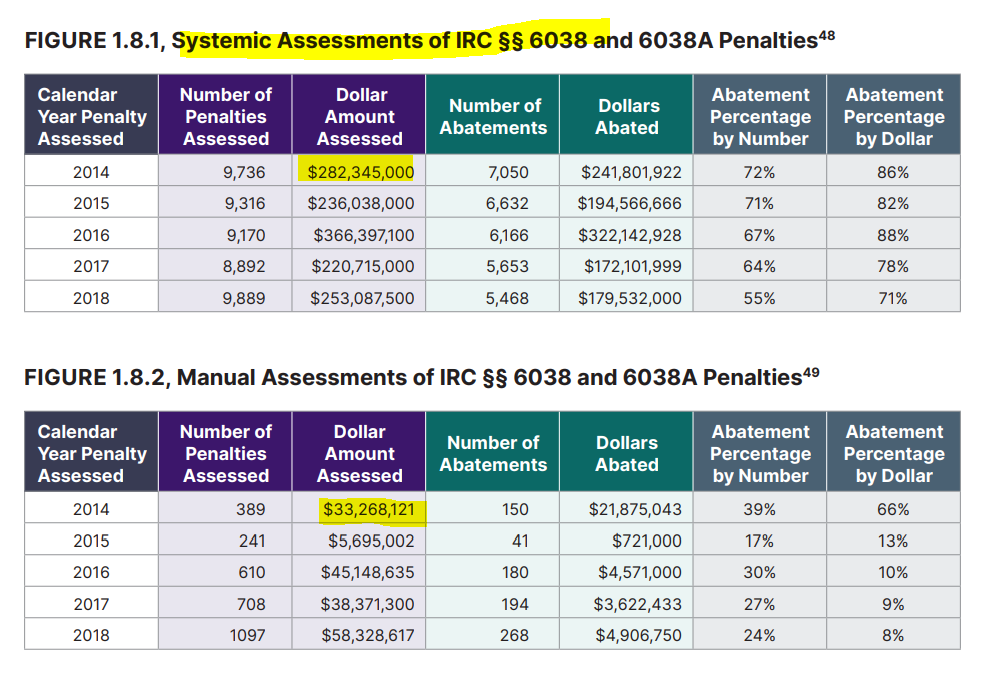
Lastly, on April 3rd, 2023, the United States Tax Court (the “Tax Court”) issued a decision in Farhy,[6] stating that the IRS does not have statutory authority to assess IIR penalties under section 6038(b). The IIR that is required by this statute is IRS Form 5471, which includes multiple filing categories. This has far reaching implications about how the government will be able to collect the IIR penalties the Service administratively determines are owed.[7] The Taxpayer Advocate previously issued a report on point titled: The IRS’s Assessment of International Penalties Under IRC §§ 6038 and 6038A Is Not Supported by Statute, and Systemic Assessments Burden Both Taxpayers and the IRS[8] In that report, the Taxpayer Advocate identified more than $310M of penalties just for the tax year 2014 the IRS “assessed” under Sections 6038 and 6038A.[9] We now know these “assessments” were invalid.
[1] See, footnote 19 regarding United States Tax Court’s Order in the case of Alberto Aroeste & Estela Aroeste vs. Commissioner.
[3] The “IRS” or the “Service” are used as shorthand for the Internal Revenue Service; and the Department of Justice; Tax Division is referred to as the “DOJ.”
[4] See, the Homeland Security, Office of Immigration Statistics – Estimates of the Lawful Permanent Resident Population in the United States and the Subpopulation Eligible to Naturalize: 2015-2019. According to the report, more than 1 million individuals become LPRs each year and 4.8 million are estimated to have died and/or emigrated. The authors have extrapolated from these estimates in the report to conclude that more than 3 million of these individuals have emigrated and left the United States. The millions of individuals do not reside in the U.S. of which Mr. Aroeste is one of these individuals; although a tax treaty must exist in the country of residence for the analysis of the District Court in Aroeste v. United States to be applicable.
[5] No. 31—1195 (U.S. Feb. 28, 2023); 598 U. S. ____ (2023); The majority opinion by Justice Gorsuch cited to the ACTEC amicus brief (where Patrick W. Martin, the author of tax-expatriation.com and a fellow of ACTEC worked on the drafting of the brief) and concluded:
“Best read, the BSA treats the failure to file a legally compliant report as one violation carrying a maximum penalty of $10,000, not a cascade of such penalties calculated on a per-account basis.” The ACTEC brief was cited by the majority opinion- “ We see evidence, too, that the point of these reports is to supply the government with information potentially relevant to various kinds of investigations, criminal and civil alike. But what we do not see is any indication that Congress sought to maximize penalties for every nonwillful mistake (whether a late filing, a transposed account number, or an out-of-date bank address). See Brief for American College of Trust and Estate Counsel as Amicus Curiae 5–7.”
[7]See, Patrick W. Martin, Megan L. Brackney, Robert Horowitz, and Javier Diaz de Leon Galarza: Problems Facing Taxpayers with Foreign Information Return Penalties, November 12, 2020.
The Number of LPRs Declined in the Corona-virus Pandemic
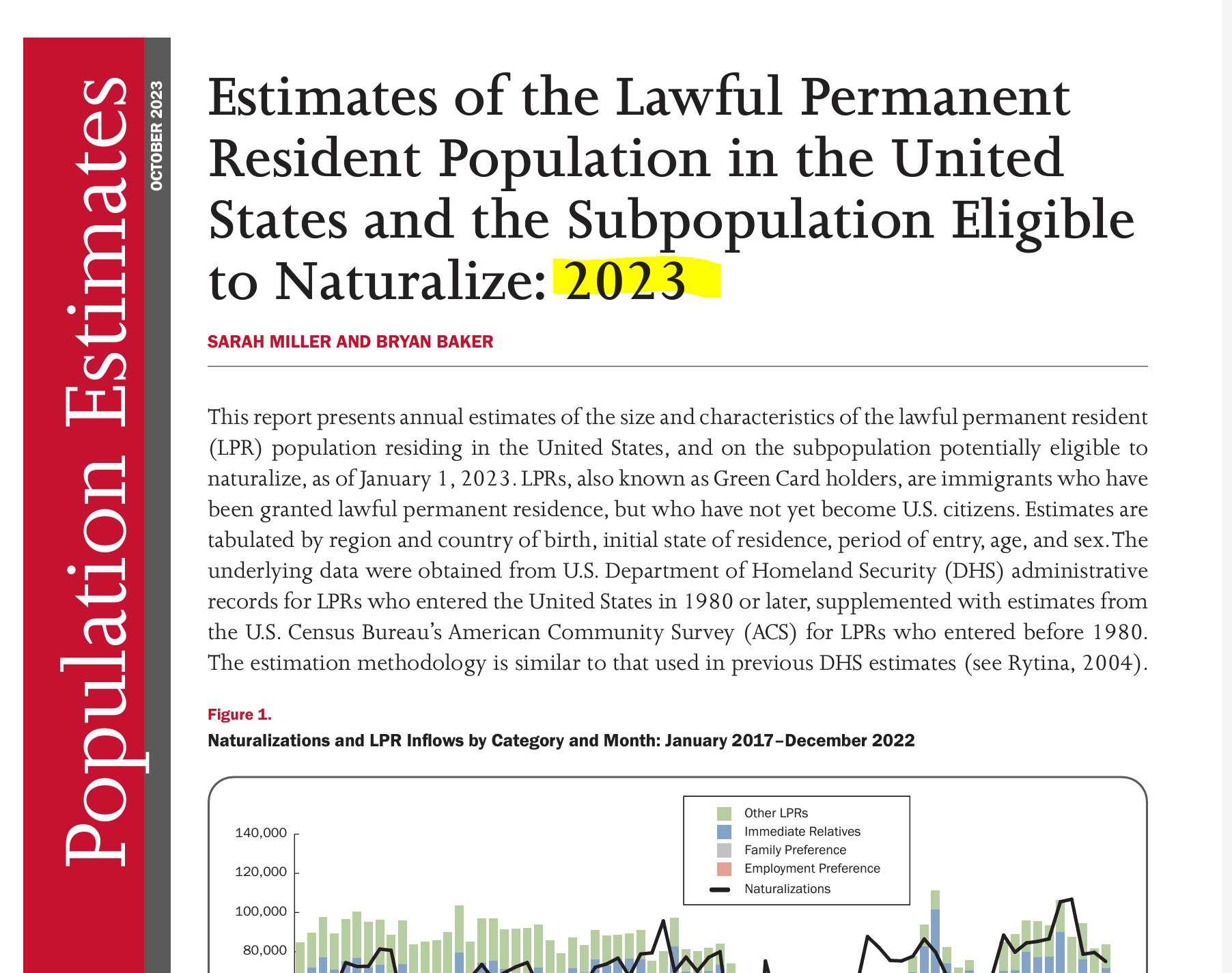
Not surprisingly, the number of new LPRs into the U.S. dropped substantially in correlation with the Corona-virus pandemic. See, the Office of Immigration Statistics, 28 Sept. 2021: Fiscal Year 2021 U.S. Lawful Permanent Residents Annual Flow Report. The Figure 1 (highlighted by me) and that report notes:
Just over 700 thousand persons became LPRs in 2020, as reduced international travel during the COVID-19 pandemic and policy changes brought new LPR admissions in 2020 to their lowest
level since 2003. The majority of these LPRs (62 percent) were already present in the United States when they were granted lawful permanent residence. A little under two-thirds (63 percent) were granted LPR status based on a family relationship with a U.S. citizen or current LPR. The leading countries of birth of new LPRs were Mexico, India, and People’s Republic of China (China). In 2020, there was a 31 percent reduction in U.S. grants of LPR status compared to 2019.
Largely due to the COVID-19 pandemic, LPR flows in 2020 were not representative of typical trends (Figure 1). Travel restrictions and processing slowdowns generally resulted in fewer inflows, while foreign-born residents within the United States also confronted immigration status-specific COVID-19 vulnerabilities.5
The key tax question for LPRs who no longer live in the U.S. (or who are planning to leave the U.S. to live in another country) is: Are they (or will they become) a so-called “long-term resident” as defined in the federal “expatriation” tax law?
IRC Section 877(e)(1) and (2) define a “long-term resident” and these paragraphs are included below in their entirety:
(1) In general
Any long-term resident of the United States who ceases to be a lawful permanent resident of the United States (within the meaning of section 7701(b)(6)) shall be treated for purposes of this section and sections 2107, 2501, and 6039G in the same manner as if such resident were a citizen of the United States who lost United States citizenship on the date of such cessation or commencement.
(2) Long-term resident
For purposes of this subsection, the term “long-term resident” means any individual (other than a citizen of the United States) who is a lawful permanent resident of the United States in at least 8 taxable years during the period of 15 taxable years ending with the taxable year during which the event described in paragraph (1) occurs. For purposes of the preceding sentence, an individual shall not be treated as a lawful permanent resident for any taxable year if such individual is treated as a resident of a foreign country for the taxable year under the provisions of a tax treaty between the United States and the foreign country and does not waive the benefits of such treaty applicable to residents of the foreign country.
The Next Post on this topic will break down the elements of –
(1) who will necessarily be a “long-term resident”?
(2) who may be “long-term resident”?
(3) what steps can be taken to necessarily avoid “long-term resident” status?
Finally, a discussion will be had in the last post in this series of some of the potential adverse tax consequences to “long-term residents” depending upon different factual scenarios.
IT AIN’T FAIR: First (1) taxing me as a U.S. citizen and then (2) taxing me on my relinquishment or renunciation of U.S. citizenship or LPR abandoment and further (3) taxing my children on their inheritance from me!@!@!
This sums up the argument of many critics of U.S. citizenship based taxation of worldwide income.
Many may agree with this conclusion from an equity or sense of fairness argument. See proposal below at the end of this post.
Also, virtually no courts of the U.S. find U.S. tax laws to be unconstitutional. It is a very rare occurrence that the U.S. Supreme Court even takes up a tax case to determine its constitutionality. The “Obamacare” with broad application throughout society was a case heard by the Supreme Court which upheld a law signed by President Obama on March 23, 2010, more correctly called the Patient Protection and Affordable Care Act. That law increased Medicare taxes and imposed a penalty surcharge on individuals who do not maintain certain health coverage.
This paper proposes to eliminate the U.S. citizenship based taxation and create a consistent exit tax system. The complex web of the current U.S. tax law has made it nearly impossible for all but the most sophisticated U.S. citizens and lawful permanent residents (“LPRs”) residing overseas to file complete and accurate tax returns. The proposal should bring consistency, tax simplicity for taxpayers residing outside the U.S., and do so in part by eliminating the U.S. citizenship based tax system, which is unique in the world, dates to the civil war and is inappropriate for the global world we live in.
Summary of Current Status of the Law
To date, there is no serious and comprehensive proposal to modify the U.S. federal tax law imposing U.S. taxation of the worldwide income of USCs and LPRs residing outside the U.S.
Unplanned Expatriation: Lawful Permanent Residents’ Deportation Risks for Filing U.S. Federal False Tax Returns
One sure way to “get expatriated” as a lawful permanent resident (even if that was not the plan) is to file a false federal tax return, statement or provide false information to the government. U.S. citizens cannot be deported for filing false tax returns, due to Constitutional rights.
Kawashima vs. Holder, (2012), is a story of a Japanese family that lived legally in the U.S. with lawful permanent residency status. According to the L.A. Times,
“Akio and Fukado Kawashima came to Southern California in 1984 as lawful Japanese immigrants determined to succeed in business. They operated popular sushi restaurants in Thousand Oaks and Tarzana and recently opened a new eatery in Encino.
But after they underreported their business income in 1991, they paid a hefty price. The Internal Revenue Service hit them with $245,000 in taxes and penalties. The couple pleaded guilty and paid in full. A decade later, the Immigration and Naturalization Service decided to deport them. . . “
The crucial mistake was the filing of a false return as defined under IRC Section 7206(1):
“(1) Declaration under penalties of perjury . . . Willfully makes and subscribes any return, statement, or other document . . . made under the penalties of perjury, and which he does not believe to be true and correct as to every material matter . . . “
The Supreme Court ruled in this case that the false return that generated a revenue loss of at least US$10,000 for the government was properly classified by the government as an “aggravated felony.” In other words, the tax returns were materially false (which the taxpayers had plead to previously) and created an unpaid tax liability of at least US$10,000. The Supreme Court cited the immigration law (Title 8) and found such an offense to be a violation of Section 1227(a)(2)(A)(iii) as an:
“(iii) Aggravated felony
Any alien who is convicted of an aggravated felony at any time after admission is deportable.
The false tax return which created a tax liability of a relatively low threshold of US$10,000 therefore carries potentially sever consequences.
While most USCs residing overseas will never be concerned about deportation (which should generally not be available to the government, due to constitutional rights of the U.S. citizen) LPRs filing tax returns will indeed want to consider carefully the implications of ” . . . any [and all tax and other] return[s], statement[s], or other document[s] . . . ” submitted to the federal government.
Also, prior posts discussed the law and risks associated with filing or sending false documents, information or returns to the Internal Revenue Service (“IRS”) –
The relevance of the Kawashima case to readers of this blog, is how a “long-term resident” may inadvertently find they will trigger the “mark-to-market” tax on their worldwide assets and later cause their U.S. beneficiaries to be subject to what is currently a 40% tax on the receipt of certain gifts and inheritances. See, prior posts on LPR status – Who is a “long-term” lawful permanent resident (“LPR”) and why does it matter?, posted August 19, 2014.
Some prior news coverage of the Kawashima v. Holder case here:
The Supreme Court rules against a couple who pleaded guilty and paid in full, saying the crime was an ‘aggravated felony’ subject to automatic deportation. Tax lawyers say the decision is ominous.
February 26, 2012|By David Savage and Catherine Saillant, Los Angeles Times
Timing Issues for Lawful Permanent Residents (“LPR”) Who Never “Formally Abandoned” Their Green Card
The “tax expatriation” statutory provisions are fraught with ambiguity and incomplete answers for those individuals who have cases that span different time periods. This is because the law has been changed numerous times over the last several years and ad hoc concepts added, including the technical concept of “long-term residents” for the first time in 1996. As has been previously explained, the first “expatriation tax” law was not adopted until 1966 as part of the The Foreign Investors Tax Act of 1966 (“FITA”) – The Origin of U.S. Tax Expatriation Law (Posted on April 6, 2014).
Next, 1996 amendments kept the basic regime but added a number of key concepts, including “long-term residents”. The changes in the law in 2004 made significant changes and in 2008 the first “mark to market” regime was adopted. Each time, the concept of “long-term residents” was maintained, but without clear thought as to the meaning and timing of “expatriation” in various cases. See, Timeline Summary of Changes in Tax Expatriation Provisions Since 1996, (Posted on April 9, 2014)
Unfortunately, none of these amendments to the law over the years carefully incorporated transition and timing rules for cases where the individual has lived in (or had U.S. citizenship or LPR) during one more of these time periods:
1966-1996
1996-2004
2004-2008
2008-present
There are many inconsistent concepts among the law and one clear example is demonstrated by an individual who became a lawful permanent resident prior to 1996 and prior to amendments in the definition of a “resident alien” which was adopted generally in the federal tax in the law in 1984. This 1984 definition was not part of any specific “expatriation tax” provisions.
Prior to 1984, a LPR was not necessarily an income tax resident of the U.S. This concept of LPR (i.e., a “green card”) driving U.S. income tax residency was adopted in 1984, long before Congress became obsessed with U.S. individual tax expatriation. For background in the law, see the 1985 Penn State Law Review Article – Internal Revenue Code 7701(b): A More Certain Definition of Resident
. . . The Act defines “lawful permanent resident” to mean an individual who has the status of having been lawfully accorded the privilege of residing permanently in the United States as an immigrant in accordance with the immigration laws, if such status has not been revoked or administratively or judicially determined to have been abandoned. Therefore, an alien who comes to the United States so infrequently that, on scrutiny, he or she is no longer legally entitled to permanent resident status, but who has not officially lost or abandoned that status, will be a resident for tax purposes. The purpose for this requirement of revocation or determination is to prevent aliens from attempting to retain an apparent right to enter or remain in the United States while attempting to avoid the tax responsibility that accompanies that right.
The logic of the LPR test is clear based upon this explanation. If one has the right to live in the U.S., they cannot avoid the tax responsibility that accompanies that right. However, as immigration lawyers will explain, there is no right to enter the U.S. after you have abandoned your LPR status and moved outside the U.S. on a permanent basis.
At the same time, there is other discussion in the report that would support the position that these provisions only apply for the years 1985 and thereafter (long after many individuals obtained LPR status, but who moved out of the country – e.g., in cases where individuals obtained LPR in the 1970s and left before 1985). Specifically, the explanation in the Joint Committee of Taxation is as follows:
. . . The purpose of this effective date rule is to delay tax resident status for only new green cardholders for a short time. Congress understood further that an alien may acquire lawful permanent resident status for immigration purposes before U.S. presence. Congress sought to impose tax resident status on all lawful permanent residents once they arrive in the United States. The Act does not affect the determination of residence, even for green card holders, for taxable years beginning before January 1, 1985.
Of course, the report by the Joint Committee on Taxation (“JCT”) is not the law and does not bind the IRS or the taxpayer. However, the JCT usually get their explanations of the law right.
Why is all of this important for LPRs who never formally abandoned their “green card”? The IRS might well try to argue they never terminated their U.S. federal income tax residency for purposes of the “tax expatriation provisions”, as later versions of the statute impose an obligation to notify the IRS. If the individual never notified the IRS, the government might ar
See, for instance Section 7701(b)(6) with specific rules for LPR individuals who live in a country with a U.S. income tax treaty. Importantly, the definition of a lawful permanent resident for tax purposes (as defined in Section 7701(b) ) is not identical to the definition for immigration law purposes as the legislative history to the 1984 amendments to the law explains.
Coming Back to the U.S. as a Permanent Resident (“Repatriating”)?
As discussed in the last post, this post addresses immigration law exclusively by a guest post writer, Ms. Teodora Purcell. She provides a good overview of EB-5 visas and the current law and likely changes in the near future.
***************************
The Pros and Cons of the EB-5 Immigrant Investor Program
The EB-5 Immigrant Investor program was created by the Immigration and Nationality Act (“INA”) of 1990 to stimulate the US economy through capital investments made by foreign investors to create jobs. It attracts capital by facilitating US permanent resident status (aka “green card”) for foreigners who make a $1 million USD (or in some cases, $500,000 USD) investment in an eligible business that results in at least ten US jobs and benefits the US economy.[1]
The pros of the EB-5 program to the US are evident from the numbers. In FY 2014, 10,928 EB-5 petitions were filed with the United States Citizenship and Immigration Services (“USCIS”), 5,115 approved, and 12,453 pending, which translates into over $2.5 billion approved for investment and an additional $6.2 billion in capital awaiting federal adjudication, and the creation of thousands of US jobs.[2] EB-5 capital is also an attractive low cost funding tool for project developers in the US, while it offers the foreign investor a path to permanent residency that is not visa backlogged and does not require sponsorship by a US employer or relative. But is the EB-5 an easy and quick way “to purchase your green card”?
Basic EB-5 Requirements
The EB-5 program includes two separate avenues: (1) Direct EB-5 investment – where the investor invests in an enterprise and plays a role in management or policy making, which will directly create ten jobs, or (2) Regional Center based EB-5 investment – where the investor invests in a USCIS approved regional center and plays a more passive role by having policy making authority. Both require: (1) the investment to be made in a for-profit, new commercial enterprise;[3] (2) a contribution of capital at risk in the amount of $1,000,000 USD, or $500,000 USD[4] if the business is in a targeted employment area (i.e. high unemployment or rural area), aka “TEA”;[5] (3) the investment to be used for creation of at least ten full time jobs for US workers;[6] and (4) the investor to establish the path and the lawful source of the investment.
Pros and Cons of Direct and Regional Center EB-5 Investments
The Regional Center (“RC”) is an entity designated and regulated by USCIS, which pools EB-5 capital from multiple foreign investors in job-creating economic development projects within a defined geographic region and designated industries.[7] USCIS has approved approximately 600 RCs[8] and 95% of the EB-5 petitions are based on a RC investment. Notably, EB-5 RC investment funds are subject to U.S. securities and anti-fraud laws and regulations,[9] and the Securities Exchange Commission (SEC) and USCIS are raising awareness of how the EB-5 program can be misused and of the importance of proper due diligence to be conducted by foreign investors.[10]
The direct EB-5 program is permanent, whereas the RC EB-5 program sunsets on September 30, 2015, but is expected to be reauthorized by Congress for another five years, and there is proposed legislation to make it permanent.[11] The most recent bipartisan bill on the RC EB-5 program, The American Job Creation and Investment Promotion Reform Act, was introduced on June 3, 2015, known as The Leahy-Grassley Bill.[12] The proposed legislation would reauthorize the EB-5 RC program until September 30, 2020, rather than make it permanent, and will provide an overhaul of reforms to improve the program’s integrity, including raise the requirement investment amount to $800,000/ $1,200,000, respectfully.[13]
With the direct EB-5 investment, the foreign national accomplishes not only an immigration purpose but also a purpose of investing in a business that he or she runs and that may provide significant return, whereas with the RC EB-5 investment, the rate of return is typically 0.5-2% and the investor plays a more passive role. However, the direct EB-5 investor must prove direct employment of ten U.S. workers, whereas, with RC EB-5 investment, the job creation is shown by a combination of direct, indirect and induced employment using reasonable economic methodologies. Most (but not all) RCs are located in $500,000 TEAs but there can be direct EB-5 investments that also qualify for the reduced capital. Both EB-5 options require the investor to be engaged in the “management” of the enterprise, which can be satisfied if the investor is a limited partner with the rights, powers and duties normally granted to limited partners under the Uniform Limited Partnership Act.[14] Which EB-5 option to choose requires an individualized analysis of the investor’s circumstances and goals.
No Fast Track EB-5 Process and No Guaranteed US Permanent Residence
The EB-5 investors are not guaranteed a green card because of the lengthy process and possibility that the project in which they invest could fail or undergo material changes, and there is no expedite processing of EB-5 petitions. The process starts with the filing of an I-526 immigrant entrepreneur petition with USCIS, in which the investor must establish the lawful source of funds, document the path of the required investment, and show that the ten US jobs will be created within two years,[15] or that the jobs have already been created as a result of the investment.
The filing of an I-526 petition alone does not give the investor the right to stay or work in the US. Current I-526 average processing time is approximately 14 months and the I-526 approval does not give the investor permanent residence. Rather, after the approval, if the investor is outside the US, he or she and dependent family members will apply for their immigrant visas at the US Consulate in their home country, which requires additional documentation, security checks and adds another 6-12 months to the process. If the investor is in the US in valid nonimmigrant status, he or she will adjust status to permanent resident in the US, which takes about six months.[16] So after 2-3 years (provided no visa retrogression), the investor receives a green card that is conditional and valid for only two years.
Within 90 days of the conditional green card expiration (i.e. between the 21 to 24 month after the green card approval), the investor must file an I-829 application to remove the condition on permanent residence with USCIS[17], and prove that the investment has been sustained and that the requisite jobs have been created or will be created within a “reasonable time.”[18] The current average I-829 processing time is 10 months and if unsuccessful, the EB-5 investor may not only lose the green card but end up in removal proceedings. If the I-829 is approved, the EB-5 investor receives his or her permanent green card. During this process, the EB-5 investment must remain in the enterprise until the condition is removed (i.e. for 4-5 years), whereas in all other employment based green card categories, the result is a permanent green card and no such significant financial commitment is required.
The EB-5 program accounts for less than 1% of the immigrant visas issued annually by the US and throughout the process, investors are subject to the same background checks as applicants in any other visa category, and their ability to eventually apply for citizenship is the same as others. The INA allocates 10,000 EB-5 immigrant visas, of which 3,000 are reserved for the RC program, and no more than 7 percent of the visas can be allocated to any one country.[19] Since close to 85% of the investors are from China, for the first time in September 2014, the EB-5 visas became unavailable for Chinese nationals, and EB-5 visa backlog for Chinese investors may be expected in 2015. There are more significant immigrant visa quota backlogs in other categories of family and employment-based immigration, which is why the EB-5 still remains attractive.
EB-5 and Other Green Card Options
Despite the challenges investors may face in tracing the invested funds or in the job creation, and the possibility of visa backlog for some, the EB-5 is still a good option, although it is not the panacea for all foreign nationals seeking permanent residence in the US. There are other employment based visa options that may be available for the investor and these alternatives, if successful, lead to a permanent green card, do not require placement of a $1,000,000 investment at risk, and there are minimal concerns about visa availability. For the foreign nationals who choose the EB-5 green card avenue, it is important to put together a competent team that includes an immigration counsel, as well as business, tax, and securities counsels, to advise on the multiple complex issues that go into determining whether the EB5 green card path is the right choice for the client.
Immigrant investors and entrepreneurs bring substantial value to the United States, not only through the capital they deploy or the jobs they create, but also with the knowledge and experience they bring to US businesses, and working with such clients is very rewarding.
[1] The immigration EB-5 laws can be found at INA§203(b)(5); 8 CFR§204.6 and 8 CFR§216.6.
[6] 8 CFR §§204.6(e) & (j)(4). The USCIS deems the two year period to commence six months after the adjudication of the I-526 petition. See USCIS Policy Memorandum (May 30, 2013)
[9] The interest being offered and sold in an EB-5 offering by regional centers constitute securities. See Securities Act of 1933; Securities Exchange Act of 1934.).
[13]If implemented, the Leahy-Grassley legislation will have a significant impact on Regional Centers and investors alike, some of the most notable changes proposed to the EB-5 Program include: (1) Raise the minimum investment amount for all EB-5 investors to $800,000 for TEAs and $1,200,000, respectively; (2) Establish an “EB-5 Integrity Fund” to cover the costs associated with audits and site visits to detect fraud in the United States and abroad; (3) Increased oversight of TEA designation; (4) Expanded USCIS authority to terminate Regional Center designation; (5) Establish a premium processing option to expedite USCIS adjudication of EB-5 petitions at an additional filing fee.
[15] The USCIS requires that the I-526 petition be accompanied by a detailed and credible business plan compliant with the requirements in the precedent decision of Matter of Ho, 22 I&N Dec. 206 (INS Assoc. Comm’r, Examinations, 1998).
[18] 8 CFR §216.6(a)(4)(iv) . In its May 30, 2013 Policy Memorandum, USCIS has interpreted “reasonable time” to mean one year, starting at the end of the conditional residence period.