IRS Beats the Drums – Re: Foreign Assets, Just Days Before April 15
The IRS is not letting up regarding USCs and LPRs living outside the U.S. Quite the opposite, the most recent announcement of the IRS released yesterday on April 11th, emphasizes the U.S. tax law requirements and their applicability to these individuals.
Specifically, the IRS reiterates as follows in IR-2014-52 – IRS Reminds Those with Foreign Assets of U.S. Tax Obligations:
- The Internal Revenue Service reminds U.S. citizens and resident aliens, including those with dual citizenship who have lived or worked abroad during all or part of 2013, that they may have a U.S. tax liability and a filing requirement in 2014.
- The filing deadline is Monday, June 16, 2014, for U.S. citizens and resident aliens living overseas, or serving in the military outside the U.S. on the regular due date of their tax return. Eligible taxpayers get one additional day because the normal June 15 extended due date falls on Sunday this year. To use this automatic two-month extension, taxpayers must attach a statement to their return explaining which of these two situations applies. See U.S. Citizens and Resident Aliens Abroad for details.
The April 11th date of the notice is ironic, since it is on the eve of the filing deadline for individuals who live within the U.S. Surely, the IRS wants to bring attention to these legal requirements days before the April 15th deadline for those residing in the U.S.
The irony is that the tax law does not require USCs or LPRs who live outside the U.S. and have U.S. tax filing obligations to file by April 15th. The deadline for these individuals who live outside the U.S. is not until June 15th as explained in the IRS notice (June 16th in 2014, since the 15th falls on a Sunday).
In this notice, the IRS does not emphasize the draconian penalties that befall these taxpayers for not filing international information returns or FBARs. The minimum civil penalties for failures to file these forms is almost always at least US$10,000. See, USCs and LPRs Living Outside the U.S. – Key Tax and BSA Forms.
Next, the due date for filing of FBARs is not the same as the due date for income tax returns, June 15th, but always falls on June 30th. There is no extension for FBARs, unlike income tax returns. See, Nuances of FBAR – Foreign Bank Account Report Filings – for USCs and LPRs living outside the U.S.
Will the IRS publish another notice, or beat more drums on the eve of the June 15th (16th for 2014) filing deadline for USCs and LPRs living outside the United States?
???????????????? ?Please click here to view the above in Chinese.?
Nuances of FBAR – Foreign Bank Account Report Filings – for USCs and LPRs living outside the U.S.
USCs and LPRs who reside exclusively outside the U.S. are nevertheless subject to reporting in the U.S. of their bank and financial accounts within their country of residence (or any other accounts in another country outside the U.S.). For instance, a USC residing in France with accounts in London and Geneva is subject to these reporting requirements, in addition to her accounts in France.
A LPR residing in Sao Paulo, Brazil with accounts in Brazil and Uruguay are also subject to these reporting requirements for the Brazilian and Uruguayan accounts.
The law is obligatory. See, FOREIGN BANK ACCOUNT REPORTS – 2011 REGULATIONS EXTEND RULES TO MANY UNAWARE PERSONS, published in the International Tax Journal.
Specifically, Title 31, Section 5314 imposes the reporting requirement. The Title 31 regulations used an entirely different law, Title 26 – the Internal Revenue Code, and its definition of who is a “resident” contained in Internal Revenue Code Section 7701(b). Some have questioned the legal authority of the Treasury Department’s ability to utilize provisions of one federal statute and incorporate it into a completely different federal statute, without having statutory authority to do so.
Nevertheless, there are some key provisions in the law worth taking note:
1. Statute of Limitations. There is a statute of limitations whether or not an FBAR was filed. Hence if a USC neglected to file an FBAR for the year 2006, for instance, the time period for the government to assess penalties has lapsed. See, When does the Statute of Limitations Run Against the U.S. Government Regarding FBAR Filings?
2. Duplicate Reporting. FBARs are often duplicate with tax provision reporting – specifically, IRS Form 8938. See,USCs and LPRs Living Outside the U.S. – Key Tax and BSA Forms and USCs and LPRs residing outside the U.S. – and IRS Form 8938
3. No Statute of Limitations. Although the law that creates FBARs does have a statute of limitations, there is no time limit against the IRS to assess income taxes and tax penalties when the taxpayer does not file tax information returns, such as IRS Form 8938.
4. FBAR Penalty is Elective. The imposition of the FBAR penalty is not mandatory under the statute, which provides the government the power to may [not shall] assess a penalty. The relevant statutory provision is that “The Secretary of the Treasury may impose a civil money penalty on any person who violates, or causes any violation of, any provision of section 5314.” 31 U.S.C. Section 5321(a)(5)(B)
5. Collection Mechanism by Government is Limited. The collection of the FBAR penalty is not as easily collected under the law, as is a tax claim. A Title 26 tax lien and levy claim against the taxpayer’s property cannot be used to collect an FBAR penalty. Instead, the government has rights of set-off and will typically be required to bring a judicial action in Court to enforce the penalty assessment. See, U.S. vs. Williams, where the government sued to collect the 50% FBAR willfulness penalty.
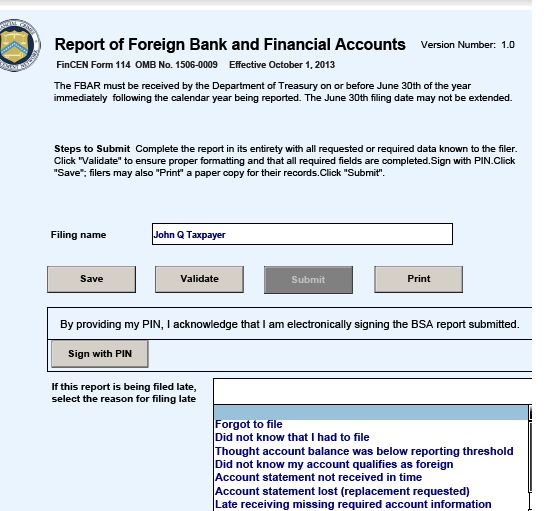
6. All FBARs must now be filed electronically. The filing of the FBAR form is not with the IRS, but rather with FinCEN. It must now be filed electronically on Form 114, Report of Foreign Bank and Financial Accounts through the BSA E-Filing System website. The electronic form supersedes TD F 90-22.1 (the FBAR form that was used in prior years).
For a good overview of additional aspects of the law, see, Jack Townsend’s federal tax crimes blog and the guest blog written by Robert Horowitz – Guest Blog: Litigating the FBAR Penalty in District Courts and Court of Federal Claims (3/31/14)
???????????????? ?Please click here to view the above in Chinese.?
USCs and LPRs residing outside the U.S. – and IRS Form 8938
By definition, anyone who does not live in the United States will have assets in their home country. Their value and amount may not be significant, but ownership of assets of various kinds is of course routine for all persons.
I have put a number of posts regarding FBARs – foreign bank account reports. See, When does the Statute of Limitations Run Against the U.S. Government Regarding FBAR Filings? and USCs and LPRs Living Outside the U.S. – Key Tax and BSA Forms
In addition, IRS Form 8938 is the form where USCs and LPRs (those who are “resident aliens” by definition) must report so-called “specified foreign financial assets.”
These include shares, partnership interests, investment accounts, bank accounts, etc. This reporting requirement started in 2012 for the years 2011 and hence is relatively new.
In addition to the asset type, any income and gains from the sale of the asset must be reported. There are detailed items of information that must be reported on this form.
One of the practical problems taxpayers always have, is making sure their tax return and the information they reported on it and the plethora of forms (such as Form 8938) is “complete and accurate”. A return which is not, is always subject to potential attack by the IRS. See, What could be the focal point of IRS Criminal Investigations of Former U.S. Citizens and Lawful Permanent Residents?
Next, the civil penalties for failing to file IRS Form 8938 is US$10,000 for each violation that can increase to US$50,000 after notification by the IRS. It’s an area you do not want to make a mistake – which can be costly.
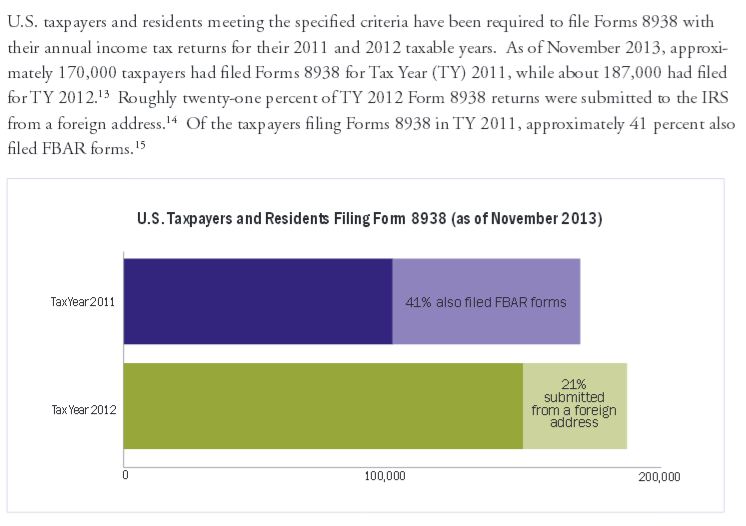
The Taxpayer Advocate Report provides a graphical showing of how many taxpayers filed both IRS Form 8938 and the FBAR. The point is that filing one form, does not relieve the USC or LPR from also filing the other form. If they both apply, they both must be filed under the law.
See, 2014 Taxpayer Advocate Report – Re: Expanded Reporting Obligations and IRS Form 8938 (FATCA – specified foreign financial assets)
???????????????? ?Please click here to view the above in Chinese.?
Sir Winston Churchill – Famous People. Did he become a U.S. citizen at birth via “derivative citizenship”? Did he file U.S. income tax returns?
The U.S. tax law imposes federal tax on all worldwide income of any U.S. citizen no matter where they reside. Sir Winston Churchill, was the famous Englishman who was credited with helping defeat the Axis powers in World War II. He became Prime Minister during that War.
 Sir Winston Churchill’s mother was born Jeannette Jerome in Brooklyn, New York. His mother later became known as Lady Randolph Churchill and would have been a U.S. citizen by virtue of her birth in the United States pursuant to the 14th Amendment (Section 1) of the U.S. Constitution. However, the 14th Amendment was adopted after her date of birth.
Every individual, such as Winston Churchill who was born to a parent who was a U.S. citizen must consider whether they too are also a U.S. citizen by the concept known as “derivative citizenship“; i.e., “derived” from a U.S. citizen parent. The U.S. Citizenship and Immigration Services (USCIS) has a “Nationality Chart 1, for Children Born Outside U.S.” to help determine if the individual was a U.S. citizen at birth.
Having “derivative citizenship” means the individual became a citizen at birth, even if no (i) Application for Certificate of Citizenship (Form N-600) or (ii) U.S. passport (Form DS-11: Application For A U.S. Passport) is ever applied for by the individual.
In addition, Winston Churchill was granted honorary citizenship of the United States during his lifetime. Was he already a U.S. citizen by virtue of his mother?
Did he ever file U.S. income tax returns? Did he die owing U.S. income taxes to Uncle Sam?
If he was a U.S. citizen, he would have also been subject to U.S. estate taxes on his worldwide estate. Did his executor ever file U.S. estate tax returns when there was only a US$60,000 exemption and a top estate tax rate of 77%?
At least, fortunately for Sir Winston Churchill, the law of FBARs was not created until 1970, some 5 years after his death in 1965.
See, When does the Statute of Limitations Run Against the U.S. Government Regarding FBAR Filings?
???????????????? ?Please click here to view the above in Chinese.?
Was Mother Teresa a “U.S. person” under the Internal Revenue Code subject to worldwide income taxation and FBAR reporting?
Mother Teresa was named an honorary citizen by a proclamation of the U.S. President and an act of Congress. 
Mother Teresa received her honorary citizenship while she was still living in 1996 pursuant to Public Law 104-218.
Did Mother Teresa need to file FBARS (foreign bank account reports) for the accounts in India and throughout the world where she oversaw non-profit organizations and had “signature authority over” such accounts? The FBAR filing requirement has been around since 1970, although only in the last few years have individuals and the U.S. federal government become aware and enforced it vigorously.
Fortunately, for Mother Teresa and the executor of her estate, there was a 6 year statute of limitations against an assessment of FBAR penalties against her individually, over such non-U.S. accounts. When does the Statute of Limitations Run Against the U.S. Government Regarding FBAR Filings?
Assume, however, that her Missionaries of Charity that operated in over 100 countries had some 50 accounts in countries outside the U.S. where Mother Teresa had signature authority over such accounts in 1996. In such a scenario, since Mother Teresa was an “honorary citizen” during that year, she presumably was a “U.S. person” under Section 7701 of the Internal Revenue Code. She would therefore also have been subject a host of other tax and filing requirements as a U.S. citizen. See USCs and LPRs Living Outside the U.S. – Key Tax and BSA Forms.
Would she have had a legal defense (e.g., “reasonable cause”) for not being subject to the US$10,000 civil penalty per account for each failure to file the FBAR? In this example, 50 accounts multiplied by US$10,000 per account equals US$500,000 of civil penalties per year for failure to file.
The law is obligatory. See, FOREIGN BANK ACCOUNT REPORTS – 2011 REGULATIONS EXTEND RULES TO MANY UNAWARE PERSONS, published in the International Tax Journal. Specifically, 31 Section 5314 imposes the reporting requirement. Fortunately (or unfortunately) for individuals like Mother Teresa, the actual imposition of the penalty is in the hands of the government, since the statute provides in relevant part –
“The Secretary of the Treasury may impose a civil money penalty on any person who violates, or causes any violation of, any provision of section 5314.” 31 U.S.C. Section 5321(a)(5)(B)
Sounds crazy – but it is the law and life in the U.S.
*
As Mother Teresa said –
. . . La vida es misterio, devélalo.
La vida es promesa, cúmplela.
La vida es tristeza, supérala.
La vida es himno, cántalo.
La vida es combate, acéptalo.
La vida es una tragedia, domínala.
La vida es aventura, arrástrala.
La vida es felicidad, merécela.
La vida es la vida, defiéndela.
???????????????? ?Please click here to view the above in Chinese.?
When does the Statute of Limitations Run Against the U.S. Government Regarding FBAR Filings?
The law that created the foreign bank account report (“FBAR”) filings is different from the federal tax law. The tax law is Title 26 and the Bank Secrecy Act, which creates FBAR requirements is Title 31. The laws are very different and have very different obligations and rights.
One of the important differences, is the time frame in which the government can assess penalties. This law, according to its expansive terms (some would say extraterritorial application) applies to United States citizens residing outside the U.S. It also applies to most LPRs residing outside the U.S. See, FOREIGN BANK ACCOUNT REPORTS – 2011 REGULATIONS EXTEND RULES TO MANY UNAWARE PERSONS, published in the International Tax Journal.
The statute of limitations is the time frame in which the government has to asses penalties for not complying with the law. These time periods are different under Title 31 versus Title 26.
The failure to file an income tax return, means the time period against the IRS to make tax assessments against the USC or LPR residing overseas will never lapse. See, When the U.S. Tax Law has no Statute of Limitations against the IRS; i.e., for the U.S. citizen and LPR residing outside the U.S.
In contrast, Title 31 the Bank Secrecy Act, does have a time period against the U.S. federal government, even if the FBAR was never filed. The time period for civil assessments of penalties is 6 years. Importantly, a USC or LPR living overseas could become criminally liable for willfully not filing such FBAR form, which has different legal consequences.
All FBARs must now be filed electronically. The filing of the FBAR form is not with the IRS, but rather with FinCEN. It must now be filed electronically on Form 114, Report of Foreign Bank and Financial Accounts through the BSA E-Filing System website. The electronic form supersedes TD F 90-22.1 (the FBAR form that was used in prior years).
The laws of many countries outside the U.S. often conclude that the enforcement of these FBAR penalties in the home country of the USC violates the laws of that country (e.g., Canada). See the thoughtful article of Calgary based tax attorney Roy Berg – IRS says FBAR penalties not collectible under Canada-US Treaty?
Finally, there are also statute of limitations for criminal charges brought by the government for FBAR violations. The law gets much more complex in this area, including if the taxpayer is residing outside the U.S.; where the time period can be tolled/suspended in favor of the government. See, Jack Townsend’s thoughts –
???????????????? ?Please click here to view the above in Chinese.?
Read the Q&A format here.
Will the Justice Department and Criminal Investigation Division of the IRS Turn Their Sights on USCs or LPRs living Overseas?
To date, there have been numerous indictments of non-U.S. resident persons in the “offshore financial account world” which has been a great focus of the U.S. federal government starting in 2008. An updated list of indictments of these persons can be found at Jack Townsend’s federal tax crimes blog here where he keeps a spreadsheet of cases.
To date, the author is not aware of any tax indictments (solely based upon a tax crime) of any United States Citizens or LPRs who have lived most all of their lives overseas. Is this an anomaly? Will the government be interested in bringing criminal charges against non-resident USCs or LPRs in the future?
Those persons living outside the U.S. who have been indicted (typically for conspiracy/aiding and abetting charges) have been so-called enablers; non-U.S. bankers, lawyers and accountants. Some of these cases can also be reviewed at at the federal tax crimes blog of Jack Townsend, which is the most comprehensive source of this information.
???????????????? ?Please click here to view the above in Chinese.?
USCs and LPRs Living Outside the U.S. – Key Tax and BSA Forms
U.S. citizens and Lawful permanent residents living outside the U.S. generally have additional tax and financial account (from the Bank Secrecy Act – “BSA”) reporting requirements. These filings are unique for persons who reside in their home country compared to those who reside in the U.S.
The forms and basic concepts that may be applicable are as follows:
A) Foreign Earned Income Exclusion –
The IRS explains the confusion that commonly exists from this form, which is only available from so-called “earned” income (not passive investment type income):
A common misconception that contributes to the international tax gap is that this potentially excludable foreign earned income is exempt income not reportable on a US tax return. In fact, only a qualifying individual with qualifying income may elect to exclude foreign earned income and this exclusion applies only if a tax return is filed and the income is reported.
In addition to filing a U.S. tax return, the taxpayer must meet the residency tests and file IRS Form 2555, Foreign Earned Income
B) Foreign Tax Credits
A credit is a “dollar for dollar” (subject to various limitations) reduction in the federal tax burden for taxes paid in another country for income sourced in that country.
Importantly, as the government explains, ” . . . Once you choose to exclude either foreign earned income or foreign housing costs, you cannot take a foreign tax credit for taxes on income you can exclude. If you do take the credit, one or both of the choices may be considered revoked. . . ”
In addition to filing a U.S. tax return, the taxpayer must meet various conditions for eligibility for the foreign tax credit. The calculation is complex and is ultimately reported on IRS Form 1116 and must be attached to the income tax return, which will always be IRS Form Form 1040 for U.S. citizens and LPRs who reside in a country with no U.S. income tax treaty; and could be IRS Form 1040NR for certain LPRs residing in a country with a U.S. income tax treaty.
C) Information Reporting Requirements
There can be multiple reporting requirements, depending upon the type of transaction, foreign asset, etc.
A summary of these reporting requirements is set forth towards the end of the article “Accidental Americans” – Rush to Renounce U.S. Citizenship to Avoid the Ugly U.S. Tax Web” International Tax Journal,CCH Wolters 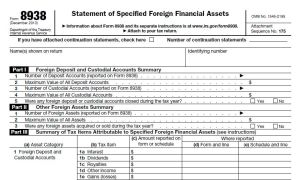 Kluwer, Nov./Dec. 2012, Vol. 38 Issue 6, p45.
In addition to the forms reflected in the article, IRS Form 8938 Statement of Specified Foreign Financial Assets became part of the law for 2011 tax year filings in 2012. There is often overlap of reporting on this form and the FBAR referred to below.
This form 8938, along with most other forms must be attached to your income tax return (e.g., IRS form 1040) when filed with the IRS. It is common for most types of tax preparation software NOT to have support for this and other particular forms that must be filed regarding non-U.S. assets. Accordingly, the forms often times need to be completed manually by using an Adobe Acrobat version.
D) Foreign Bank Account Reports (“FBAR”)
The definition of “ownership interest in” or “signature authority over” is very broad under the FBAR regulations. See, FOREIGN BANK ACCOUNT REPORTS – 2011 REGULATIONS EXTEND RULES TO MANY UNAWARE PERSONS
The filing of the FBAR form is not with the IRS, but rather with FinCEN. It must now be filed electronically on Form 114, Report of Foreign Bank and Financial Accounts through the BSA E-Filing System website. The electronic form supersedes TD F 90-22.1 (the FBAR form that was used in prior years).
The penalties for not filing or even filing late are by statute $10,000 for each failure to file (or up to 50% of the account balances when intentionally not filed by the person with the requirement to file).
* Simply More Compliance Obligations for Persons Residing Outside the U.S.
At the end of the day, a USC or LPR residing outside the U.S. necessarily has a much greater burden of tax compliance and filings of these forms, compared to someone living in the U.S. without foreign bank accounts, foreign assets, foreign income, etc.
???????????????? ?Please click here to view the above in Chinese.?
Mixed Messages – U.S. Ambassador to Canada vs. IRS Commissioner
The apparent renewed focus of the government on U.S. citizens and LPRs residing overseas is worth considering in the current environment.
I wrote an article that was published back in Jan-Feb 2012 in the International Tax Journal titled Unsettled Future for U.S. Taxpayers Residing Overseas: Mixed Messages from IRS Commissioner vs. Ambassador—Part I
The article explains the contradictory statements of David Jacobson, then U.S. Ambassador to Canada and then IRS Commissioner Shulman. See page 33 of the article, which provides as follows:
More troubling and problematic is the mixed
message sent to U.S. citizens residing overseas,
including by David Jacobson, the U.S. Ambassador
to Canada who stated in a recent interview:
“What the IRS is saying here is that if … you don’t
owe taxes to the U.S., and you file your return and
they show you don’t owe taxes, there aren’t going
to be any penalties for having filed late.” Is that
what the IRS is really saying? The short answer is
a resounding “NO”! The IRS spoke a few days
after the Ambassador’s comments when it issued a
statement entitled, Information for U.S. Citizens or
Dual Citizens Residing Outside the U.S. In the IRS
statement, they indicate that taxpayers who do not
owe any U.S. taxes “ … due to the application of
the foreign earned income exclusion or foreign tax
credits) will owe no failure to file or failure to pay
penalties. In addition, no FBAR penalty applies in
the case of a violation that the IRS determines was
due to reasonable cause.” [Emphasis added.]
There are a number of problems USCs and LPRs living overseas face regarding the application of U.S. law and whether they have filed U.S. income tax returns, FBARs or information returns, such as IRS Form 5471, 3520, 8858, etc. These problems include:
1. The IRS makes the determination of whether there is “reasonable cause” when no FBARs were previously filed. The IRS has not attempted to articulate in any real detail, what they view as “reasonable cause.” This is not a determination by the taxpayer. Will one know it when they see it?
2. USCs and LPRs living outside the U.S. can be subject to the FBAR penalties even if no U.S. income tax is owing (e.g., due to the foreign earned income exclusion and/or foreign tax credits). Each of these individuals have to track the exchange rate applicable in their home country of residence to know if and when the U.S. dollar thresholds in the U.S. law are met.
3. The FAQs 17 and 18 provide solace to USCs and LPRs residing outside the U.S. only if they ” . . . reported, and paid tax on, all their taxable income for the prior years but did not file FBARS . . . ” Of course, the school teacher in the IRS’s own example in IRS Example 1 and 2 did not have an account that ever reached the equivalent of US$10,000. If the school teacher in the IRS example did have such an account, even for a day, she would not fall within the “free on base” rule that the IRS will not assess an FBAR penalty. That “free on base rule” is only applicable when ” . . . The IRS will not impose a penalty for the failure to file the delinquent FBARs if there are no underreported tax liabilities and you have not previously been contacted regarding an income tax examination or a request for delinquent returns. . . ” In example 2, there is an unreported tax liability of $2,100. Hence, according to the IRS analysis the school teacher can be subject to a $10,000 FBAR failure to file penalty, even if the income tax is paid of $2,100, if the IRS determines the late FBAR filing was not due to “reasonable cause.”
4. A published 2012 District Court opinion, McBride, held the taxpayer was liable for FBAR penalties even if the taxpayer had no actual knowledge. The facts of that taxpayer were very bad in the case of McBride, yet the conclusions of the Court and statements below, give little comfort to USCs and LPRs residing overseas who have not filed FBARs, that the government might assess large FBAR penalties (the 50% willfulness penalty of the highest account balance in the case of McBride):
. . . The government does not dispute that McBride’s failure to comply with FBAR was the result of his belief that he did not have a reportable financial interest in the foreign accounts. However, because it is irrelevant that McBride “may have believed he was legally justified in withholding such information[,] [t]he only question that remains is whether the law required its disclosure.” Lefcourt, 125 F.3d at 83. Here, the FBAR requirements did require that McBride disclose his interests in the foreign accounts during both the 2000 and the 2001 tax years. As a result, McBride’s failure to do so was willful. . .
* * *
A. Constructive Knowledge of the Reporting Requirement Is Imputed to Taxpayers Who Sign Their Federal Tax Returns.
All persons in the United States are charged with knowledge of the Statutes-at-Large. Jones v. United States, 121 F.3d 1327 (9th Cir. 1997) (citing Bollow v. Federal Reserve Bank, 650 F.2d 1093, 1100 (9th Cir.1981)). It is well established that taxpayers are charged with the knowledge, awareness, and responsibility for their tax returns, signed under penalties of perjury, and submitted to the IRS. Magill v. Comm’r, 70 T.C. 465, 479-80 (1978), aff’d, 651 F.2d 1233 (6th Cir. 1981); Teschner v. Comm’r, T.C. Memo. 1997-498, *17 (1997); accord United States v. Overholt, 307 F.3d 1231, 1245-46 (10th Cir. 2002) (observing that in Bryan v. United States, 524 U.S. 184, 194-95 (1998), the Supreme Court distinguished cases like Cheek v. United States, 498 U.S. 192 (1991) and Ratzlaf v. United States, 510 U.S. 135 (1994) from another context of willfulness on the grounds that the “highly technical statutes” involved in criminal tax prosecutions “carve out an exception to the traditional rule that ignorance of the law is no excuse and require that the defendant have knowledge of the law.”) (internal quotation marks and citations omitted); see also Am. Vending Group, Inc. v. United States, 102 A.F.T.R.2d 6305, *6 (D. Md. 2008) (“Failing to read does not absolve a filer of his or his corporation’s legal obligations. Of course if one does not read the instructions, one does not know of the obligation to file the informational returns.”). . .
* * *
Is the new government focus on U.S. citizens living outside the U.S. misguided or a glimpse at the new future?
Senators on the Permanent Subcommittee on Investigations have recently focused extensively on U.S. nationals living outside the U.S. who have Swiss accounts. The full report can be read REPORT: Offshore Tax Evasion:The Effort to Collect Unpaid Taxes on Billions in Hidden Offshore Accounts (February 26, 2014)
There are millions of U.S. citizens living in all parts of the world, many of whom I have identified as “Accidental Americans.” See the detailed tax article Accidental Americans” – Rush to Renounce U.S. Citizenship to Avoid the Ugly U.S. Tax Web” International Tax Journal,CCH Wolters Kluwer, Nov./Dec. 2012, Vol. 38 Issue 6, p45; Martin, P.
During the past century U.S. Citizens living permanently or nearly permanently outside the U.S. have been “de facto” non-residents for U.S. income tax purposes. Not because the law provided they were not residents, but simply because there was little awareness of the unique system of U.S. citizenship based taxation (or those cases where individuals purposefully chose not to comply with U.S. tax laws). The U.S. Supreme Court in Cook vs. Tait found it Constitutional nearly 100 years ago. See . “Tax Simplification: The Need for Consistent Tax Treatment of All Individuals (Citizens, Lawful Permanent Residents and Non-Citizens Regardless of Immigration Status) Residing Overseas, Including the Repeal of U.S. Citizenship Based Taxation,” by Patrick W. Martin and Professor Reuven Avi-Yonah, 2013.
This “de facto” non-residency for U.S. citizens is rapidly changing for several reasons:
First, the UBS scandal of U.S. citizens with undeclared accounts broke in 2008 and 2009.
Second the legal struggle between the U.S. Justice Department and the Swiss government and Swiss financial institutions during these past years.
Third, the adoption of FATCA by the Congress and President Obama in 2010.
Fourth, the current day technology which makes collecting, sending, sorting and identifying taxpayers and their assets through the worldwide financial sector now feasible.
Fifth, the implementation of FATCA by the U.S. in 2014 and the 20 plus FATCA Intergovernmental Agreements entered into with various countries.
Sixth, the OECD plan for a worldwide multilateral FATCA like system to be implemented shortly.
Seventh, the high profile IRS offshore voluntarily disclosure programs in 2009, 2011 and the current program launched in 2012.
Eighth, the on-going deferred prosecution agreements that have been entered into with more than 100 Swiss banks and the U.S. Justice Department.
Ninth, on-going criminal indictments by the U.S. Justice department of various taxpayers, foreign bankers, foreign lawyers and other so-called enablers for tax evasion, filing fraudulent documents and aiding and abetting the same.
Tenth, the Senate bi-partisan hearings that have and keep focusing and pushing these issues publicly at multiple levels.
Eleventh, the internet and current methods of communications and intern ational media that have brought worldwide awareness to all of the above. This awareness has arrived to many of the corners of the world about these efforts and the concept of U.S. citizenship based worldwide taxation.
A large portion of the Senate committee report is dedicated to U.S. citizens who live outside the U.S. and are not compliant with U.S. tax laws. The following chart from the report highlights this focus as to the approximately 6,000 U.S. citizen accounts at Credit Suisse who were/do not live in the U.S:
For further observations on this topic, see an earlier post – Key Take Aways from Senate Investigations re: Foreign Banks and “Offshore Tax Evasion”: U.S. Citizens Residing Overseas have Become a Focus of the Government.; Posted on March 4, 2014
???????????????? ?Please click here to view the above in Chinese.?