International Tax · Citizenship Renunciation · LPR Abandonment
International Tax Shareholder
FATCA IGA with Hong Kong Signed: U.S. Citizens and Lawful Permanent Residents Residing in or Around Hong Kong Need to Know
Those USCs and LPRs who are living in Hong Kong or the Pacific Rim with accounts in the Hong Kong financial sector, need to be aware of the FATCA implications and the Intergovernmental Agreement (IGA) that was just signed.
The U.S. Treasury had announced in May 2014 that Hong Kong had previously ” . . . reached agreements in substance and have consented to being included on this list . . . “
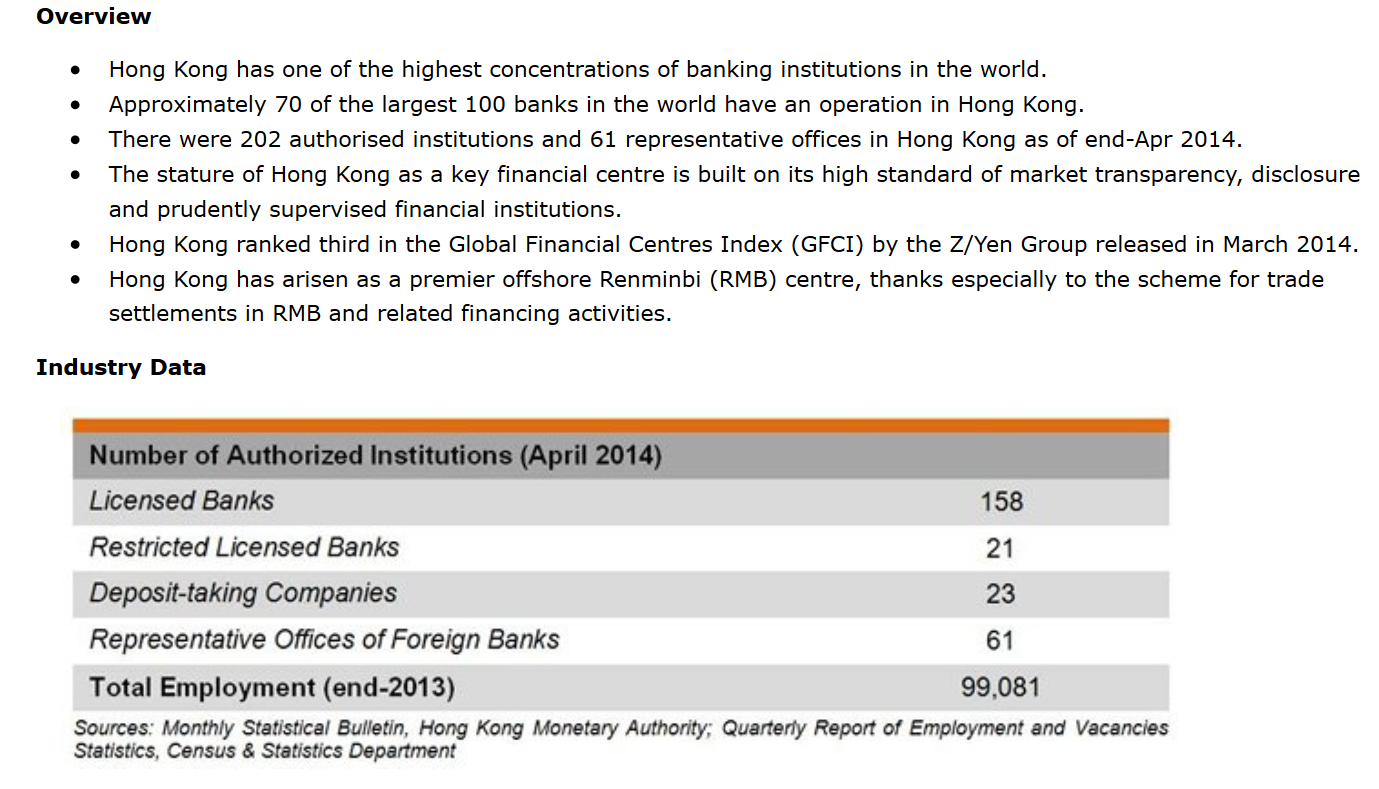
The Government of the Hong Kong Special Administrative Region (HKSAR) publishes facts about the financial sector that can be reviewed here:
Undoubtedly, numerous companies, entities and trusts with Hong Kong based investments, accounts, funds and financial activities will have U.S. citizen and LPR investors and be subject to reporting under the U.S.-Hong Kong IGA.
USCs and LPRs Who Are Having Their Non-U.S. Accounts Closed: Is it hype or is it real?
Is it hype or is it real?
It’s difficult to know with certainty how accurate are the various claims that U.S. citizens overseas are having their accounts closed by foreign financial institutions. If it has happened to you, of course you will know it. See for instance the following reports, just to name a few:
Anecdotally, I have certainly seen it in my practice, in places such as Hong Kong, London, Geneva and Zurich, but I can’t say I have seen it as a widespread practice. Indeed, for those individuals with large investment accounts (e.g., greater than US$1M, the banks seem to accommodate, or at least require them to move their assets to their U.S. affiliate or branch). I suspect those with smaller accounts of less than US$100,000, are seeing a broader brush stroke closing these accounts.
For good practical advice about maintaining or opening foreign accounts, I recommend you read:
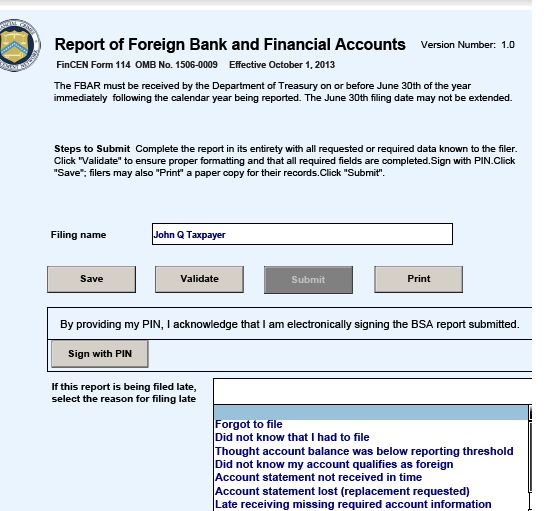
I can say that what I have seen in practice is a widespread plan by individuals to close foreign financial accounts and relocate the assets to a U.S. financial institution. This is not the decision of the financial institution, but rather the individual. The reason is not FATCA, per se, but a desire to reduce the compliance costs of filing and reporting on these foreign accounts. See, Nuances of FBAR – Foreign Bank Account Report Filings – for USCs and LPRs living outside the U.S.
At the end of the day, the practical affect I have seen (anecdotally) is a widespread desire to close foreign accounts and move them to the U.S.; not because of FATCA, but because of the costs and compliance and risk (more than just perceived – considering the IRS now regularly threatens large multiple year 50% willfulness penalties for those who did not file an FBAR) of being penalized by the IRS.
I find this ironic, since there is no legal restriction for a USC to hold foreign accounts and indeed a USC or LPR residing outside the U.S., will generally find it easier from a lifestyle and personal financial management perspective to have an account in their home country. The affect, however, is that U.S. financial institutions are receiving these assets and investments.
I will post a survey this week to ask individuals if they have had their non-U.S. bank accounts closed.
Part II: U.S. Citizens Residing Outside the U.S. Probably Have Some Solace Re: Acquittals of Foreign Bank Employees
Monday’s post on https://tax-expatriation.com/ – the day the Florida District Court jury acquitted the UBS banker, explained the background of what has been a significant prong of the U.S. international tax enforcement efforts by the IRS and Department of Justice. That prong has focused upon non-resident individuals and in the case of the Mizrahi banker, a U.S. based employee of an Israeli bank.
Indeed, the UBS banker Mr. Raoul Weil was a fugitive from the U.S. justice system for several years, until he was arrested while in Italy (since Switzerland would not extradite him to the U.S.).
One principle strategy of the IRS and DOJ is loud “saber rattling” when focusing on both resident and non-resident individuals. The limitations on the actual authority over these cases was displayed prominently this Monday when the U.S. jury acquitted the ex-UBS banker, who had allegedly committed the following crimes pursuant to the indictment and DOJ press release:
Weil oversaw the Swiss bank’s cross-border private banking business that provided services to some 20,000 U.S. clients who reportedly concealed approximately $20 billion in assets from the IRS. Weil, who allegedly referred to this business as “toxic waste,” mandated that Swiss bankers grow the cross-border business, despite knowing that this would cause bankers to violate U.S. law.
Why is this relevant to the ordinary United States citizen or lawful permanent resident living overseas most (if not all) of their lives? What if these USCs and LPRs have not filed U.S. income tax returns? See, USCs and LPRs Living Outside the U.S. – Key Tax and BSA Forms
The big takeaway from these recent acquittals is that the DOJ and IRS will need to tread more thoughtfully when they decide to bring criminal tax charges against any USC or LPR who have lived most all of their lives outside the U.S. The U.S. tax law is exactly the same for a non-resident USC versus a U.S. resident USC; however, explaining this difference to a jury in a criminal trial will be difficult for prosecutors.
While a criminal tax case will be difficult in these cases for USCs and LPRs residing outside the U.S., the IRS will nevertheless have multiple incentives to continue to aggressively pursue civil actions and civil penalties against these taxpayers. Under U.S. law, the burden of proof for civil penalties is much lower and the costs to the individual of challenging a particular case by the USC or LPR can be high, with significant time invested. See, Why the Zwerner FBAR Case is Probably a Pyrrhic Victory for the Government – for USCs and LPRs Living Outside the U.S. (Part II)
The civil arena, where 99%+ of all tax cases reside, is where the IRS will still have significant strategic advantages compared to the taxpayer. The IRS can unilaterally make tax assessments and file IRS prepared “substitute returns” for those overseas USC individuals who do not file U.S. income tax returns.
In the meantime, and as civil tax collections steps will be taken increasingly by the IRS, against USCs and LPRs residing outside the U.S.; these individuals still need to be aware of what could befall them if they take the approach of not filing tax returns or information forms required under U.S. law.
At the end of the day, it is very difficult from a policy point of view to defend the logic of worldwide income taxation in the U.S. for U.S. citizens who live outside the U.S.; but that is the law that the IRS must enforce.
A most significant limitation for the government reared its head twice in the last few hours, after two juries came back with acquittals of two separate bankers who were accused of aiding and abetting U.S. taxpayers. They were both employed by non-U.S. banks.
The most reverberating acquittal was the former head of wealth management at the large Swiss Bank UBS, Raoul Weil. He was indicted in 2008 and was a fugitive until his arrest in 2013 in Italy. The U.S. federal government had alleged he had aided and abetted U.S. taxpayers’ evade the reporting of billions of dollars of U.S. assets. According the Financial Times, the Florida jury only deliberated a little more than an hour on Monday 3 Nov. 2014, Ex-UBS banker cleared on US tax charges
Also, on Friday a federal jury in California deliberated and acquitted a former retired banker from the Israeli bank Mizrahi on conspiracy and other related tax crime charges. See Bloomberg, Ex-Mizrahi Octogenarian Banker Acquitted at Tax Trial.
“Professionals, including bankers, who promote fraudulent offshore tax schemes against the United States, will be held accountable,” said John A. Marrella, Deputy Assistant Attorney General of the Justice Department’s Tax Division. “These individuals face severe consequences including imprisonment and substantial fines.”
“The IRS is aggressively pursuing anyone who helps wealthy individuals hide their assets offshore and dodge the tax system,” said IRS Commissioner Doug Shulman. “As the global commerce and capital flows continue to increase, we have stepped up our efforts on international tax evasion.”
In these two cases, the juries obviously did not agree with the government that the bankers were illegally assisting their clients under U.S. law.
Part II of this post will discuss the impact these acquittals will likely have as the government attempts to pursue U.S. citizens on tax charges who live overseas.
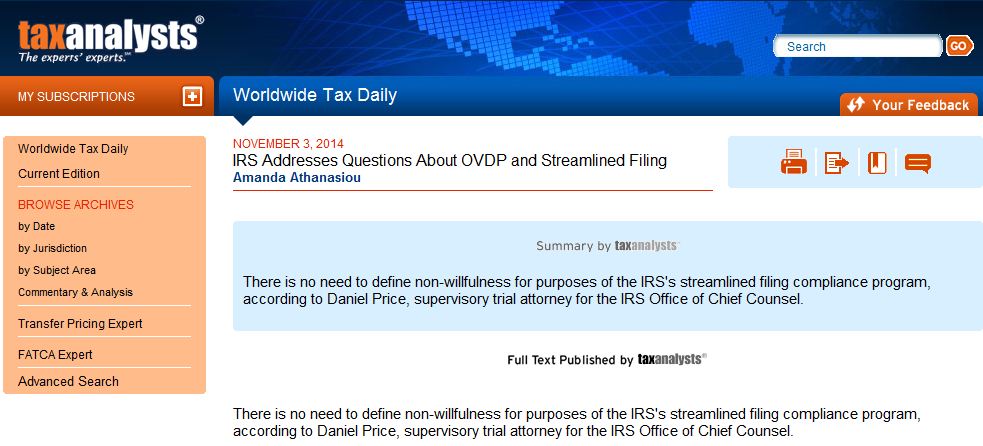
Specifically, Mr. Price said that “Practitioners know what tax fraud is, practitioners know what willful conduct is — the government doesn’t need to provide a negative definition in this context.”
The panelists spent a significant time on the streamlined filing compliance program and how it should be more efficient for taxpayers and the government. As reported in the TaxAnalysts article, Mr. Price “said the Service’s goal is to direct willful individuals with true criminal liability to OVDP and non-willful individuals to the streamlined program.”
The University of San Diego School of Law – Procopio International Tax Institute Covers Topics of Interest for Expatriation
The 10th annual conference, going on right now in San Diego, covers several courses of interest to those who are considering renouncing U.S. citizenship or abandoning their lawful permanent resident status.
The courses include the following (October 30 and 31):
The Treasury Department, through the Treasury Inspector General for Tax Administration (“TIGTA”) has highlighted what the U.S. government should be doing in the 21st century to collect U.S. taxes owed under U.S. law, against overseas taxpayers and their worldwide assets. The highlight of the report is set out below and the complete report of 12 Sept. 2014 can be read here TIGTA Report:
WASHINGTON – As international tax noncompliance remains a significant area of concern for the Internal Revenue Service (IRS), its collection efforts need to be enhanced to ensure that delinquent international taxpayers become compliant with their U.S. tax obligations, according to a report released publicly today by the Treasury Inspector General for Tax Administration (TIGTA).
The overall objective of TIGTA’s review was to evaluate the IRS’s collection efforts on delinquent taxpayers residing in foreign countries. Income received from international transactions of these taxpayers is subject to U.S. tax rules and reporting requirements.
“The IRS faces many unique challenges in collecting taxes from international taxpayers,” said J. Russell George, Treasury Inspector General for Tax Administration. “In today’s global economy, businesses and individuals are becoming more and more involved in international transactions. Accordingly, the role of an international revenue officer is very important in helping taxpayers comply with the tax laws and improving international tax compliance.”
TIGTA’s review found that ineffective management oversight has contributed to several control weaknesses in the International Collection program. Moreover, the IRS does not have reliable statistics on the rate of noncompliance of these taxpayers with their U.S. tax obligations.
For example, International Collection does not have:
• Adequate policies, procedures, position descriptions, or the training needed to ensure that international revenue officers can properly work International Collection cases.
• A specific inventory selection process that ensures that the International Collection cases with the highest risk are worked.
• Performance measures and enforcement results reported separately from Domestic Collection.
• A process to measure the value of the “Customs Hold” as an enforcement tool.
TIGTA recommended that the IRS: 1) develop a formal International Collection Strategic plan; 2) update International Collection guidance to provide specific policies and procedures to international revenue officers; 3) evaluate and update the current international revenue officer position descriptions; 4) develop a formal International Collection training plan using Subject Matter Experts to develop and teach international specific courses; 5) evaluate the International
Collection inventory selection criteria; 6) develop separate performance measures and track specific enforcement results for International Collection; and 7) continue to pursue direct access to the Customs Hold information.
IRS officials agreed with all of TIGTA’s recommendations and have taken or plan to take corrective actions. However, while the IRS has implemented some corrective actions to improve the selection of International Collection inventory, develop separate performance measures, and track enforcement results, TIGTA does not believe that the IRS’s completed corrective actions fully addressed the recommendations.
It seems that every time TIGTA issues a report, and demands the IRS modify their methods and procedures, the IRS takes action. If the information and premises in the TIGTA report are valid, then the IRS changes in policy can be for the good.
The IRS has already dedicated tremendous resources to the area of international taxation. It will be interesting to see if the IRS will dedicate even more resources to this area in response to the TIGTA report?
I have posted a number of posts related to the enforcement and collection of taxes against taxpayers residing overseas, including:
Canadian Perspective of U.S. Senator Who Renounced Citizenship
The following article has little to do, directly, with the U.S. tax and legal consequences of renouncing U.S. citizenship. It is an opinion piece reflecting a Canadian perspective of renouncing Canadian citizenship.
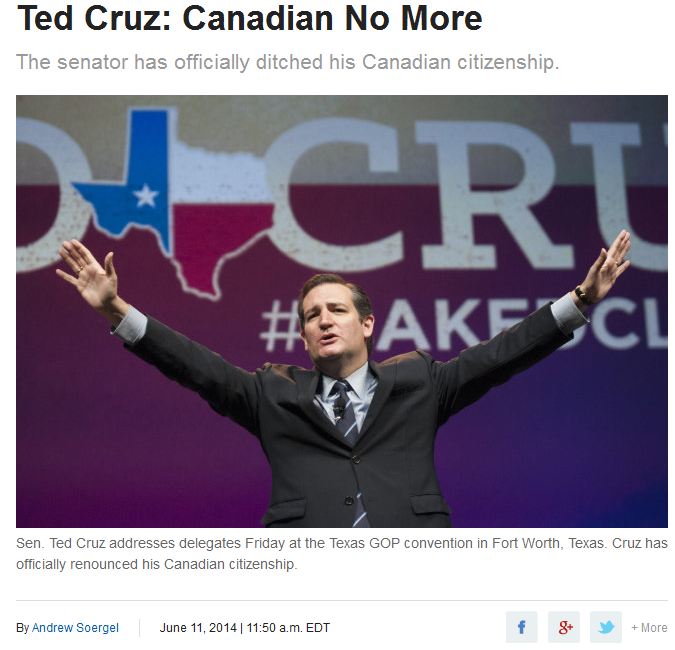
Sen. Ted Cruz (R-Texas) will renounce his Canadian citizenship.
“I have nothing against Canada,” insists Cruz. “But I’m an American by birth and as a U.S. senator; I believe I should be only an American.”
[U.S. News & World Report issued a story on 11 June 2014 of the renunciation of Senator Cruz’s Canadian citizenship]
That’s a perfectly logical, rational perspective.
It is one shared by many Canadians, only in reverse. They have lived their entire lives as Canadians only. They were born to Canadian parents temporarily working or studying in United States. Like Cruz, they returned to their country of citizenship as small children. Some were born in United States only because it was the closest hospital for their mother to give birth.
Like Cruz, they had no idea they had citizenship of another country. They never claimed U.S. citizenship. They never had a U.S. passport or Social Security number and never worked in United States. Until recently, they had “nothing against” United States.
Suddenly, the U.S. Congress, U.S. Treasury and Internal Revenue Service turned their lives topsy-turvy..
These “accidental Americans” only recently learned IRS expects them to file income tax returns each year. Most owe no U.S. tax because they pay taxes to Canada, where they have lived their entire lives. Yet accounting and legal costs are prohibitive due to the complexity of the U.S. tax code, especially for non-resident aliens.
In addition to annual IRS returns, these Canadians are expected file a Foreign Bank Account Report (FBAR), outlining all “foreign” bank and credit union accounts, insurance policies, mutual funds, retirement savings and other assets and investments they have in Canada. If they don’t, they could face draconian penalties of up to 50 percent for each account or $100,000, whichever is greater.
Fortunately, the Canadian government resists that absurdity. Canada’s Finance Minister Jim Flaherty has made it clear Canada Revenue Agency (CRA) does not and will not collect penalties for IRS for any Canadian citizen or resident. Nor will CRA collect any tax liability for IRS for a Canadian citizen, even if the person was also a U.S. citizen at the time of the tax liability.
As Flaherty has stated numerous times, “Canada is not a tax haven. People do not flock to Canada to avoid paying taxes.”
That’s not enough to keep IRS away from the business of Canada, Canadian banks or Canadian citizens and residents. Beginning in 2015, IRS expects Canadian banks to report on assets held by “US persons” living in Canada under the U.S. Foreign Account Tax Compliance Act (FATCA). If banks refuse, U.S. will impose huge financial penalties. If Canadian citizens and residents refuse to give consent for personal information to be released to IRS, FATCA demands Canadian banks declare these honest, law-abiding citizens “recalcitrant” and close their legal Canadian accounts.
Flattery calls this intrusion into Canada “unwarranted” and “extraterritorial.”
These accounts are not “foreign.” They are not “offshore.” They are held in Canada where citizens and residents live, work, earn an income, bank and pay taxes. Many are retirement savings of seniors.
FATCA clearly violates Canadian banking, privacy and human rights laws and Canada’s constitution and Charter of Rights and Freedoms, as well as laws of other countries. Congress, IRS and U.S. Treasury have shown disdain for other countries as they inflict their atrocious demands on the globe.
Who are “US persons” living in Canada?
*Canadian citizen, but “acccidental Americans” born in United States to Canadian parents.
*Canadian citizens who were told clearly and firmly by United States Consulates decades ago they were “permanently and irrevocably” relinquishing U.S. citizenship by becoming Canadian citizens.
*Dual Canadian-American citizens who took pride in U.S. heritage—before FATCA, FBAR and IRS entered their responsible Canadian lives;
*Canadian-born citizens with one parent born in U.S.;
*Canadians who returned home after working in U.S. on a green card;
*and Canadian “snowbirds” who support the U.S. economy by spending winters in southern states
If Canadians and others around the world want to renounce U.S. citizenship to protect their private financial information from U.S. snooping, IRS expects five years of income tax returns, destructive penalties and a possible exit tax.
Senator Cruz, Canada respects your decision to renounce your Canadian citizenship. When it is granted, I assure you Canada will not stalk you for information about your private finances and will not demand taxes or penalties from you.
Senator Cruz, will you and your Congressional colleagues do the same to protect Canadians and others around the world from outrageous demands of the IRS and U.S. Treasury?
Swanson is a retired human resources manager, writer and blogger. Born and raised in Pennsylvania, she has been a Canadian citizen for 40 years.
Samples of International Tax Frauds that are Flourishing Now with More Taxpayer Financial Information Required Under the Law
This post is a follow-on to the post of yesterday explaining the explosion of tax frauds that are flourishing requesting bank and financial account information. The law indeed requires U.S. citizens living abroad (and some LPRs living outside the U.S.) to report and file various detailed personal and bank information as follows:
passport numbers,
bank account names
bank account addresses,
bank and financial account information,
highest balance in these bank accounts,
full name of individual,
taxpayer identification numbers of the individuals,
along with extensive personal and financial information.
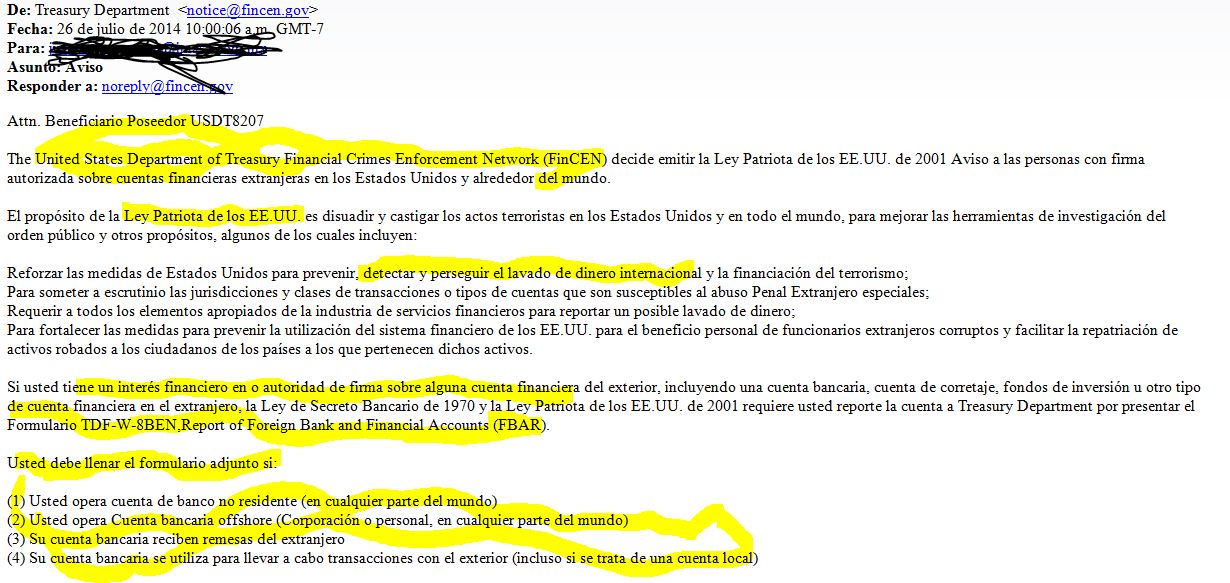
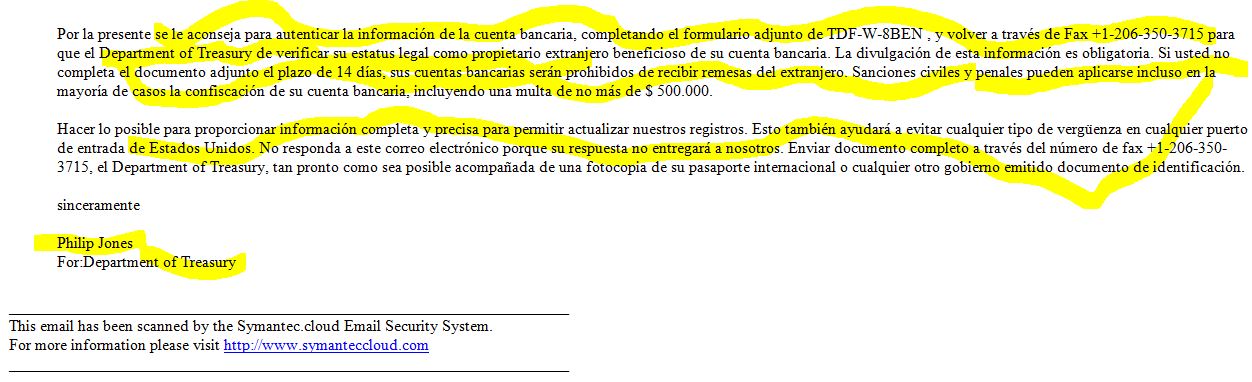
Accordingly, the type of frauds demand immediate reporting of the bank account information, purportedly to the U.S. Treasury Department. Here are examples of some of these fraudulent demands (this one in Spanish) that warns of stiff penalties, including criminal penalties for failure to provide the information within 14 days.
These requests are typically accompanied by an actual Treasury Department Form TD F 90-22.1 (Report of Foreign Bank and Financial Accounts) which are being requested to be completed with the detailed information required under the law and to be returned and sent via facsimile immediately to the U.S. Treasury Department (with an area code that is indeed in the Washington D.C. area). These are false requests.