What could be the focal point of IRS Criminal Investigations of Former U.S. Citizens and Lawful Permanent Residents?
Below is a fairly detailed summary of the type of tax crimes that are commonly investigated by IRS Criminal Investigation (“CI”) agents.
As has already been noted, TaxAnalysts reporter Jaime Arora reported in the 3 March 2014, Worldwide Tax Daily certain comments made by Mr. Jeffrey Cooper, who is the deputy director of the IRS Criminal Investigation division’s international operations. It was reported that IRS CI is looking into why people are making the choice to shed their U.S. citizenship; whether it is related to any particular laws. Cooper was quoted at the Federal Bar Association’s Section on Taxation’s 38th Annual Tax Law Conference held on February 28, 2014.
TaxAnalysts journalist Arora quoted Cooper as identifying why people are making the choice and “If we find something, we do; if not, we just move on,” he said.
It is common policy for the IRS CI not to provide information on how they commence taxpayer investigations, including how they obtain U.S. citizenship renunciation referrals or documents. There could be a number of ways these investigations are commenced. It may be as simple as taking the list from the Quarterly Publication of Individuals, Who Have Chosen to Expatriate – Quarterly Publication of Individuals, Who Have Chosen To Expatriate, as Required by Section 6039G and start reviewing their tax return files (IRS Forms 1040, 8854, etc.) along with FBAR filings.
IRS CI tax investigations generally focus on false documents or false statements, evasion of taxation, aiding and abetting of the above along with other related tax and Bank secrecy (Title 31) crimes.
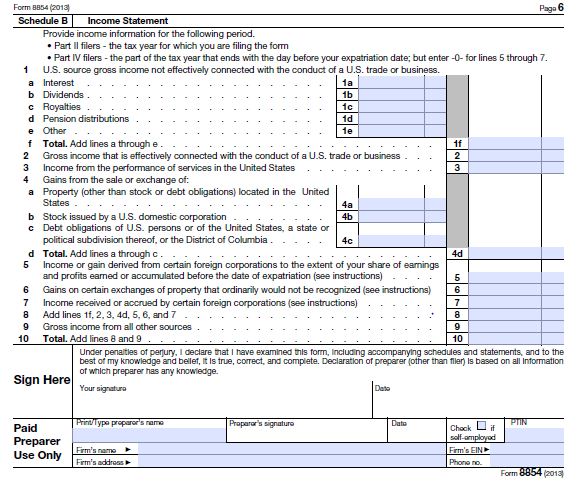
The tax reporting process for expatriates is extensive, including the basic requirement of signing IRS Form 8854 under penalty of perjury, which provides as follows on the last page of the form: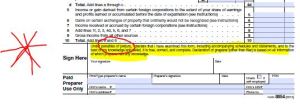
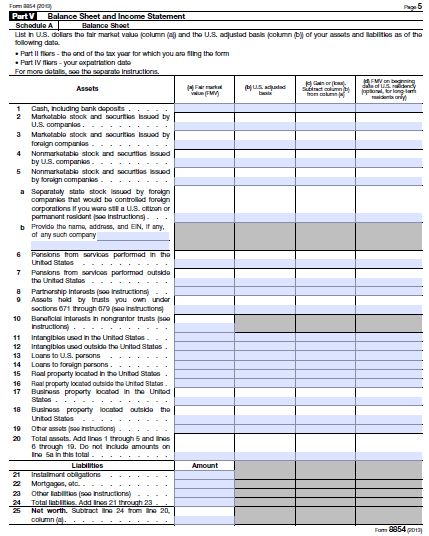
There are a host of reporting requirements and factual information that must be provided under Sections 877 and 877A, for all persons (including those with little to no assets), specifically including filing IRS Form 8854 which asks for a “boat load” of asset, income, liability and tax information. A former U.S. citizen or LPR always needs to be careful that the information provided is true, accurate and complete. See Part V of the form.
A summary of these crimes is set out below:
1. Criminal Offenses under Title 26 (Federal Tax Law)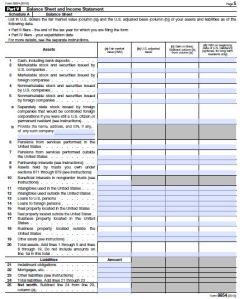
a. Tax Evasion (IRC Section 7201)
b. Filing a False Return or Other Document – Perjury (IRC Section 7206(1) )
(i) Aiding or assisting in the perpetration of a false or fraudulent document (26 U.S.C. § 7206(2))
(ii) Removal or concealment with intent to defraud, commonly related to untaxed liquor (26 U.S.C. § 7206(4))
(iii) Compromises and closing agreements involving fraud or concealment (26 U.S.C. § 7206(5))
c. Failure to File Return, Supply Information, or Pay Tax – (IRC § 7203 – Misdemeanor – up to 12 months imprisonment)
d. Fraudulent Returns, Statements, or Other Documents (IRC § 7207)
e. “Structuring” Transactions to Evade Cash Reporting (IRC § 6050I)
In addition to these tax specific crimes, other key crimes commonly used by IRS CI agents in tax cases, particularly international cases, include:
2. Tax Related Criminal Offenses under Titles 18 and 31 (Not Tax Law Specific)
a. Conspiracy (Section 371 of Title 18)
(i) Elements of the Offense
(ii) Penalties and Statute of Limitations
b. False Statements (Title 18 U.S.C. § 1001)
(i) Penalties and Statute of Limitations
c. Perjury
d. Mail fraud
e. Principals and those Who Aid and Abet (Title 18)
f. Accessory After the Fact
Finally, it is worth noting that the government regularly collects information from internet resources, such as blogs and e-mails as they build a case for criminal prosecution. A former head of the Tax Division at the U.S. Department of Justice once told me that “e-mails and internet communications was God’s gift to prosecutors”.
???????????????? ?Please click here to view the above in Chinese.?
Key Take Aways from Senate Investigations re: Foreign Banks and “Offshore Tax Evasion”: U.S. Citizens Residing Overseas have Become a Focus of the Government.
Instead of the government finding U.S. citizens living outside of the United States, as a low priority, the Senate Permanent Subcommittee on Investigations focused extensively on Swiss accounts opened by these individuals. The full report can be read REPORT: Offshore Tax Evasion:The Effort to Collect Unpaid Taxes on Billions in Hidden Offshore Accounts (February 26, 2014)
Some key excerpts of that report are as follows (at page 4):
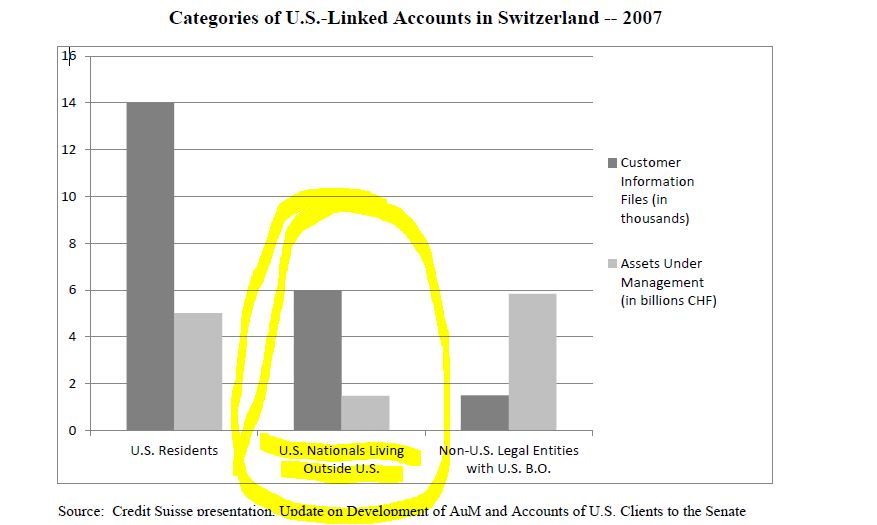
. . . focused primarily on Swiss accounts held by U.S. residents, ignoring the over 6,000 accounts opened by U.S. nationals living outside of the United States. . . . It was not until 2012, that the bank expanded the Exit Projects to include a review of the thousands of Swiss accounts opened by U.S. nationals living outside of the United States.. . .
In addition, the report is replete with statistical data of accounts held by U.S. nationals living outside the U.S., such as the following:
Instead of concluding that the complex U.S. laws are leading to non-compliance by U.S. citizens residing outside the U.S. (per the Taxpayer’s Advocate Report), it seems to conclude to the contrary and the report highlights the virtues of the OVD program in non-compliance as generally willful with millions of U.S. citizens living outside the U.S. who are not in compliance, per the following statement (at page 22):
“The OVDP continues to provide valuable information for the United States in its efforts
to combat offshore tax abuse, although it is far from clear that effective use is being made of the
information generated. For taxpayers, it continues to offer a useful alternative to report
undeclared offshore accounts that, potentially, number in the millions. According to the Taxpayer Advocate, “While 7.6 million U.S. citizens reside abroad and many more U.S. residents have FBAR filing requirements, the IRS received only 807,040 FBAR submissions in 2012,” signaling “significant information reporting noncompliance.”69 2013 Annual Report to Congress — Volume One, Taxpayer Advocate Service, “OFFSHORE VOLUNTARY DISCLOSURE: The IRS Offshore Voluntary Disclosure Program Disproportionately Burdens Those Who Made Honest Mistakes,” at 229.
This report seems to get off track by not distinguishing between normal U.S. citizens who are living out their lives in their country of residence, as opposed to U.S. nationals who are intentionally attempting to evade taxes, filing false documents, not filing returns, or otherwise intentionally violating U.S. law. All of these 7.6 million U.S. nationals living around the world are being lumped together by the government with U.S. resident citizens, irrespective of the facts of each individual and family.
Hearings – Permanent Subcommittee on Investigations – re: Offshore Tax Evasion: The Effort to Collect Unpaid Taxes on Billions in Hidden Offshore Accounts – February 26, 2014
How does the basic premiss that there are ‘Unpaid Taxes on Billions in Hidden Offshore Accounts'” hurt the average U.S. citizen taxpayer living overseas?
The hearings of the Senate on “Offshore Tax Evasion” of the “Billions in Hidden Offshore Accounts” make for good headlines, but no one seems to ask the critical questions of the basic premiss.
Will the hearings scheduled for February 26th, 2014, shed any light on this issue?
Here is what the government says:
Offshore Tax Evasion: The Effort to Collect Unpaid Taxes on Billions in Hidden Offshore Accounts
Permanent Subcommittee on Investigations
February 26, 2014 09:30AM
Location: Dirksen Senate Office Building
Agenda
The Permanent Subcommittee on Investigations will hold a hearing, “Offshore Tax Evasion: The Effort to Collect Unpaid Taxes on Billions in Hidden Offshore Accounts,” on Wednesday, February 26, 2014, at 9:30 a.m., in Room G-50 of the Dirksen Senate Office Building.
The hearing will continue the Subcommittee’s examination of tax haven bank facilitation of U.S. tax evasion, focusing on the status of efforts to hold Swiss banks and their U.S. clients accountable for unpaid taxes on billions of dollars in hidden assets. Witnesses will include representatives from a Swiss bank and the U.S. Department of Justice. A witness list will be available Monday, February 24, 2014.
How much “Myth” versus “Reality” is in the Treasury’s claim – Myth vs. FATCA: The Truth About Treasury’s Effort To Combat Offshore Tax Evasion? Is it a Myth? ?- ? [Myth No. 3: Some claim that Americans living abroad will give up their U.S. citizenship because of liabilities and burdens created by FATCA.] ?
It is worth reading “Myth vs. FATCA” by Robert Stack, Deputy Assistant Secretary (International Tax Affairs) at Treasury; to obtain a better understanding of the U.S. Treasury’s views of how it will impact Americans living outside the U.S. “Myth No. 3” is particularly relevant here: Myth No. 3: Some claim that Americans living abroad will give up their U.S. citizenship because of liabilities and burdens created by FATCA.
The argument made by Mr. Stack is that it is a myth that FATCA imposes no new obligations on U.S. citizens living abroad. This is indeed correct in a technical sense of how the tax law works; Title 26 applies to U.S. citizens who have spent most all of their lives in a country other than the U.S. This has been the law since the time of the U.S. Civil War in the 1800s. However, what is not mentioned, is that there are a host of international tax penalties that will apply to these individuals, even if no income taxes are owing. These information reporting requirements in the law are typically not understood among most U.S. tax professionals (U.S. tax lawyers, CPAs and enrolled agents) let alone the layperson taxpayer.
For instance, the “FBAR law” from the Bank Secrecy Act has been around since 1970, yet virtually no one in the private sector or the government had much of any understanding of that law until the last few years. Plus, Congress adopted various information reporting requirements in the 1980s, the 1990s and now during the last decade that are still not well understood.
The civil penalties for each failure by the U.S. citizen living abroad for these information reporting requirements is consistently US$10,000 per violation. If an individual inadvertently failed to file 3 information returns over a period of 5 years (e.g., regarding their accounts or companies in their home country of residence, e.g., they could be facing US$150,000 of civil penalties – 3x5xUS$10,000!). For a more detailed discussion of these penalties see pages 8 and 9 – http://www.procopio.com/userfiles/file/assets/files1/docs-1738595-v2-accidental-americans-and-the-push-to-renounce-us-citizenship-2448.pdf
Mr. Stack goes on to say “U.S. taxpayers, including U.S. citizens living abroad, are required to comply with U.S. tax laws?. Individuals that have used offshore accounts to evade tax obligations may rightly fear that FATCA will identify their illicit activities. Yet a decision to renounce U.S. citizenship would not relieve these individuals of prior U.S. tax obligations, and might well create additional U.S. tax obligations for certain citizens and long-term residents who give up citizenship or residency.”
This statement assumes that U.S. citizens residing overseas have somehow been using their normal individual, business or other investment accounts in their home country of residence to “evade tax obligations”! This is where there is a big disconnect in the understanding (or lack of understanding) of the U.S. Treasury Department and IRS of those millions of U.S. citizens who reside overseas. Undoubtedly, there are some U.S. citizens residing overseas who are taking steps to evade tax and not comply with the law. However, this author’s experience is that far far far more of the U.S. citizens residing overseas, simply do not have a complete understanding of a very complex U.S. tax law and bank secrecy reporting.
The “Myths” identified by the Treasury Department are set out below and can be read in their entirety at (Are they really “Myths”?)-
Myth vs. FATCA: The Truth About Treasury’s Effort To Combat Offshore Tax Evasion,
By: Robert Stack
9/20/2013
http://www.treasury.gov/connect/blog/pages/myth-vs-fatca.aspx
Myth No. 1: Some claim it’s overly costly and burdensome due to complex
regulations and difficult to meet reporting requirements.
Myth No. 2: Some claim that U.S. citizens living overseas will become
outcasts in the international financial world.
Myth No. 3: Some claim that Americans living abroad will give up their U.S.
citizenship because of liabilities and burdens created by FATCA.
Myth No. 4: Some claim that countries are opposed to FATCA, in part because
the legislation could force foreign banks to violate laws in their own
countries.
Myth No. 5: Some claim that FATCA will generate a backlash from foreign
governments who view this as an overreach of U.S. law.
Myth No. 6: Some claim that FATCA will unfairly expose FFIs to heavy
penalties before they have the necessary mechanisms in place to comply.
Myth No. 7: Some claim that FATCA aims to use foreign banks as an extension
of the IRS.
???????????????? ?Please click here to view the above in Chinese.?
Should IRS use Department of Homeland Security to Track Taxpayers Overseas Re: Civil (not Criminal) Tax Matters? The IRS works with Department of Homeland Security with TECs Database to Track Movement of Taxpayers
The Department of Homeland Security (DHS) uses the TECS database, which was originally managed and created by the Treasury Department as the Treasury Enforcement Communications System. This database allows the U.S. federal government to track the movement of people, funds and various transactions. It is now being used by the IRS to feed taxpayer data to the TECS as described in the IRS Internal Revenue Manual –
http://www.irs.gov/irm/part9/irm_09-004-002.html
9.4.2.4.1 (08-09-2004) Treasury Enforcement and Communication System
- The Treasury Enforcement and Communication System (TECS) is used extensively by the law enforcement community. This subsection discusses the information available on TECS. Items discussed include:
- description and purpose of TECS
- responsibilities for TECS
- information available from TEC
9.4.2.4.1.1 (03-15-2007) Description and Purpose of Treasury Enforcement and Communication System
- Treasury Enforcement and Communication System (TECS) is a computerized information system designed to identify individuals and businesses suspected of, or involved in, violation of Federal law. Treasury Enforcement and Communication System is also a communications system permitting message transmittal between Treasury law enforcement offices and other Federal, national, state, and local law enforcement agencies. The TECS provides access to the FBI’s National Crime Information Center (NCIC) and the National Law Enforcement Telecommunication Systems (NLETS) with the capability of communicating directly with state and local enforcement agencies. The NLETS provides direct access to state motor vehicle departments.
9.4.2.4.1.2 (08-09-2004) Responsibilities for the Treasury Enforcement and Communication System
- The responsibility for TECS lies both in Headquarters (HQ) and the field offices. The following subsections provide a brief description of these responsibilities.
9.4.2.4.1.2.1 (03-09-2012) Associate Director, Warrants and Forfeitures
- The Associate Director, Warrants and Forfeitures will be responsible for ensuring that all TECS entries meet authorized disclosure criteria.
- All fugitive entries will be made through HQ and all non-fugitive entries will be made through or authorized by the Associate Director, Warrants and Forfeitures.
- Headquarters is also responsible for conducting and coordinating periodic training for TECS operators, as well as providing operating instructions, including the TECS Operating Manual, at all locations, and additional instructions as needed.
9.4.2.4.1.2.2 (03-09-2012) Resident Agent in Charge, Scheme Development Center
- Each Resident Agent in Charge (RAC), Scheme Development Center (SDC), will be responsible for:
- designating TECS users and coordinating their training
- performing queries for field offices upon request, and reporting the results upon receipt of a TECS reply (either a HIT or a No Record) by telephone, transmission of the TECS hard-copy reply to the field office, or by attachment of the hard-copy reply to the primary investigation (PI) being evaluated
9.4.2.4.1.2.3 (08-09-2004) Special Agent in Charge
- The Special Agent in Charge (SAC) in each field office will be responsible for:
- designating a TECS Systems Control Officer (SCO) to assist other users and compliance functions in obtaining authorized data
- designating TECS users and coordinating their training
- disseminating written instructions to field office personnel regarding TECS query requests within the general guidelines as stated in this section
- providing HQ with a mailing list for their field office of direct distribution recipients of wanted circulars
9.4.2.4.2 (08-09-2004) Information Available From Treasury Enforcement and Communication System
- All information retrieved from TECS must be stamped OFFICIAL USE ONLY.
- The US Customs Financial Intelligence Branch (FIB) Financial Information Database provides information via TECS as follows:
- Form 4789, Currency Transaction Reports (CTR)
- Reports of Foreign Bank and Financial Accounts (FBAR), Treasury Form 90-22.1
- Form 8362, Currency Transaction Reports by Casinos (CTRC)
- Suspicious Activity Reports (SARs), Form TDF 90-22.47
See Also –
http://www.dhs.gov/xlibrary/assets/privacy/privacy-pia-cbp-tecs-sar-update.pdf