W-8s for U.S. Citizens Abroad: Filing False Information with Non-U.S. Banks
Prefer a Q&A format instead? Read this: https://tax-expatriation.com/why-is-signing-an-irs-form-w-8ben-a-significant-criminal-risk-for-u-s-citizens-living-abroad/
Individuals who do not specialize in U.S. federal tax law, often have little detailed understanding of the U.S. federal “Chapter 3” (long-standing law regarding withholding taxes on non-resident aliens and foreign corporations and foreign trusts) and “Chapter 4” (the relatively new withholding tax regime known as the “Foreign Account Tax  Compliance Act”) rules.
Indeed, plenty of U.S. tax law professionals (CPAs, tax attorneys and enrolled agents) do not understand well the interplay between these two different withholding regimes –
Plus, the IRS forms have been significantly modified over the years; with increasing factual representations that must be made by individuals who sign the forms under penalty of perjury. They are complex and not well understood. For instance, the older 2006 IRS Form W-8BEN for companies was one page in length and required relatively little information be provided.
The entire form is reproduced here; indicating how foreign taxpayer information was optional and generally there was no requirement to obtain a U.S. taxpayer identification number. It was governed exclusively by Chapter 3 and the regulations that had been  extensively produced back in the early 2000s.
The forms were even easier before those regulations (see old IRS Form 1001). No taxpayer identification numbers were ever required and virtually no supporting information regarding reduced tax treaty rates on U.S. sources of income.
Life was simple back then – compared to today!
The one thing all of these forms have in common is that all information was provided and certified under penalty of perjury. Current day IRS Forms W-8s can typically be completed accurately by experts who understand the complex web of rules. Plus, multiple versions of W-8s exist today; most running some 8+ pages in length.
See the potpourri of current day W-8 forms –
Form W-8BEN, Certificate of Foreign Status of Beneficial Owner for United States Tax Withholding and Reporting (Individuals)
Form W-8BEN-E, Certificate of Status of Beneficial Owner for United States Tax Withholding and Reporting (Entities)
Form W-8IMY, Certificate of Foreign Intermediary, Foreign Flow-Through Entity, or Certain U.S. Branches for United States Tax Withholding
Form W-8EXP, Certificate of Foreign Government or Other Foreign Organization for United States Tax Withholding
Making certifications under penalty of perjury are more complex, the more and more factual information that is being certified. If I certify the dog I see in front of me is “white and black” that is not a complex certification, if I see the dog and see the “white and black”. If the dog also has some brown coloring, my certification would necessarily not be false.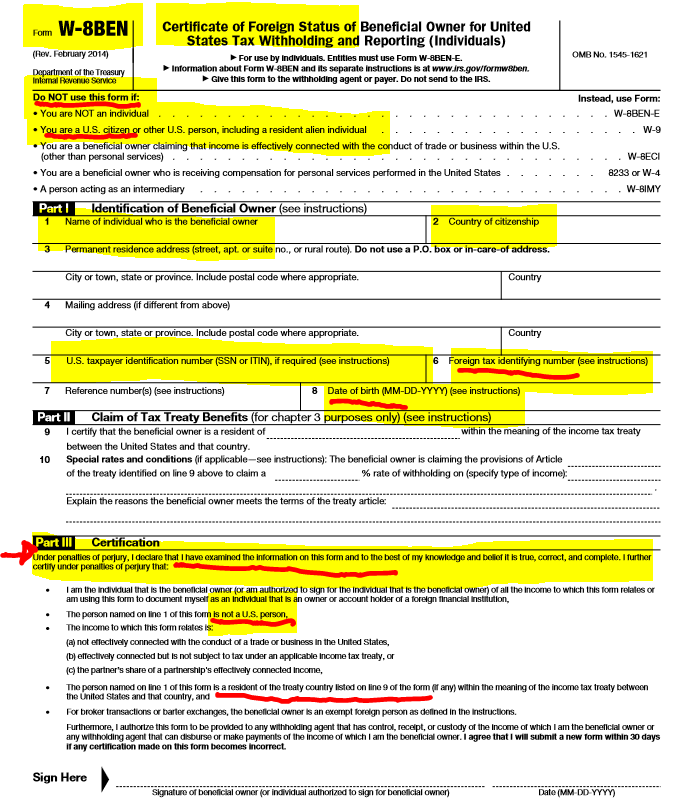
However, if I have to certify as to the colors of each dog in a pack of 8 dogs (and each and every color that each dog is/was), that becomes a much more complicated certification.
That’s my analogy for the old IRS Forms W-8s and the current day IRS Forms W-8s.
Compare that form, of just 10 years ago, with what is required and must be certified to under current law. It can be daunting.
Now to the rub. Individuals who certify erroneously or falsely, can run a risk that the government asserts such signed certification was done intentionally. I have seen it happen in real cases; even though the individual layperson (particularly those who speak little to no English and live outside the U.S.) typically has little understanding of these rules. They typically sign the documents presented to them by the third party; usually the banks and other financial institutions.
The U.S. federal tax law has a specific crime, for making a false statement or signing a false tax return or other document – which is known as the perjury statute (IRC Section 7206(1)). This is a criminal statute, not civil. Some people are also under the misunderstanding that a false tax return needs to be filed. The statute is much broader and includes “. . . any statement . . . or other document . . . “.
(1) Declaration under penalties of perjury
Willfully makes and subscribes any return, statement, or other document, which contains or is verified by a written declaration that it is made under the penalties of perjury, and which he does not believe to be true and correct as to every material matter; or . . .
Therefore, if a U.S. citizen living overseas (or anywhere) signs IRS Form W-8BEN (or the bank’s substitute form, which requests the same basic information), that signature under penalty of perjury will necessarily be a false statement, as a matter of law. Why? By definition, the statute says a U.S. citizen is a “United States person” as that technical term is defined in IRC Section 7701(a)(30)(A). Accordingly, IRS Form W-8BEN, must only be signed by an individual who is NOT a “United States person”; who necessarily cannot be a United States citizen. To repeat, a United States citizen is included in the definition of a “United States person.” Plus, the form itself, as highlighted at the beginning of the form, warns against any U.S. citizen signing such form. 
Accordingly, if a U.S. citizen were to sign IRS Form W-8BEN which I have seen banks erroneously request of their clients, they run the risk that the U.S. federal government will argue that such signatures and filing of false information with the bank was intentional and therefore criminal under IRC Section 7206(1). See a prior post, What could be the focal point of IRS Criminal Investigations of Former U.S. Citizens and Lawful Permanent Residents?
Indeed, criminal cases are not simple, and I am not aware of any single criminal case that hinged exclusively on a false IRS Form W-8BEN. However, I have seen cases, where the government has alleged the U.S. born individual must have signed the form intentionally, knowing the information was false. It’s a question of proof and of course U.S. citizens wherever they reside, should take care to never sign an IRS Form W-8BEN as an individual certifying they are not a “United States person”; even if they think they are not a U.S. person
For further background information on this topic, see a prior post: FATCA Driven – New IRS Forms W-8BEN versus W-8BEN-E versus W-9 (etc. etc.) for USCs and LPRs Overseas – It’s All About Information and More Information
Part II: “Neither Confirm nor Deny the Existence of the TECs Database”: IRS Using the TECs Database to Track Taxpayers Movements – and Assets
Part II: This is a follow-up to the federal government’s database known as “TECS” (Treasury Enforcement Communication System)that is now operated by the Department of Homeland Security (“DHS”). The IRS uses it to track travel, trips, movement and even asset movements (e.g., wire transfers) by U.S. citizen taxpayers; including those residing outside the U.S.
See, “Neither Confirm nor Deny the Existence of the TECs data”: IRS Using the TECs Database to Track Taxpayers Movements –, posted Dec. 13, 2014.
This previous post described how the U.S. federal government uses the TECS to locate assets and travel patterns of U.S. citizens; specifically outside the U.S. The IRS trains their employees to (1) Not discuss TECS with taxpayers; (2) Neither confirm nor deny existence of TECS; (3) Keep in separate “Confidential” envelope; and (4) Stamp documents as “OFFICIAL USE ONLY”
The image in this post reflects a page from IRS training materials for their employees; e.g., revenue agents (those individuals who audit taxpayers and determine tax deficiencies and the like), revenue officers (those individuals who work on collecting taxes owed or alleged to be owed) and chief counsel attorneys (those individuals who litigate tax cases against taxpayers); among other IRS employees.
Frankly, there is not a lot of detailed law about how and when the IRS can use TECS or other tracking techniques of individuals and their assets. There are no tax cases (at least none that I am aware of) where the Courts have tried to impose limits on the use and  methods of the federal government in collecting this type of TECS information. Indeed, there are specific provisions granting broad use of taxpayer information when the government alleges there is a “terrorist incident, threat, or activity” as that term is defined in IRC Section § 6103.
On the other hand, there are important laws about how the IRS cannot generally disclose taxpayer information. For instance, see the same code section IRC Section § 6103 for wrongful disclosures of taxpayers’ information. That statute makes it a violation (even a criminal violation in certain willful circumstances) to disclose taxpayer information in “most” (or at least many) circumstances. The statute is comprehensive and there is a lot of case law interpreting various provisions. A good overview of the statute can be found in the Criminal Tax Manual for the Department of Justice, Tax Division – Chapter 42.00
A recent case (United States v. Garrity, 2016 U.S. Dist. LEXIS 66372 (D. Conn. 2016), discussed in Jack Townsend’s blog, was one where the IRS had disclosed the name of a deceased taxpayer Paul G. Garrity, Sr. regarding his foreign (non-U.S.) accounts. The disclosure included IRS investigation techniques that were disclosed as part of a FOIA request, which ultimately made it to the public. This was found to be disclosure of return information as defined by IRC Section § 6103. However, the Court there found that there was no violation of the statute by the IRS, as the taxpayer was deceased by the time the claim was brought by the estate. The government made a Title 31 FBAR penalty assessment of over US$1M including interest and penalties that is still pending.
It seems to me that the use of the TECS database by the IRS and Section 6103 are a bit like two heads of a coin. It all deals with taxpayer information and what rights, if any do taxpayers have to protect their personal and financial information – especially where it can (purposefully or inadvertently – e.g., through a data breach/hacking) be released to the public.
There are many unanswered questions as there has been little to no litigation regarding how and when the TECS database can and should be used.
Does the government have any limits on its use?
This ultimately becomes more of a policy discussion about how and to what extent can/should the federal government have and use and collect personal financial and travel information of individuals (particularly for tax purposes)?
As FATCA data collection has now allowed exchanges of millions of records, these questions in my view take on even greater importance. See 21 Dec 2015 post, Foreign Government Receives a “FATCA Christmas Gift” from IRS: 1 Gigabyte of U.S. Financial Information.
See a prior related post, 19 Jan 2014 – Should IRS use Department of Homeland Security to Track Taxpayers Overseas Re: Civil (not Criminal) Tax Matters? The IRS works with Department of Homeland Security with TECs Database to Track Movement of Taxpayers
The “Dirty Secret” of U.S. FATCA IGAs
The world is starting to wake up to better understand how the U.S. Treasury negotiated so-called “bilateral” FATCA Intergovernmental Agreements (“IGAs”) with some 113 countries around the world.  The list of all countries can be found here at the Treasury website – Foreign Account Tax Compliance Act (FATCA)
Not all of these countries have actually signed the IGAs. Many of them have what the U.S. Treasury calls an “agreement in substance.”
How does this impact USCs and LPRs residing outside the U.S.? Many ways.
First, extensive information is being collected by foreign financial institutions (FFIs – non-U.S. financial institutions) throughout the world to identify “U.S. Persons” and “Substantial U.S. Owners.” The IGAs use the term “Specified U.S. Person” with respect to what are defined as “U.S. Reportable Accounts.” See as an example, the Treasury FATCA IGA with Colombia, which is largely identical in form to almost all other IGAs.
Second, many FFIs have adopted a policy to no longer accept or retain U.S. accounts, due to the cost of compliance associated with U.S. citizens and lawful permanent residents. Also, many FFIs simply want to avoid the risk of being penalized heavily by the U.S. federal  government for having U.S. taxpayers and being charged with some type of wrongdoing; namely aiding and abetting U.S. taxpayers to evade U.S. tax obligations. See, Jack Townsend’s thoughtful website Federal Tax Crimes that reviews in detail the various cases with foreign banks, with a particular focus on Swiss banks, U.S. DOJ Program for Swiss Banks .
Now to the “dirty little secret” of FATCA IGAs. They are not bilateral in the sense that U.S. banks do not need to provide the same detailed information on their non-U.S. clients (e.g., UK, French, Canadian, Mexican, Chinese, Dutch, Spanish, Colombian, Brazilian, residents, etc.) as do FFIs regarding “U.S. accounts.” This is no real secret, since a simple reading of the FATCA IGAs will get you to this conclusion by simply understanding the difference between what is defined as a “U.S. Reportable Account” (which is extraordinarily broad) compared to “Country X Reportable Account.” The latter definition, e.g., a Colombian Reportable Account, only obligates U.S. banks to send information of individual residents on U.S. source income under chapter 3 and certain accounts of Colombian entities. 
Hence, all non-U.S. source income to a Colombia resident individual is not subject to reporting by the U.S. financial institution. She could have a portfolio of US$150M in non-U.S. mutual funds, ADRs traded on the NYSE and have no reporting of all of her income going back to the Colombian government. Also, stock sales of U.S. corporations (e.g., Apple, Ford or Microsoft) is not treated as “U.S. source income” defined under chapter 3. Plus, a Colombian resident who has an offshore corporation (e.g., a BVI company) that owns the investments, NO reporting is required of the U.S. financial institution; even if the entire US$150M portfolio were invested in U.S. stocks, U.S. treasuries, and other American made financial investments.
Contrast that with what is defined as a “U.S. Reportable Account” that would include a U.S. Person that is a “Controlling Person” of a “Non-U.S. Entity.” Take the same example in reverse; a Colombian bank must identify all of its clients with Non-U.S. Entities (undertake an expensive due diligence process) to then identify whether such entities (e.g., a BVI company) has a “Specified U.S. Person”. Plus, it does not matter if the income is from Colombian sources or non-Colombian sources. Income is income and must be reported by the FFI.
Accordingly, Banks around the world in at least 113 countries (e.g., UK, French, Mexican, Chinese, Dutch, Spanish, Colombian, Brazilian, Cayman, Singapore, Guatemala, Hong Kong, etc.) are required to drill down and collect detailed information on beneficial owners of basically all companies, trusts and other legal entities. This work is required, so as to identify who are “U.S. persons” to identify “substantial U.S. owners” as that term is defined in the FATCA regulations. The IGAs call these essentially “U.S. Reportable Accounts.” In the case of FFIs, U.S. taxpayers cannot hide behind offshore opaque legal entities (e.g., which would generally be illegal for USCs to form and hold assets in a foreign corporation and not report the assets, activities and earnings of the foreign corporation, which would generally be a CFC or possibly a PFIC).  See prior post: March 30, 2015, The Problem with PFICs! “Avoid PFICs Like the Plague”
The FATCA IGAs, require these FFIs to provide extensive information on all income on these “U.S. Reportable Account” to the IRS, either directly or indirectly through their own governments.
In contrast, individuals resident in any foreign country (e.g., UK, French, Mexican, Chinese, Dutch, Spanish, Colombian, Brazilian, Belgium, Guatemala, Luxembourg, etc.) can generally hold their ownership interests of U.S. investment assets in U.S. banks and financial institutions through opaque legal structures and hide behind the entity without worrying that a U.S. financial institution has any duty to identify and disclose who are the beneficial owners to the tax authorities of those residents. See Colombian individual scenario above with a BVI company.
Read the Q&A format here.
Will U.S. Tax Law Regarding “Covered Expatriates” get Modified with Recent Government Push in International?
It is rare to have the President of the United States hold press conferences specifically dealing with international tax policy and tax enforcement. Nevertheless, this is what happened last week when President Obama announced his administration’s recent efforts in the field of international tax, anti-corruption and financial transparency.
His remarks can be watched here: President Obama’s Efforts on Financial Transparency and Anti-Corruption: What You Need to Know
Also, the White House is putting forward a series of initiatives in this area:
Fact Sheet: Obama Administration Announces Steps to Strengthen Financial Transparency, and Combat Money Laundering, Corruption, and Tax Evasion
To date, none of the specific initiatives address current “tax expatriation law” under IRC Sections 877, 877A, et. seq.
U.S citizens (USCs) and Lawful Permanent Residents (LPRs): Caution When Making Gifts. US Tax Court Recently Ruled a 1972 Gift by Sumner Redstone Still Open to IRS Challenge
The statute of limitations is one of the most important considerations for any individual when considering what tax consequences the Internal Revenue Service (“IRS”) might argue they have for years past. This can occur many years into the future as explained further below. 
Former USCs and LPRs can be in a particularly precarious position, as was recently demonstrated by a U.S. Tax Court case for a gift that was made decades ago in 1972. See, Redstone vs. Commissioner (TCM 2015-237). Although this U.S. Tax Court case involving Sumner Redstone had nothing to do with renunciation of citizenship, it shows how the IRS can reach back many years and even decades in assessing taxes it claims are owing. The newly (in year 2010) added IRC Section 6501(c)(8) makes this highly likely under current revised law.
- Transfers to U.S. Beneficiaries (e.g., U.S. resident or citizen children or grandchildren who might receive gifts or bequests from a “Covered Expatriate” the former USCs or “long-term resident” – Green Card Holders)
Former USCs and any U.S. beneficiaries of theirs (e.g., U.S. resident children or grandchildren who might receive gifts or bequests from the former USCs) should be cognizant of the statute of limitations. See a prior post from 2014, When the U.S. Tax Law has no Statute of Limitations against the IRS; i.e., for the U.S. citizen and LPR residing outside the U.S.
As this prior post noted, there are at least three basic scenarios when there is no statute of limitations for federal tax matters are as follows:
1. The former USC or LPR does not file a U.S. income tax return, when they had a requirement to so file. IRC Section 6501(c)(3). See a post from 2014, When do I meet the gross income thresholds that require me to file a U.S. income tax return?
- Fraud when Tax Return Filed

2. There is fraud on the part of the taxpayer (e.g., the taxpayer intentionally does not report income). IRC Sections 6501(c)(1), (c)(2).
- Missing Information on Tax Return Filed – re: International Matters
3. The USC or LPR fails to report certain foreign transactions, including inadvertently neglecting to report. IRC Section 6501(c)(8). This rule was only recently adopted as part of the “HIRE Act” which also created FATCA. The types of transactions set above in the table provides a brief summary of when transactions can give rise to an “open” statute of limitations period. In other words, as many years and decades can pass (see Redstone 1972 gift transaction) before the IRS ever has to make a proposed assessment of taxes and penalties. These include numerous ownership or economic interests in foreign (non-U.S.) companies, partnerships, foreign trusts, foreign investment accounts, among others.
This is indeed one of those areas where the IRS can argue a “gotcha moment”; simply because the former USC or LPR was not aware of the extremely complex rules of reporting assets (normally in their own country of residence outside the U.S.). The consequences to these families can go on indefinitely, per post from September 2015, Finally – Proposed Regulations for “Covered Gifts” and “Covered Bequests” Issued by Treasury Last Week (Be Careful What You Ask For!)
For a more in depth review of the international (non-U.S.) transactions that give rise to this reporting, see IRS Forms 3520, 3520-A, 5471, 8865, 5472, 8938, 8858, 926 among others.
Foreign Government Receives a “FATCA Christmas Gift” from IRS: 1 Gigabyte of U.S. Financial Information
The last post discussed how the director of the Mexican tax administration was critical of the U.S. federal government for not providing FATCA information on U.S. financial accounts. See, Foreign Government Criticizes U.S. Government for  NOT Providing FATCA IGA Information on Their Taxpayers with U.S. Accounts, dated December 14, 2015.
The automatic exchange of bank and financial information is driven by the U.S. Treasury driven Intergovernmental Agreement (IGA).
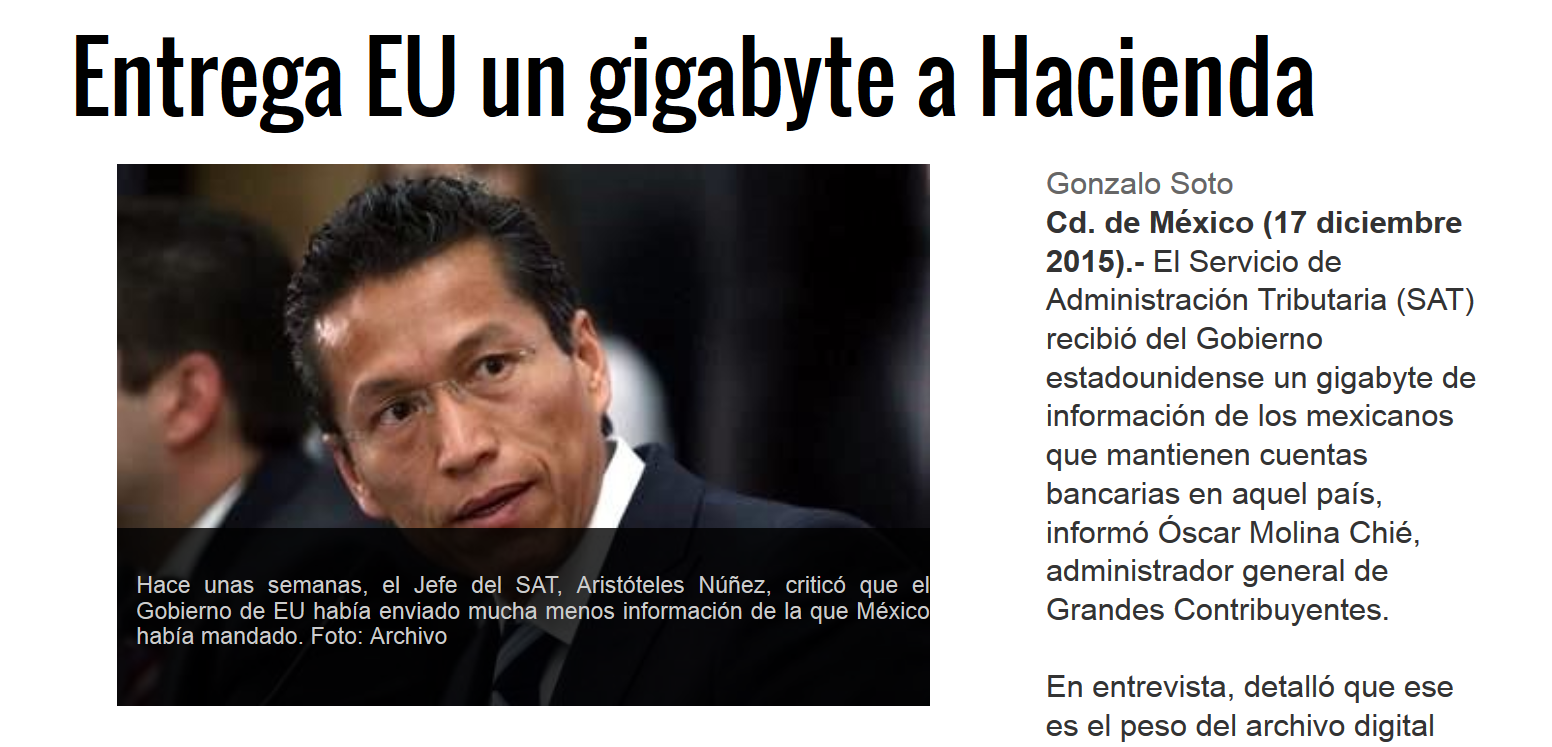
As a follow-up, the Mexican newspaper Reforma reported on the 17th of December that the U.S. just provided Mexico’s treasury with a gigabyte of Mexican taxpayer information regarding U.S. financial and bank accounts. See, Entrega EU un gigabyte a Hacienda, dated Dec 17, 2015.
This news comes on the heals of the earlier criticism by the Commissioner of the Mexican IRS (SAT – Servicio de  Administración Tributaria (SAT)), Mr. Aristóteles Núñez Sánchez. The Reforma article quotes Óscar Molina Chié (who is in charge of the large taxpayers division at SAT) generously regarding how and what information was provided by the U.S. federal government.
Finally, the article emphasized that Mexico has sent the IRS information regarding Mexican bank accounts of U.S. citizens.
The question is how much Mexican bank and financial information has actually been provided by SAT of the hundreds of thousands (if not more than 1 million) dual national taxpayers, who are citizens of both Mexico and the U.S.? See, Where the IRS will likely look overseas: USCs are Millions Yet U.S. Tax Returns are Just a Few Hundred Thousand, dated January 28, 2015.
Foreign Government Criticizes U.S. Government for NOT Providing FATCA IGA Information on Their Taxpayers with U.S. Accounts
This news is ironic. The U.S. government has chastised various banks and governments around the world since 2009 for not providing financial information on U.S citizens (USCs) and other U.S. taxpayers regarding their foreign bank and financial accounts. See, How Congressional Hearings (Particularly In the Senate) Drive IRS and Justice Department Behavior, posted Sept 8, 2014. 
Now, it is foreign governments’ turn, to criticize the U.S. Treasury and IRS for not keeping up with its promises to provide U.S. financial and bank information on taxpayers of their countries pursuant to all of the FATCA Intergovernmental Government Agreements (IGAs) that were pushed so hard by U.S. Treasury. See, FATCA IGA with Hong Kong Signed: U.S. Citizens and Lawful Permanent Residents Residing in or Around Hong Kong Need to Know, posted on Nov. 17, 2014.
The Commissioner of the Mexican IRS (SAT – Servicio de Administración Tributaria (SAT)), Mr. Aristóteles Núñez Sánchez just announced that the U.S. government is not holding up its side of the bargain under the U.S.-Mexico IGA. See, the Dec. 12, 2015 article en the national Mexican newspaper, El Universal, EU incumple entrega de informacion: SAT: Mexico ha hecho su parte, asegura Aristóteles Núñez
The article, which is in Spanish, explains that Mexico has complied with its obligations under the IGA by providing detailed information about U.S. taxpayers with accounts in Mexican financial institutions to the U.S. government. However, the U.S. government has not complied with its side of the bargain. The news report says no specific details were provided by Mr. Núñez about what type of information was provided.
Revocation or Denial of U.S. Passport: More on new section 7345 (Title 26/IRC) and USCs with “Seriously Delinquent Tax Debt”
New Section 7345 completely modifies how U.S. citizens (“USCs”) living and traveling around the world have to now consider very seriously actions taken by the Internal Revenue Service (“IRS”). It is the IRS which now holds the power under this new law that requires the U.S. Department of State (“DOS”) to revoke or deny to issue a U.S. passport in the first place.

New Section 7345(e) provides in relevant part as follows: “upon receiving a certification described in section 7345 of the Internal Revenue Code of 1986 from the Secretary of the Treasury, the Secretary of State shall not issue a passport to any individual who has a seriously delinquent tax debt described in such section. . . ” [emphasis added].
This new law mandates (not at the discretion of the DOS) that various U.S. passports be denied at the direction of the IRS. Once the IRS issues the certification of “seriously delinquent tax debt.”
All it takes, is for the IRS to claim tax or penalties are owing of at least US$50,000 through an assessment (plus start a lien or levy action).
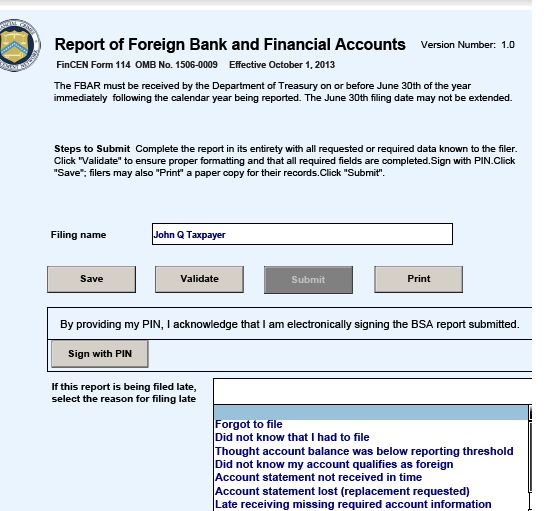
Of course, US$50,000 sounds like a large sum for many modest USCs, until an individual understands that there are a host of international reporting requirements for taxpayers. Specifically, the IRS can impose a US$10,000 penalty for each violation of failing to complete and file various IRS information forms; EVEN IF NO income  taxes are owing. See IRS website – FAQs 5 and 8 regarding civil penalties (see also How is the offshore voluntary disclosure program really working? Not well for USCs and LPRs living overseas).
For a summary of these forms and filing requirements, see a prior post, Oct. 17, 2015, Part II: C’est la vie Ms. Lucienne D’Hotelle! Tax Timing Problems for Former U.S. Citizens is Nothing New – the IRS and the Courts Have Decided Similar Issues in the Past (Pre IRC Section 877A(g)(4))
Indeed, our office has seen and assisted numerous taxpayers around the world where the IRS has assessed tens of thousands, hundreds of thousands and in some cases in excess of US$1M (in proposed assessments) against an individual for failure to simply file information reporting forms. See, for instance, a prior post on Nov. 2, 2015, Why Most U.S. Citizens Residing Overseas Haven’t a Clue about the Labyrinth of U.S. Taxation and Bank and Financial Reporting of Worldwide Income and Assets
Also, we have seen several IRS assessments of income tax (not just penalties) against individuals of hundreds of thousands of dollars which are not supported by the law. For instance, it is not uncommon for the IRS to issue a “substitute for return” alleging income taxes owing. See, How the IRS Can file a “Substitute for Return” for those USCs and LPRs Residing Overseas, posted Nov. 8, 2015. We have a number of those cases pending, where the IRS has taken erroneous information and made such assessments against USCs residing and working outside the U.S. for much if not most of their professional lives.
New Section 7345 requires that USCs, wherever they might reside, take great care in knowing about any actions the IRS might be taking against them; as to tax and penalty assessments, whether or not they are supported under the law.
One basic method of learning more about the activities of the IRS is to make a transcript request directly to the IRS regarding the status of a USC’s federal tax status according to IRS records. See, IRM, Part 21. Customer Account Services . . . Section 3. Transcripts.
It is also possible for the USC to obtain additional tax information from the IRS through a Freedom of Information Act (“FOIA”) request.
WSJ Asks the Question: Is the IRS Undercounting Americans Renouncing U.S. Citizenship?
Is the IRS Undercounting Americans Renouncing U.S. Citizenship?, posted Sept. 16, 2015.
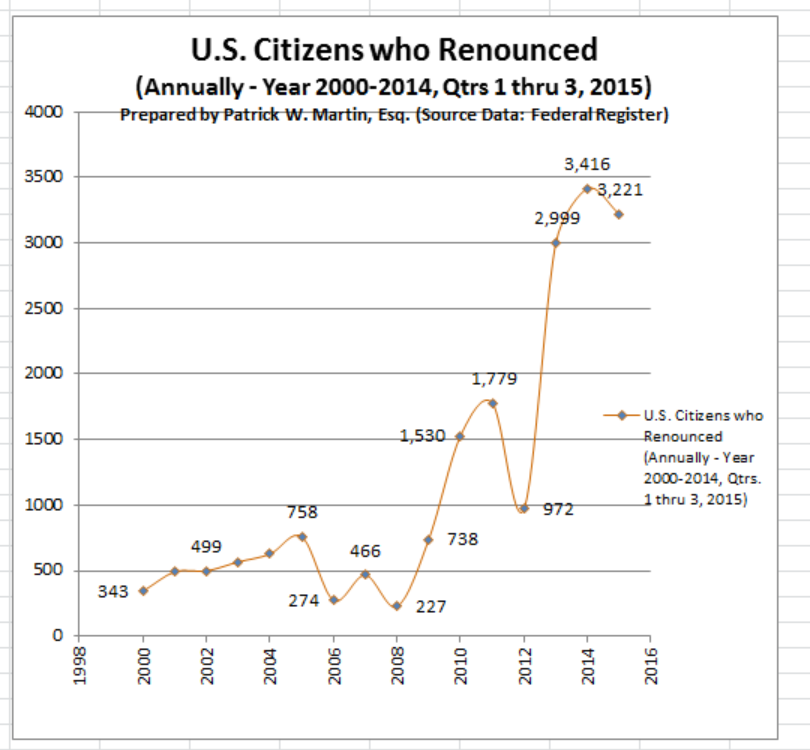
The names of U.S. citizens who have renounced is published quarterly pursuant to IRC Section 6039G. See, prior related posts: 1,426 Individuals Give Up Passport: Record Number of U.S. Citizens Renouncing: Quarter 3 for 2015, October 30, 2015.
No one knows for certain if the IRS (including the IRS per some of my conversations) is getting complete data from the Department of State regarding each name and individual.
The graph I have prepared shows the number of names reported quarterly as I track all reported names quarterly that related to clients and non-clients. The latest cumulative amounts for 2015 (which does not include the 4th quarter) shows 3,221 thus far in the year. If there is close to 1,400 as was the case for the last quarter, the total will be a record – by a bunch; i.e., close to 5,000 renunciations for the year.
Anecdotally, I have seen renunciations surge in our practice, largely as U.S. citizens residing around the world (typically in the “Accidental American” category) learn about the long arm of the U.S. tax law by way of their local financial institutions and reporting and documents requested as part of FATCA. See, Why Most U.S. Citizens Residing Overseas Haven’t a Clue about the Labyrinth of U.S. Taxation and Bank and Financial Reporting of Worldwide Income and Assets, posted Nov. 2, 2015.
None of this answers the question of whether there is under-reporting of the names? Indeed, the question will likely not be answered without more information provided by the U.S. Department of State and the U.S. Treasury (i.e., the IRS officers responsible for issuing the names and report in the Federal Register).
The government is also likely to reject issuing information on these details to individuals and their advisers as part of a Freedom of Information Act (“FOIA”) request. I have had similar requests rejected by the government under the so called “Exemption 7(E)” of FOIA. See,
Why Most U.S. Citizens Residing Overseas Haven’t a Clue about the Labyrinth of U.S. Taxation and Bank and Financial Reporting of Worldwide Income and Assets
This post is written simply because so many U.S. citizens residing overseas are reasonably confused about the complexity of U.S. tax law. The mere requirement to file U.S. income tax returns for those overseas often comes as a great surprise. My non-U.S. born wife is an exception (as she also lives outside the U.S.) simply because I have repeatedly told her for our 20 some years of marriage. 
Some in the IRS erroneously think U.S. citizens residing overseas do and should understand U.S. tax law. I posed one simple scenario to a very sophisticated IRS attorney not very long ago who specializes in the FATCA rules.
Her view is (hopefully was) that U.S. citizens throughout the world know or should know the U.S. tax laws because the instructions to IRS Form 1040 are clear.
This thought knocked me off my figurative chair onto the floor! Smack.
My surprise is based upon my own experience working with individuals and families throughout the world, in numerous countries. I have noticed a number of notions, based upon these andectodal experiences as follows:
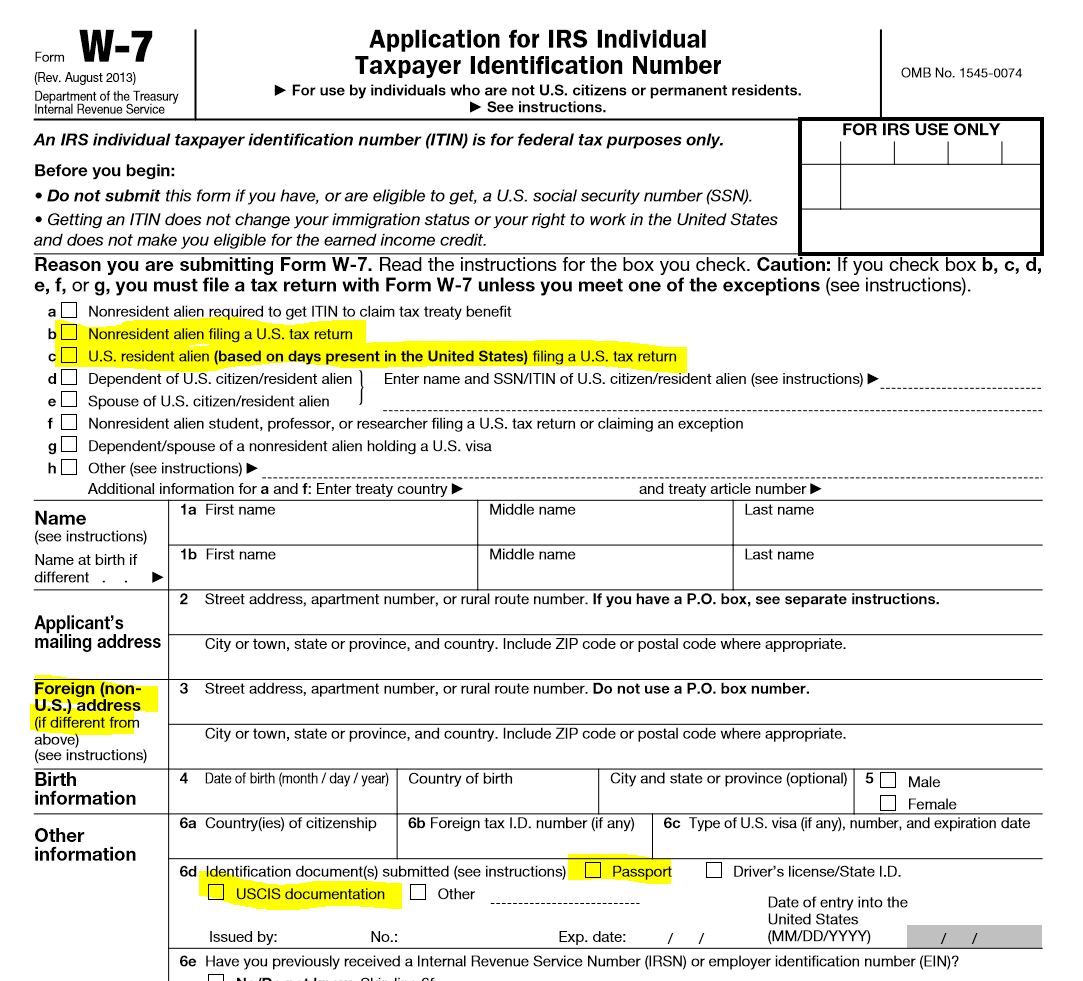
- A minority of U.S. citizens (unless they lived most of their lives in the U.S. and recently moved overseas as an “expatriate”) have no real basic idea of how the U.S. federal tax laws work; let alone to their assets and income in their country of residence. See USCs and LPRs Living Outside the U.S. – Key Tax and BSA Forms
- There are indeed plenty of immigrant U.S. residents (certainly less than 50% by my own experience – especially when concepts of PFICs and foreign tax credits start being discussed) who even understand the basics of U.S. international tax law.
- If they reside in an English speaking country that has relatively strong family or historical ties to the U.S. (e.g., England, Ireland, Scotland, and Canada, etc.) they are likely to have a better idea of the U.S. federal tax laws, but still the majority don’t know key concepts. See, Nuances of FBAR – Foreign Bank Account Report Filings – for USCs and LPRs living outside the U.S.
- Even those in English speaking countries that have less historical or family ties to the U.S. have a lesser understanding (e.g., New Zealand, Australia, Kenya, South Africa, India, etc.).
- Those who do not speak English know even less about U.S. tax laws and how they apply to them.
- Many individuals who learn of these requirements overseas are sometimes driven to great despair. The message they receive is not a correct one under the law in my view: as they read IRS materials (for instance, see FAQs 5, 6 and and former 51.2 from the Offshore Voluntary Disclosure Program Frequently Asked Questions and Answers 2014) and come to the conclusion they will soon be going to jail, criminally prosecuted or otherwise be subject to tens of thousands of dollars worth of penalties for their failure to file a range of tax forms.
- Literally, sometimes as a tax lawyer I feel more like a psychologist, when these individuals come to me saying they can’t sleep, they can’t eat, they are seeing a cardiologist for high blood pressure, etc. and even in a most extreme case they thought suicide was a solution. See, How is the offshore voluntary disclosure program really working? Not well for USCs and LPRs living overseas.
- Individuals around the world (even tax professionals) and certainly laypeople, are not commonly reading TaxAnalysts (nor would they subscribe) or other tax professional publications that explain many of the intricacies of U.S. tax laws.
- Learning and understanding U.S. tax laws, including just the basics, requires a great deal of time, aptitude for nuances and details, literacy, patience and a level of aptitude for such matters that simply escape many people around the world (most I would say). see, “PFICs” – What is a PFIC – and their Complications for USCs and LPRs Living Outside the U.S. I can relate to this personally, as I am an international tax professional (indeed I even studied a post graduate law course outside the U.S. in a non-English language), have spent my entire professional career of more than 25 years in the area, and yet only generally have a very superficial understanding of tax laws throughout the countries where I am dealing with clients. I don’t try to understand the details of those laws.
- Many people are angry and frustrated (justifiably so, in my view, in many cases) after learning they are subject to these rules. See comment above about being a psychologist. Plus, USCs and LPRs residing outside the U.S. – and IRS Form 8938. In addition, see, Taxpayer Advocate Report on Burdens of Benign Taxpayers who Make Mistakes
Back to the intelligent IRS tax attorney. My question to her was: “Why would you, as a U.S. born individual not be reviewing the tax laws, tax forms and tax instructions of the country where your parents were born prior to immigrating to the U.S.?” I asked: “Are you not reviewing those laws in the original language of your parents (not English, but the other language of your parent’s country) to understand what tax forms and returns you should be filing?”
The IRS attorney’s response was: “What: of course, I am not reviewing such tax forms or filing information or tax laws, as I would have no tax obligations in that foreign country where I have no income, no assets or no bank or financial accounts!”
My follow-up question was a simple one: “Don’t you realize that U.S. federal tax law (Title 26) and financial bank reporting laws (Title 31) do just that!”
“Hmm she paused: how can that be?” I don’t recall if she said this out loud, or just said it with her puzzled expression.
The answer of course is that through citizenship (including derivative citizenship through a U.S. parent even though the child never spent a single day of residence in the U.S., let alone received any income or assets); that same individual in the mirror position as that IRS attorney is subject to a host of U.S. federal tax and financial reporting laws. See, Sir Winston Churchill – Famous People. Did he become a U.S. citizen at birth via “derivative citizenship”? Did he file U.S. income tax returns?
Here is the big disconnect. It’s not just among the ill-informed or those lesser educated on the fine points of law. I had the pleasure this week along with my wife to host two educated, worldly and engaging individuals who have been married some 20 years together. They are well read and highly educated. Both are lawyers by training, one practices law that often pushes him fairly deeply into the tax law and his wife is a wonderful and experienced judge in the California state courts.
I asked them (as I like to ask people around the world) if they had ever heard or understood that the U.S. federal tax law imposes taxation and very detailed reporting on the worldwide income and assets of U.S. citizens who reside outside the U.S. I discussed  Cook v. Tait and the U.S. Civil War a bit. See both Supreme Court’s Decision in Cook vs. Tait and Notification Requirement of Section 7701(a)(50) and The U.S. Civil War is the Origin of U.S. Citizenship Based Taxation on Worldwide Income for Persons Living Outside the U.S. ***Does it still make sense?
All of it was a great surprise to them! They were in utter shock and both are residents in the U.S., highly educated in the law and are like the vast majority of the world, including U.S. citizens who reside outside the U.S.
This is the common response for many U.S. citizens residing overseas.