Ineligibeility for a SSN after Taking Oath of Renunciation – TINs, ITINs, EINs, etc.
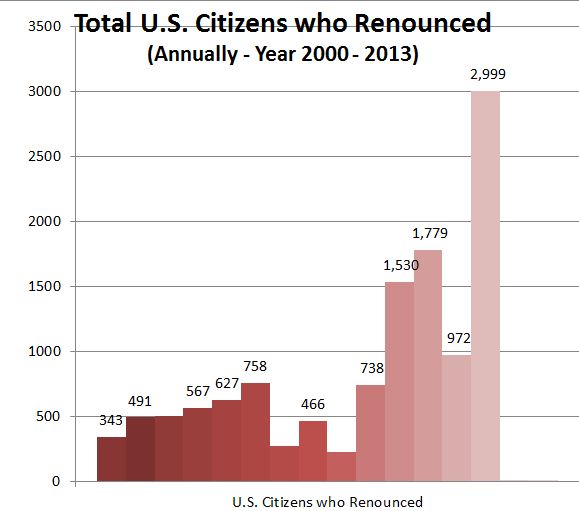
USCs and LPRs residing outside the U.S. have been increasingly renouncing their citizenship and abandoning their lawful permanently residency status, respectively. In some cases, individuals who have lived virtually all (or all) of their lives in a country other than the U.S. are a lmost making a “knee jerk” decision to renounce.
The statistics as to the absolute number and relative increases are astonishing. See, Wow, the number of 2,999 U.S. citizens who renounced in the year 2013 shattered the prior record set in 2011 of 1,782 renunciations. Why so many renunciations?
There is a practical problem for an individual who has renounced his or her U.S. citizenship prior to obtaining a Social Security Number (“SSN”). The individual will NOT be able to obtain a SSN once they have taken the oath of renunciation. See, *Why the Oath of Renunciation is Not the Opposite of the Oath of Allegiance
Of course, as prior posts have explained, an individual must have a “taxpayer identifying number” which must be a SSN for a U.S. citizen. However, the Social Security Administration will not allow an individual who has taken the oath of renunciation to apply for a SSN. See, The Catch 22 of Opening a Bank Account in Your Own Country – for USCs and LPRs
Also, see, Why do I have to get a Social Security Number to file a U.S. income tax return (USCs)?
The only way an individual can avoid becoming a “covered expatriate” is by filing U.S. federal income tax returns and being able to satisfy the certification requirement of Section 877(a)(2)(C). Accordingly, if a SSN is not available, the former citizen will need to file for an ITIN, as explained in previous posts.
Part I: Then and Now: Certificates of Loss of Nationality (CLNs)
How the world has changed since the 1960s; or rather how the world has remained the same and we humans have changed it so!?!
Imagine the shock and fear one might have if they learn they are a U.S. citizen while at the same time learning about U.S. citizenship based taxation of worldwide income regardless of where one lives. I use these terms purposefully, because a U.S. citizen who has spent almost all of their lives in the U.S., will likely have the sam reaction if they were born in another country and they were just told they should have been filing tax returns and detailed bank account reports for the last several decades under the law of that country (e.g., France, Canada, Libya, Mexico, South Africa, Germany, Eritrea, etc.). That person would probably be shocked and would also have some “fear” – depending upon which country is identified.
See, Why Section 7701(a)(50) is so important for those who “relinquished” citizenship years ago (without a CLN). . . This “shock and fear” was recently on display with a client who realized (rather should I say – “thought”) he was a U.S. citizen and therefore a U.S. income tax resident. For more background on U.S. citizenship and taxation, see – Sometimes Old is as Good as New – 1998 Treasury Department Report on Citizens and LPRs.
Ironically, the CLNs issued by the then U.S. Department of Sate versus the CLNs issued today are surprisingly similar in format and content. See Wide Window of Wait Times for CLN: One Month to 9 Months (or More?)
Imagine you have lived all of your life in your home country, for decades and decades. You were raised, educated and built your business or profession in your home country. Indeed you have become quite successful in your own country after a long life dedicated to your work.
However, by a pure act of arbitrariness (at least as far as you are concerned – since it was your mother who gave birth – without any input from you), you were born on U.S. soil. For those of us who live along the international border, this is a common occurrence.
Here in San Diego, the border crossing is one of the busiest land crossing in the world (if not the busiest). The U.S. federal government has reported (in the year 2000, which was presumably much less busier than today) it “ . . . processed over 41.5 million northbound passengers in personal vehicles and 8 million northbound pedestrians.” That is nearly 50 million going northbound, not counting the border crossing going southbound to Mexico.
The United States Department of Transportation reported that ” . . . Personal vehicles entered the United States nearly 96 million times in 2012, 33.1 million from Canada, and 62.7 million from Mexico, according to the U.S. Department of Transportation’s Bureau of Transportation Statistics’ (BTS). Border crossings also included 10.7 million trucks, 320 thousand buses, and 37 thousand trains in 2012 (Table 1).. . . ”
Needless to say lots of Canadians and Mexicans are born in the U.S. as part of the transit to and from the U.S., just along the borders.
This gentleman was born in the border town of Brownsville, Texas, many decades ago, where thousands of Mexicans are born to this day. He took an oath of allegiance to the Mexican government in the 1960s as was required at that time pursuant to the Mexican Constitution, so as not to lose Mexican citizenship. See, the 1997 article by Paula Gutierrez in the LMU of LA International and Comparative Law Review, Mexico’s Dual Nationality Amendments: They Do Not Undermine U.S. Citizens’ Allegiance and Loyalty or U.S. Political Sovereignty.
Recently, his U.S. citizenship and tax journey began after some 40+ years.
The redacted CLN from the 1970s is part of the story.
Subsequent posts will discuss the tax and other legal implications of this CLN, when it was issued, how and why;
- what the tax law said then versus now;
- what the immigration law said then versus now;
- what it meant (under U.S. immigration law) to take an oath of allegiance to a foreign country;
- the timing of when and what date is used for “renunciation” (how many years back in time?);
- what penalties (if any) he might have vis-à-vis U.S. law?
In this case, the basic fact that he never remembered taking these specific steps back when he was a teenager of 18 years of age and shortly thereafter as a young man.
He never notified the IRS of his USC renunciation (or maybe you prefer to call it relinquishment – though there is no clear legal distinction between these two terms) pursuant to Section 7701(a)(50). – See, Why Section 7701(a)(50) is so important for those who “relinquished” citizenship years ago (without a CLN). . .
His story, fortunately has a very happy ending considering the application of Section 877, et. seq.
To be continued . . .
IRA Distributions – (Counter-intuitive Results) U.S. Tax Consequences to Former USCs and Long Term Residents (LPRs)
IRA Distributions – (Counter-intuitive Results) U.S. Tax Consequences to Former USCs and Long Term Residents (LPRs)
Those USCs who have renounced citizenship (or who are contemplating renunciation) and those LPRs who (were/are/will) fall into the category of “long-term residents” who have qualified retirement accounts, known as “Individual Retirement Arrangement” (“IRAs”) have special considerations to consider under IRC Sections 877, et. seq. For more details on how IRAs work and the deduction limits, see the IRS website explanation.
In short, if an individual is a “covered expatriate” upon renunciation (or LPR abandonment), they will generally be subject to U.S. income taxation on the entire amount of the IRA (along with all other assets with unrealized gains), reduced by the exemption amount (currently US$680,000 for the year 2014).
Unfortunately, it is fairly easy to become a “covered expatriate” even if the asset or tax liability tests are not satisfied, simply if the individual fails to satisfy the certification requirement under Section 877(a)(2)(C). There are multiple posts that address this important certification requirement of Section 877(a)(2)(C), irrespective of how poor or how few of assets might be held by the individual. See, Certification Requirement of Section 877(a)(2)(C) – (5 Years of Tax Compliance) and Important Timing Considerations per the Statute, also see Can the Certification Requirement of Section 877(a)(2)(C) be Satisfied “After the Fact”?
Plus, the topic is covered yet further in More on “PFICs” and their Complications for USCs and LPRs Living Outside the U.S. -(What if there are No Records?)
Generally “covered expatriate” status is to be avoided, give the various adverse tax consequences. See, for instance, Why “covered expat” (“covered expatriate”) status matters, even if you have no assets! The “Forever Taint”!
However, since the U.S. tax law is complex and oftentimes full of unintended consequences, there may be times when “covered expatriate” status is desirable in any particular circumstance. I have seen and advised on several; including scenarios, where some planning steps can help get a much better U.S. tax result in various cases.
Assume a former USC does not meet the certification requirement (e.g., since they neglected to properly file a complete and accurate IRS Form 8854, or they otherwise did not comply with Title 26 for one or more of the five years preceding the renunciation/abandonment). Further, let us assume, she has an IRA with a total value of US$1.4M and all of her other assets have no unrealized gain (e.g., Euros in a bank in Europe and an apartment she purchased in her country of residence in Europe that continues to have depressed real estate prices). These other assets, the apartment and Euros are US$500,000 in value; hence, less than the US$2M net worth threshold. However, we will assume she did not timely comply with the certification requirements under the law.
In such an “unfortunate” case, she would have to accelerate all of the income (gain) from her IRA in the year she has her “date of expatriation”. This would cause a U.S. federal income tax liability of about US$260,000 that would become immediately due and payable. This amount is calculated as follows: US$1.4M total IRA, less the $680,000 exclusion amount, for a total taxable income of about $720,000 (which will generate an approximate US$260,000 income tax for someone who is not married filing jointly. This represents an effective tax rate of approximately 36% on the taxable income portion (US$260,000/US$720,000). Remember, however, $680,000 escapes taxation under the exclusion amount. Hence, the effective tax rate on the entire IRA portion is actually only about 18.6% in this case. This amount is calculated as total IRA income of US$1.4M against tax of US$260,000 (i.e., $260,000/$1.4M= 18.6%).
An 18.6% tax rate is generally a very “attractive” U.S. individual income tax rate for those who have high amounts of income, as is this case with US$1.4M.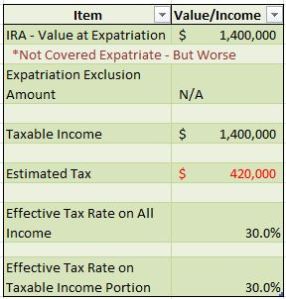
If instead, she is not a “covered expatriate” at the time she renounces her citizenship in 2014 (as she did comply with the certification requirements and otherwise would not meet the $2M net worth and her average annual net income tax liability for the preceding 5 years did not exceed $157,000) she would have a very different tax result. In short, she would not have to accelerate the entire tax liability. That sounds like good news, until one considers the U.S. tax rate on future IRA distributions to her after she ceases to be a U.S. citizen. Absent, an income tax treaty, she would have a 30% tax withheld at source (i.e., by the U.S. payer – trustee of the IRA) on each distribution made. If all US$1.4M is distributed out in one lump sum, there will be a tax of US$420,00 (US$1.4M X 30%); much more than the $260,000 for the “covered expatriate” scenario above. See calculations in this table:
Also, if she prefers to defer the IRA distributions (e.g., to make 14 annual distributions of US$100,000), she will have the same 30% tax withheld on each payment; hence, a total tax of US$420,00.
Obviously, a 30% tax is much worse than an 18.6% tax. Accordingly, this is a scenario where an individual may prefer to be a “covered expatriate” as opposed to avoiding such status. A bunch of factual analysis and strategic considerations would need to be considered in her case (e..g, where are her future heirs, what other income might she receive, will she receive any future gifts of inheritances herself, etc. etc.?).
Indeed, in this particular case, I can imagine a scenario (if accompanied by some focused tax planning), she could pay no more than a total effective tax rate of 12.2% on her income. Of course, 12.2% is better than 18.6% and 30%.
Finally, there is one more important wrinkle that can modify these results yet further; a particular income tax treaty with the U.S. that has a specific tax result that is better than the statutory 30% rate on distributions from an IRA to a non-resident alien. The U.S. has numerous income tax treaties with numerous countries, almost all of which have different terms and conditions. See, Countries with U.S. Income Tax Treaties & Lawful Permanent Residents (“Oops – Did I Expatriate”?)
Part I: What is “Willful” and what is “Non-Willful” for USCs and LPRs Residing Overseas Who Have Not Filed U.S. Tax Returns or FBARs?
Part I: What is “Willful” and what is “Non-Willful” for USCs and LPRs Residing Overseas Who Have Not Filed U.S. Tax Returns or FBARs?
This will be one of the most important questions to understand for any USC or LPR residing outside the U.S. who has not been filing U.S. income tax returns or FBARs. See, Nuances of FBAR – Foreign Bank Account Report Filings – for USCs and LPRs living outside the U.S.
The willfulness question is important, when the USC or LPR decides what steps they need to take regarding the filing of U.S. income tax returns.
A LPR residing predominantly in a country with a US. income tax treaty (of which there are 68) may be in the best position to “clean up” their U.S. tax filing and return positions. Specifically their facts might allow them to file as a non-resident under the “tie-breaker provisions” – typically Article 4); and indeed such filings might be applicable for several prior years.
See, Countries with U.S. Income Tax Treaties & Lawful Permanent Residents (“Oops – Did I Expatriate”?) for a comprehensive list of each income tax treaty and country.
The issue of “expatriation” becomes front and center for the LPR who notifies the IRS that he or she is not a resident of the U.S, pursuant to an applicable income tax treaty and files the treaty position accordingly.
Specifically, the statutory language of IRC Section 7701(b)(6) has three tests for when the individual is no longer a LPR for federal tax purposes:
- The individual is treated as a resident of a foreign country under the provisions of a tax treaty;
- The individual does not waive the benefits of the treaty, and
- Notifies the Secretary of the commencement of such treatment.
See, LPR status can be abandoned for tax purposes (since 2008 tax law changes) by merely leaving and moving outside the U.S. in some cases.
If the LPR has had that status for the requisite number of 8 years or more, to be treated as a “long term resident”, he or she would generally be subject to the “exit tax” of Sections 877 and 877A (plus a tax to any future U.S. persons who receive gifts or inheritances from such former LPR). See, The “Hidden Tax” of Expatriation – Section 2801 and its “Forever Taint.”
If the LPR has not been “non-willful” (double negative intended) by not filing U.S. income tax returns, interesting legal questions are raised as to the consequences to the LPR.
In addition, the IRS “streamlined” procedure announced on June 18th, 2014, has specific requirements obligating the taxpayer to certify “non-willful” behavior.
Various consequences of signing these certifications under penalty of perjury, will be discussed in later posts.
Read the Q&A format here.
Li Lianjie – Famous Former U.S. Citizens – Born in Beijing, China (“Jet Li”)
The Chinese actor Li Lianjie, who is better known by his stage name Jet Li, was born in Beijing. He was born in 1963 and his father died when he was just 2 years old and he “. . . was from a very poor family and . . . didn’t have enough money for a good school, so sports-school was good . . . ”
He is a huge star in China and throughout Asia and became famous in Hollywood.
As a teenager he became a master at Wushu, the full-contact sport from Chinese martial arts. His martial arts fame led to acting, first in China and also in the United States. His film debut Shaolin Temple (1982), helped make him a star.
He apparently became a naturalized citizen of the United States while working in Hollywood.
He apparently has also become a naturalized citizen of Singapore.
He is often highlighted by government officials of China as a model citizen and success story. 
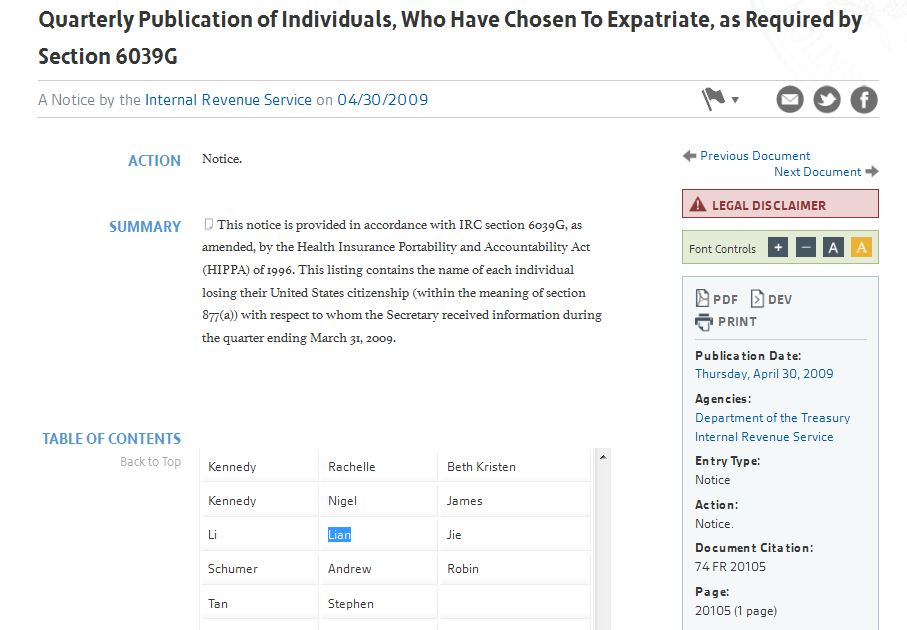
By the year 2009 he renounced his U.S. citizenship as listed in the U.S. federal government’s “Quarterly Publications of Individuals, Who Have Chosen to Expatriate, as Required by Section 6039G“
See here the list for the first quarter of 2009, where Li Lianjie is in the 2009 first quarter list of expatriates.
Presumably, Jet Li solicited timely and filed for a Certificate of Loss of Nationality (“CLN”) timely so he was not subject to the rules of 7701(a)(50) that went into effect in 2008 – See, Why Section 7701(a)(50) is so important for those who “relinquished” citizenship years ago (without a CLN). . .
Finally, the certification requirement that is available to those individuals who are born with dual national citizenship to avoid “covered expatriate” status, was presumably not available for Li Lianjie, since he was not born a U.S. citizen. Presumably, he could not satisfy each of the requirements of IRC Section 877A(g)(1)(B).
More on “PFICs” and their Complications for USCs and LPRs Living Outside the U.S. -(What if there are No Records?)
More on “PFICs” and their Complications for USCs and LPRs Living Outside the U.S. – -(What if there are No Records?)
The statutory rules of PFICs are set forth in 26 U.S. Code § 1297 – Passive foreign investment company. The U.S. Treasury and IRS also published new regulations in January 2014 on PFICs.
For an overview, see “PFICs” – What is a PFIC – and their Complications for USCs and LPRs Living Outside the U.S.
United States Citizens living overseas, whether or not they are “Accidental Americans”, as well as lawful permanent  residents (LPRs) living outside the U.S. generally have the burden of proof under U.S. tax law to show they complied with U.S. law. Indeed, when the Internal Revenue Service (IRS – the U.S. revenue authority) makes a tax assessment against an individual, the law generally carries with it a “presumption of correctness” in favor of the IRS.
This presumption of correctness was confirmed by the U.S. Supreme Court and therefore imposes the burden on the taxpayer of proving that the assessment made by the IRS is erroneous. During my career, I have seen plenty of erroneous assessments made by the IRS, and an increasing number of assessments made against taxpayers residing in countries throughout the world, be it France, Australia, Canada, Russia, Germany, Mexico, Thailand, Japan, Hong Kong, etc.
Why is this presumption of correctness relevant, when PFICs are explained and discussed here? The law of PFICs is complex, to the point that very few IRS revenue agents really have any detailed understanding of how PFICs work, when they apply and how taxpayers are to report their investments in PFICs. Very few U.S. tax practitioners understand PFICs.
Accordingly, I regularly see errors made by the IRS in proposed tax assessments, including PFIC calculations. Unfortunately for the individual taxpayer, they must prove the IRS is wrong in its tax assessment.
PFICs create a real burden on individual taxpayers who have shares in a PFIC in different locations around the world, since it is rare that foreign companies, investment funds, mutual funds and the like ever provide any detailed accounting of (a) asset, or (b) income information (per U.S. tax rules) that are required to be reported by PFIC investors who are USCs or LPRs.
Unlike a controlled foreign corporation (CFC), a PFIC has no ownership threshold. If a USC owns just 1,000 shares/units out of 20M issued shares in a foreign mutual fund, the U.S. citizen will nevertheless need to report this 1,000 share/unit interest (even though this is only 0.0005% of the fund) on his or her individual income tax return if the foreign mutual fund meets – the income test or asset test. Virtually all mutual and investments funds will satisfy these tests, since by definition the funds are making investments in other companies or other passive income items, such as bonds, stocks, futures, ETFs, etc.
The income test is met when at least 75% of the income is passive income as defined under the law. The asset test is satisfied when at least 50% of the foreign corporation’s average assets produce such passive income.
The practical problem arises when the individual taxpayer needs information from the fund (or other foreign entity) that reflects information such as –
- the pro-rata share of the “ordinary” earnings (in the example above, just 1,000 share/20M shares – 0.0005% of the fund);
- the pro-rata share of the “net capital gain”;
- the total cash or property distributed;
- the total cash or property “deemed” distributed (which means there was actually no distribution – but the law “deems” there to have been a distribution); and
- many other complex calculations that require basic information to be provided by the PFIC in the first place.
What foreign fund or investment company around the world (located in whatever country – catering to customers commonly in their own country) even tracks or accounts for income and gains for U.S. tax law purposes; i.e. “ordinary” earnings versus “capital gains” – specifically including the netting of “capital gains” and “capital losses” as required by U.S. law? I certainly do not see such accounting records provided in the marketplace of investment funds, hedge funds and companies that cater to persons residing outside the U.S.
Most foreign companies around the world (unless they are controlled and managed by USCs who are aware of these U.S. tax obligations) never maintain such accounting records or the detailed information necessary to even provide it to their USC or LPR investors. Hence, USCs/LPR investors may never be able to accurate make these PFIC calculations.
Also, the ownership of shares/units of the fund might always be changing throughout the year. In other words, even if the “ordinary income” and “net capital gain” is available for a particular fund/PFIC, the total number of outstanding shares/units has to be stable or known for the USC or LPR to calculate their pro-rata share. In the above example, if there are 20M outstanding shares/units at the beginning of the year, but by the end of the year there are 22M outstanding shares/units, how is the USC or LPR investor ever going to be able to calculate their pro-rata share, assuming they have the “ordinary” earnings and “capital gains” amounts for the entire calendar year? Its not simply the “ordinary” earnings and “capital gains” multiplied by 0.0005%.
The only “good news” in this explanation of PFICs, is that there is not an automatic US$10,000 penalty for failure to file their investments in a PFIC on IRS Form 8621, Information Return by a Shareholder of a Passive Foreign Investment Company or Qualified Electing Fund.
This is a departure from the normal rule of a minimum US$10,000 penalty for failure to file information returns regarding international (i.e., non-U.S. assets and investments). See, USCs and LPRs Living Outside the U.S. – Key Tax and BSA Forms.
All of these tax compliance rules begs a very important question for a USC who is considering renouncing their U.S. citizenship. The issue arises if they have had investments in PFICs during the last five years. If the USC has not been complying with IRC Section 1297 regarding PFICs, how can the taxpayer ever certify under penalty of perjury ” . . . that he has met the requirements of this title for the 5 preceding taxable years. . . [for purposes of Section 877(a)(2)(C)]”?
See, Certification Requirement of Section 877(a)(2)(C) – (5 Years of Tax Compliance) and Important Timing Considerations per the Statute
More details about PFICs to come in later posts.
Senator Reed Again Proposes Special “Tax Expatriation” Legislation Adverse to Former Citizens (not LPRs)
This blog has covered a number of posts related to Senator Reed, important to USCs who are considering (or who have already) renounced United States citizenship. See for instance, The 1996 Reed Amendment – The Immigration Law with “No Teeth” and “No Bite”
As previously explained, the 1996 Reed Amendment which is part of the immigration law (Title 8), but not the tax law (Title 26) –
– has never been invoked by the federal government to bar reentry of a former U.S. citizen in its history (even when it was relevant from the mid 1990s through the following two decades).
A bit of background on Senator Jack Reed of Rhode Island is worthwhile at this point. Senator Reed has had a long and illustrious public service career in the U.S. government. He has a military background where he studied at West Point, served as an Army Ranger, studied law at Harvard and previously was in the House of Representatives.
Senator Reed tried in 2012 to convince then Department of Homeland Security, Secretary Napolitano to enforce the 1996 Reed Amendment to preclude Facebook co-founder Eduardo Saverin from re-entry to the U.S. after he renounced U.S. citizenship. See portion of the letter in this blog.
Of course, Mr. Saverin would have been obliged to pay any “mark to market” U.S. tax applicable to his assets at the time of expatriation. He could not have escaped taxation under the law as it was written; which is the current law in effect today.
This past week Senator Reed was a sponsor of a new appropriates bill for the Department of Homeland Security; the “2015 Homeland Security” bill that provides for US$47.2B (billion) in appropriates for a range of spending; such as $10.2B for the Coast Guard, $5.5B for Immigration and Customs Enforcement (ICE), $1.6B for the Secret Service, among other spending items.
Senator Reed is identified in his own website as ” . . . A member of the powerful Appropriations Committee, which controls the purse strings of the federal government, Reed has been described by the Boston Globe as “a relentless advocate for his home state.” –
Within Senator Reed’s “2015 Homeland Security” proposed amendments, he apparently introduces a new provision to the immigration law – which is explained in his website as –
- Reed’s provision to help prevent expatriate tax dodgers from reentering the United States calls on DHS to report within 90 days on their efforts to enforce the law that Senator Reed authored to prohibit individuals from reentering the United States if they renounced their citizenship in order to avoid taxes.
This Reed proposal seems very odd, since the motivation of how or why someone renounced their U.S. citizenship or formally abandoned their LPR status, became irrelevant for federal income tax purposes with the 2008 “mark to market” modifications. See, Joint Committee Reports – 2008 Report re: HEROES Act – Mark to Market Regime – New Section 877A (55 pages)
Indeed, the reason or purpose anyone decided to renounce their citizenship, became irrelevant for tax purposes with the 2004 amendments to Title 26. See, more detailed information on this blog in the Government Reports Re – Law.
Senator Reed’s proposal seems even more odd, when one considers that the federal government is already required to publish quarterly the list of USCs who have renounced. See, Will the IRS simply select the list of published former citizens for tax audits?
This begs the question – Why does Senator Reed propose such legislative modifications?
- for political reasons;
- to attract more press;
- to identify those who actually owe taxes – “tax dodgers”; or
- to generally demonize United States citizens living overseas who have decided to shed their USC?
Why does Senator Reed persist on trying to get former USCs barred from re-entering the U.S., if and when they fully comply with the tax provisions; IRC Sections 877, 887A, 2801, et. seq.? See, Reed Asks Homeland Security to Enforce Law on Ex-Citizen Tax
Also, see Senator Reed’s complete 17 May 2012 letter (Reed’s letter to Napolitano) on the subject; which of course was never enforced at the time. It was not enforced by the Department of Homeland Security or the U.S. Justice Department.
Finally, see also, Obtaining a U.S. Visa after Renouncing U.S. Citizenship – The Cloud of the Still Living “Reed Amendment”
Senator Reed’s shadow looms large, at least theoretically, over anyone considering renouncing their United States citizenship.
Supreme Court’s Decision in Cook vs. Tait and Notification Requirement of Section 7701(a)(50)
The U.S. Supreme Court upheld as Constitutional the concept of citizenship based taxation in 1924 in Cook v. Tait. In that case, the U.S. citizen resided permanently and was domiciled in Mexico City with his Mexican citizen wife.
In those years, the Revenue Act of 1921 imposed a top income tax rate of 8%. The IRS made a demand against Mr. Cook to pay his tax. Mr. Cook paid it and sued for refund of the US$1,193 paid. That amount represents about  US$16,893 in 2014 inflation adjusted dollars. Neither amounts are significant in current actions taken by the IRS.
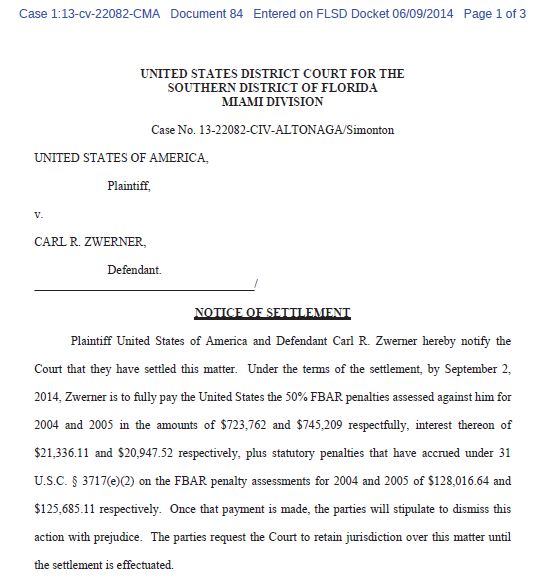
As a point of reference, Mr. Zwerner was alleged to owe US$3,630,119 (on an account with a maximum value during the years at issue of apparently no more than US$1.69M) and ultimately paid about US$ 1.75M (more than he even had in his account?) per the Notice of Settlement filed with the Court referenced here:
Even in 1922 dollars when Mr. Cook was living in Mexico City, the payment by Zwerner of about US$ 1.75M in current dollars, would represent about $123,581 in those dollars. See, Why the Zwerner FBAR Case is Probably a Pyrrhic Victory for the Government – for USCs and LPRs Living Outside the U.S. (Part II)
There was no Foreign Account Tax Compliance Act (“FATCA”) in the days of Cook in Mexico City, so it would be interesting to know how and why the audit and tax assessment collection was commenced. This was long before e-mails and internet, and there was a very different system of international travel. Communication and technology in 2014 is quite different from technology nearly 100 years ago when the first transcontinental (not transnational) telephone call was made in 1915 a few years before the tax issue arose in the case of Mr. Cook.
Now to the key point of this post. The Supreme Court in Cook vs. Tait framed the question before the Court as follows:
- The question in the case . . . as expressed by plaintiff [Mr. Cook], whether Congress has power to impose a tax upon income received by a native citizen of the United States who, at the time the income was received, was permanently resident and domiciled in the city of Mexico, the income being from real and personal property located in Mexico.
Can the United States impose worldwide taxation on U.S. citizens who permanently live overseas and who only have income from property or services outside the U.S.? Of course, the Supreme Court, said, that such a citizenship based rule was Constitutional. The rationale of the Court was explained in the opinion as follows, specific to the rights of citizenship:
- . . . the scope and extent of the sovereign power of the United States as a nation and its relations to its citizens and their relation to it.’ And that power in its scope and extent, it was decided, is based on the presumption that government by its very nature benefits the citizen and his property wherever found, and that opposition to it holds on to citizenship while it ‘belittles and destroys its advantages and blessings by denying the possession by government of an essential power required to make citizenship completely beneficial.’ In other words, the principle was declared that the government, by its very nature, benefits the citizen and his property wherever found, and therefore has the power to make the benefit complete. Or, to express it another way, the basis of the power to tax was not and cannot be made dependent upon the situs of the property in all cases, it being in or out of the United States, nor was not and cannot be made dependent upon the domicile of the citizen, that being in or out of the United States, but upon his relation as citizen to the United States and the relation of the latter to him as citizen. [emphasis added]
The Supreme Court emphasizes at several points that it is because of the benefits of citizenship and the rights conferred to the citizen of the United States, that the United States government has the Constitutional power to impose worldwide taxation.
What is the difference, if someone is NOT a U.S. citizen? How can the U.S. federal government impose worldwide taxation on property outside the U..S. when the individual is not a citizen, has no right to even enter the United States and generally has no benefits or protections afforded to a U.S. citizen? Indeed, a recent interpretation of the U.S. government in a Justice Department memo spells out the rights of certain U.S. citizens. See New York Times recent article, Court Releases Large Parts of Memo Approving Killing of American in Yemen Targeting Anwar al-Awlaki Was Legal, Justice Department Said
Back on topic, the rationale in Cook v. Tait did not extend to someone who was not a citizen. For example, the Internal Revenue in the 1920s was of course not attempting to impose taxation on Mr. Cook’s Mexican national wife who lived exclusively in Mexico.
Herein, is a most interesting problematic and possibly (maybe – probably?) unconstitutional aspect of current law under the provisions off IRC Section 7701(a)(5)(if the loss of nationality is retroactive to a date long ago in the past but the tax code/IRS is not recognizing that past date as the expatriation date.
See, Why Section 7701(a)(50) is so important for those who “relinquished” citizenship years ago (without a CLN)
If someone has lost all rights to U.S. citizenship years or decades ago, how can the U.S. federal government continue to impose worldwide income taxation for all of the intervening years?
How can the tax law impose a “Constitutional fiction” that a person continues to be “. . . treated as a United States citizen . . . ” simply because they did not file a paper notification with the U.S. federal government. See, Section 7701(a)(50) was adopted and has a very clear timing rule about when a person “. . . cease[s] to be treated as a United States citizen. . . ” It is not the same as for immigration law purposes. It’s a fiction in the tax law as to when one ““. . . cease[s] to be . . . a United States citizen. . . ”
The statute says ” . . . An individual shall not cease to be treated as a United States citizen before the date on which the individual’s citizenship is treated as relinquished under section 877A (g)(4). . .”
How can the U.S. federal government continue to impose U.S. worldwide income taxation on former U.S. citizens because of the provisions under Section 7701(a)(50) and 877A (g)(4)?
The U.S. Supreme Court in Cook vs. Tait found the U.S. citizenship based taxation system as Constitutional since ” . . . government by its very nature benefits the citizen and his property wherever found . . .” and because of “ . . . his relation as citizen to the United States and the relation of the latter to him as citizen. . . . ” [emphasis added]
A person who is not a citizen, obviously does not receive these benefits from the government as does a United States citizen.
In practice, the only body that can determine whether a law is Constitutional or not, is the U.S. Supreme Court. It’s not likely that this question will reach the Supreme Court any time soon; if ever. Meanwhile, the IRS generally has the duty to enforce the law as currently written.
IRS Sting Operation and Criminal Tax Indictments of Canadian Citizens – Investigations Overseas – Enabling U.S. Taxpayers with Offshore Accounts
The U.S. Department of Justice reported that two Canadian citizens along with a U.S. citizen were indicted for enabling tax evasion with offshore accounts. The press release from three months ago, 24 March 2014, can be reviewed here. Some highlights of the press release are below:
- According to the indictment, . . . Poulin, an attorney at a law firm based in Turks and Caicos, worked and resided in Canada and in the Turks and Caicos. His clientele also included numerous U.S. citizens.
- According to the indictment, Vandyk, St-Cyr and Poulin solicited U.S. citizens to use their services to hide assets from the U.S. government. Vandyk and St-Cyr directed the undercover agents posing as U.S. clients to create offshore foundations with the assistance of Poulin and others because they and the investment firm did not want to appear to deal with U.S. clients. Vandyk and St-Cyr used the offshore entities to move money into the Cayman Islands and used foreign attorneys as intermediaries for such transactions.
- According to the indictment, Poulin established an offshore foundation for the undercover agents posing as U.S. clients and served as a nominal board member in lieu of the clients.
The facts of this case will be interesting to cover, to see how and to what extent the IRS and Justice Department will be focusing on U.S. citizens residing overseas and their reporting (or failure to report) their “foreign” accounts; i.e., their financial accounts in their home countries of residence.
Since the withholding tax provisions under the Foreign Account Tax Compliance Act (“FATCA”) come into effect in a matter of days, it will be interesting to see if the government has more indictments along these lines planned for the summer of 2014.
U.S. citizens who are in the process of renouncing citizenship should be aware of each of the steps required as part of the process; both under U.S. federal tax law and immigration law.
See, The Importance of a Certificate of Loss of Nationality (“CLN”) and FATCA – Foreign Account Tax Compliance Act.
Also, see Revisiting the consequences of becoming a “covered expatriate” for failing to comply with Section 877(a)(2)(C).
More on the New 2014 “Streamlined” Process for USCs and LPRs Residing Overseas
The June 2014 changes by the IRS in its offshore voluntary disclosure (“OVD”) program are significant and worthy of discussion for USCs and LPRs residing overseas.
I will dedicate several blogs to this topic over the next few weeks. See, these posts on the topic for additional background: See, “IRS Makes Changes to Offshore Programs; Revisions Ease Burden and Help More Taxpayers Come into Compliance” – How Will These Changes Affect USCs and LPRs Living Outside the U.S.?
See, New 2014 “Streamlined” Process for USCs and LPRs Residing Overseas – The Thorny “Certification Requirement”
See,earlier post –Why the so-called “Streamlined” Process is “Much Ado About Nothing” – Legally Speaking,
This post is dedicated to some background, about the legal framework of the OVD and what the IRS calls “streamlined” filing.
First, it is worth reiterating, that the tax law, Title 26, is not the source of the terms of either the OVD or Streamlined. For some basic background of the statutory regime and Title 26 (along with Title 31, et. seq), see, Why the FBAR (late filed or never filed) is not a requirement for the Certification Requirement of Section 877(a)(2)(C) – (5 Years of Tax Compliance)
In addition, the Bank Secrecy Law, title 31, is not the source of the terms of either the OVD or Streamlined.
Rather, the Internal Revenue Service (the agency responsible for enforcing Title 26) has created its own terms and conditions as part of both the OVD and the “Streamlined” process. See,the “FAQs” that are published by the IRS: Offshore Voluntary Disclosure Program Frequently Asked Questions and Answers: Effective for OVDP Submissions Made On or After July 1, 2014
The terms of these FAQs are not law. The IRS can change them at anytime and without notice to anyone. Indeed the IRS has changed and modified them on numerous occasions since the initial OVD program in 2009.
Second, it is crucial to understand the basic framework of the law from Title 26 that all USCs living overseas are subject to; and the various consequences of the law. Plus, many LPRs living overseas are subject to Title 26 (but not all of them – depending upon a number of factors). The U.S. tax law is complex and there are numerous compliance requirements with onerous penalties that can be assessed. For instance, see, “PFICs” – What is a PFIC – and their Complications for USCs and LPRs Living Outside the U.S.
Also, see, US Citizenship Based Taxation. In addition, see, What could be the focal point of IRS Criminal Investigations of Former U.S. Citizens and Lawful Permanent Residents?
In that post, I summarize the principle criminal statutory rules in Title 26 – which are set out below:
1. Criminal Offenses under Title 26 (Federal Tax Law)
a. Tax Evasion (IRC Section 7201)
b. Filing a False Return or Other Document – Perjury (IRC Section 7206(1) )
- (i) Aiding or assisting in the perpetration of a false or fraudulent document (26 U.S.C. § 7206(2))
- (ii) Removal or concealment with intent to defraud, commonly related to untaxed liquor (26 U.S.C. § 7206(4))
- (iii) Compromises and closing agreements involving fraud or concealment (26 U.S.C. § 7206(5))
c. Failure to File Return, Supply Information, or Pay Tax – (IRC § 7203 – Misdemeanor – up to 12 months imprisonment)
d. Fraudulent Returns, Statements, or Other Documents (IRC § 7207)
e. “Structuring” Transactions to Evade Cash Reporting (IRC § 6050I)
In addition to these tax specific crimes, other key crimes commonly used by IRS CI agents in tax cases, particularly international cases, include:
2. Tax Related Criminal Offenses under Titles 18 and 31 (Not Tax Law Specific)
a. Conspiracy (Section 371 of Title 18)
- (i) Elements of the Offense
- (ii) Penalties and Statute of Limitations
b. False Statements (Title 18 U.S.C. § 1001)
- (i) Penalties and Statute of Limitations
c. Perjury
d. Mail fraud
e. Principals and those Who Aid and Abet (Title 18)
f. Accessory After the Fact
You may be asking – “If the terms and conditions of OVD and Streamlined are not the law – why should I consider either in my circumstances?”
The OVD is a bargain between the IRS/Justice Department and taxpayers. In short, if you participate by its terms, you will not (at least “should not”) be criminally prosecuted. The OVD program is in my view a program worthy of consideration for those who have committed any of the above tax and tax related crimes; and this will depend entirely upon the facts of each case. How, when and if these laws have been violated, can only be analyzed and considered for each particular case, based upon the detailed factual circumstances of each individual.
For those individuals, who have not committed any of the above tax related crimes, the OVD program is probably not a good option for such USC or LPR residing overseas. See an earlier article I published titled – The 2013 GAO Report of the IRS Offshore Voluntary Disclosure Program, International Tax Journal, CCH Wolters Kluwer, January-February 2014. PDF version here.
There is one caveat to this issue, which arises from the willfulness FBAR penalty. The government has argued (at least in one case) that multiple year 50% willfulness penalties can apply, even if the individual had no knowledge of the law – See, FBAR Penalties for USCs and LPRs Residing Overseas – Can the Taxpayer have no knowledge of the law and still be liable for the willfulness penalty? See government memorandum.
Clearly, the facts of the Zwerner case need to be considered carefully in how and why the government argued their position. It seems, maybe the biggest fact used against the taxpayer was that he had “touched the money”; i.e., drawn and spent some of the funds over the years?
Next, if there is little risk of a 50% willfulness penalty and there is no criminal liability, the so-called “Streamlined” process is an option. However, again, the terms of the “Streamlined” are not terms set forth in Title 26; they are made up by the IRS. They also do not bind the IRS. I strongly recommend reading the post, –Why the so-called “Streamlined” Process is “Much Ado About Nothing” – Legally Speaking, which provides the following about the process (before modified in its current form – which continues to be applicable today):
Does any of the above [referring to Streamlined] protect the USC residing outside the U.S. from an audit for any year a U.S. federal income tax return was not filed? The short answer is – NO!
Does any of the above statements in the IRS announcement mean that a USC residing overseas could not be subject to late payment or late filing penalties for not previously filing U.S. tax returns. The short answer is – NO!
Does any provision in the IRS announcement mean the FBAR penalties could not apply for failure to file. The short answer is – NO! See, When does the Statute of Limitations Run Against the U.S. Government Regarding FBAR Filings?
Does any of the above statements in the IRS announcement mean that a USC residing overseas can never be subject to penalties for not filing information returns regarding their non-U.S. international assets and “specified foreign financial assets”? The short answer is – NO! See, USCs and LPRs residing outside the U.S. – and IRS Form 8938
Importantly, there is nothing in the law (e.g., Title 26 or elsewhere) that would obligate any USC or LPR residing overseas to participate in either OVD or the “streamlined” process. Both have different consequences, potential benefits, and certainly legal risks.
Finally, the last option, that is actually subject to the law, i.e., Title 26, is filing tax returns through normal channels. Most all U.S. taxpayer file tax returns through this normal procedure.
As always is the case, but particularly for those who have not filed tax returns or FBARs, the facts of each particular case need to be considered, to determine the legal risks, benefits and consequences of any of these three approaches.

 lmost making a “knee jerk” decision to renounce.