Part I: Common Myths about the U.S. Tax and Legal Consequences Surrounding “Expatriation”
· Myths – about Renouncing U.S. Citizenship
There are many misunderstandings of how the law works when someone renounces U.S. citizenship. The author regularly hears a range of myths that will befall an “Accidental American” when and if, they renounce. These “myths” include the following:
- Myth 1: There is a 10 year period of U.S. income taxation after renouncing citizenship.

- Fact: The old tax law from 1996 and the modifications in 2004 had a 10 year period of taxation concept after “expatriation.” There is no longer such a 10 year period of taxation for those persons who renounce on or after June 17, 2008.
- Myth 2: Former U.S. citizens will not be allowed to enter into the U.S.; i.e., will be barred from re-entry at a point of entry by a U.S. immigration officer.
- Fact: Former U.S. citizens are generally entitled to any visa status, the same as any other non-U.S. citizen. There is not a single case where a former U.S. citizen was barred re-entry to the U.S., due to tax motivated purposes.
- Myth 3 : Former U.S. citizens will not be allowed to ever re-obtain citizenship.
- Fact: Former U.S. citizens are generally entitled to U.S. citizen status, the same as any other non-U.S. citizen. Importantly, U.S. citizenship may simply not be available to any particular non-U.S. citizen, depending upon the particular circumstances.
- Myth 4: U.S. citizens do not need to renounce their U.S. citizenship if they live in a country with an income tax treaty with the U.S.; since the tie breaker rules of residency will keep them from being U.S. income tax residents.
- Fact: U.S. citizens cannot escape worldwide taxation, both income and gift/estate taxes, by living outside the U.S., since all U.S. bilateral income tax treaties and estate and gift tax treaties have a “savings clause” allowing the U.S. government to impose taxation on U.S. citizens notwithstanding the treaty.[1] This is how the U.S. tax net works on worldwide assets and income.
There are many more myths which will be discussed in a later post.
[1] See footnote no. 14 of Crow v. Commissioner, 85 T.C. 376 (1985):
14/ . . . The Treasury Department’s explanation of the Maltese treaty . . . :
“Paragraph (3) contains the traditional ‘saving clause’ under which each Contracting State reserves the right to tax its residents, as determined under Article 4 (Fiscal Residence), and its citizens as if the Treaty had not come into effect. [Department of Treasury, Technical Explanation of the Agreement Between the United States of America and the Republic of Malta with Respect to Taxes on Income 2 (Published in Treasury Department Press Release R 367 on Sept. 24, 1981), 1984-2 C.B. 366.]” This interpretation is consistent with the typical interpretations accompanying recent treaties containing general savings clauses.
“Covered Expatriate” Status is a “Scarlet Letter”
Throughout Tax-Expatriation, I have tried to emphasize the importance of avoiding “covered expatriate” status, if at all possible – and at all costs. It is a technical term defined in the tax law.
“Covered Expatriate” status is a “Scarlet Letter”.
There is much misunderstanding about how the tax expatriation provisions of the law apply. Many people think they only apply to wealthy individuals. This is not the case.
See various posts explaining the importance of the Certification Requirement of Section 877(a)(2)(C):
Why “covered expat” (“covered expatriate”) status matters, even if you have no assets! The “Forever Taint”!
Certification Requirement of Section 877(a)(2)(C) – (5 Years of Tax Compliance) and Important Timing Considerations per the Statute
Avoiding the Lobster Pot: Why becoming a Naturalized Citizen or LPR can be the proverbial “Lobster [Tax] Pot”
Why a Naturalized Citizen cannot avoid “Covered Expatriate” status under IRC Section 877A(g)(1)(B)
Can the Certification Requirement of Section 877(a)(2)(C) be Satisfied “After the Fact”?
As explained throughout, there are many ways for individuals to fall into the “covered expatriate” category. I liken it here to the “Scarlet Letter”. The fictional protagonist in Nathaniel Hawthorne book, could never shed herself of the consequences of her infidelity and wore the Scarlet Letter for life. It had devastating consequences to her, her loved ones around her and especially her daughter.
This is also true for “covered expatriate” status; but it is not fictional. Covered expatriate status can never be shed and can have disastrous consequences not only for the former USC or LPR; but also to the friends and family of the individual who carries around the “covered expatriate” status for life. See, The dangers of becoming a “covered expatriate” by not complying with Section 877(a)(2)(C).
Revisiting the consequences of becoming a “covered expatriate” for failing to comply with Section 877(a)(2)(C).
In the book, the protagonist took the Scarlet Letter to her grave and had it on her tombstone. “Covered expatriate” status extends beyond the grave and beyond the tombstone. Any loved one who is a U.S. person of a “covered expatriate” who receives a gift or inheritance, will be subject to a tax; even if the inheritance occurs many years after the death of the covered expatriate. In this case, the Scarlet Letter transfers to the loved one who receives property in the future and continues on for another generation. At least in Nathaniel Hawthorne’s book, the daughter Pearl received an inheritance not tainted by the Scarlet Letter.
The Importance of Planning – PRIOR to Renouncing, Relinquishing or Abandoning
International tax law experts who specialize in a particular area of the law, have a fairly good understanding of the importance of tax planning. The reason is simple. The law is complex and without planning,  laypeople can often cause very adverse tax consequences to themselves and their friends and family members (in the case of tax expatriation) without understanding the full implications of the law.
“Tax expatriation” in the U.S. is particular complex for several reasons:
1. The general rule is that there is an immediate income tax payable from the “mark to market” taxation rules on unrealized gains. See, Part I: Common Myths about the U.S. Tax and Legal Consequences Surrounding “Expatriation”
2. If a tax is recognized under the U.S. tax law, the only way to discharge the liability with the U.S. federal government is to pay the tax owing. The IRS generally can collect an income tax owing against a taxpayer who lives outside the U.S. indefinitely, as the 10 year collection statute does not apply when the individual outside the United States for a continuous period of at least six months. See, IRC Section 6503(c). More on this topic in another post. In other words, the IRS can “forever” pursue the collection of the “expatriation tax” against USCs and LPRs living outside the U.S.
3. It is easy to fall into the general rule of expatriation, even if the taxpayer would not otherwise be subject to income taxation. See, Why “covered expat” (“covered expatriate”) status matters, even if you have no assets! The “Forever Taint”!
4. The friends and family of the “covered expatriate” – i.e., the former U.S. citizen and long-term lawful permanent resident can be subject to U.S. taxation during their lifetimes, even if they also live outside the U.S. See also, some of the consequences of being a “covered expatriate” – The “Hidden Tax” of Expatriation – Section 2801 and its “Forever Taint.”
Each of these points help demonstrate the need for planning prior to running to the U.S. Department of State and completing and filing the following forms when you take the oath of renunciation:
Form DS-4081, Statement of Understanding Concerning the Consequences and Ramifications of Relinquishment or Renunciation of U.S. Citizenship.
See, Documents to Request the Consular Officer When Renouncing U.S. Citizenship
At the end of the day, if the individual lives outside the U.S. and does not travel to and from the U.S., it may be very difficult (at least practically speaking) for the IRS to collect on the tax judgment owing, if the individual has no assets in the U.S. There are legal means and steps the IRS can take in an attempt to try to collect U.S. taxes on overseas assets.
For a further discussion on collection of taxes overseas:
See, U.S. Enforcement/Collection of Taxes Overseas against USCs and LPRs – Legal Limitations, and
Part II: U.S. Enforcement/Collection of Taxes Overseas against USCs and LPRs – Pasquantino – Wire Fraud and Mail Fraud
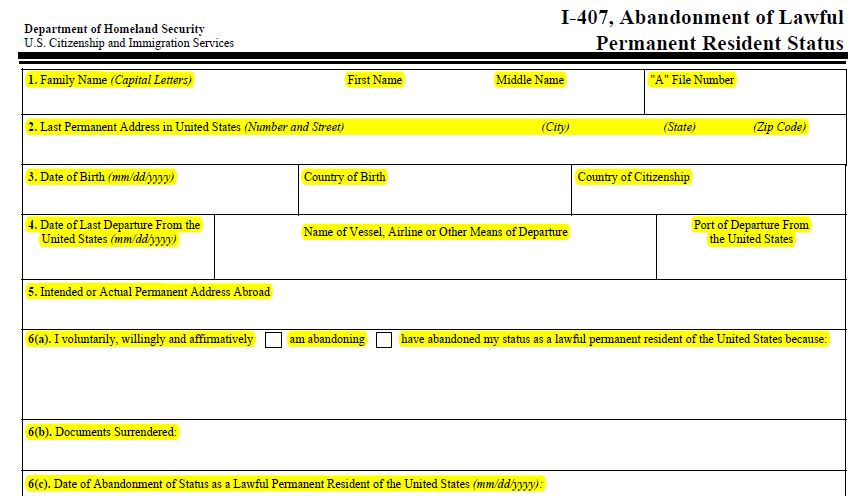
Ideally, a former U.S. citizen or long-term lawful permanent resident will wish to avoid all of the potential tax and collection issues, by engaging in thoughtful and strategic planning prior to their renunciation of U.S. citizenship or abandonment of lawful permanent residency.
Why the terms “Relinquish” and “Renounce” are Not Legally Distinguishable for Immigration or Tax “Expatriation” Law Purposes
The topic of “relinquish” versus “renounce” has already been touched upon in an earlier post. See, The Semantically Driven Vortex of “Relinquishing” vs. “Renouncing”
Posted on June 21, 2014
Guest Post from Immigration Lawyer – Mr. Jan Bejar –
***
It seems that many individuals think there is an important distinction, legally speaking for U.S. federal tax purposes.
In sum, I am of the view that both terms are in effect interchangeable for federal tax purposes.
The important time reference under the law of IRC Sections 877 and 877A is the “expatriation date” as defined in Section 877A(g)(3) – which focuses on specific dates tied to meetings or events with the U.S. Department of State.
Indeed the tax statute uses the terms “renounce” and “relinquish” in the same breath.
The key terms of the statute are set out below:
(3) Expatriation date
**
The term “expatriation date” means—
**
(A) the date an individual relinquishes United States citizenship, or
**
(B) in the case of a long-term resident of the United States, the date on which the individual ceases to be a lawful permanent resident of the United States (within the meaning of section 7701 (b)(6)).
**
(4) Relinquishment of citizenship
**
A citizen shall be treated as relinquishing his United States citizenship on the earliest of—
**
(A) the date the individual renounces his United States nationality before a diplomatic or consular officer of the United States pursuant to paragraph (5) of section 349(a) of the Immigration and Nationality Act (8 U.S.C. 1481 (a)(5)),
**
(B) the date the individual furnishes to the United States Department of State a signed statement of voluntary relinquishment of United States nationality confirming the performance of an act of expatriation specified in paragraph (1), (2), (3), or (4) of section 349(a) of the Immigration and Nationality Act (8 U.S.C. 1481 (a)(1)–(4)) . . .
As Mr. Jan Bejar said in his guest blog, renouncing citizenship is a way to relinquish it, so when discussing this form of relinquishment, the two words can be used interchangeably.
Read the Q&A format here.
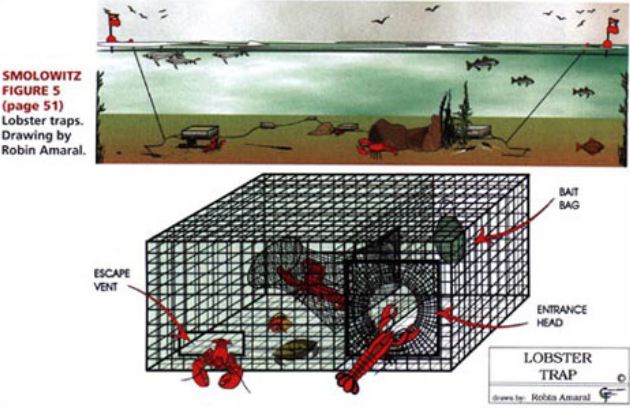
Avoiding the Lobster Pot: Why becoming a Naturalized Citizen or LPR can be the proverbial “Lobster [Tax] Pot”
Two famous tax professors coined a wonderful analogy that can largely be applicable to any non-U.S. citizen who is considering either becoming a (1) lawful permanent resident (LPR), or (2) a naturalized citizen.
Tax professors Boris I. Bittker (Yale) and James S. Eustice (NYU), both of whom are now deceased, wrote –
- “[Under the tax laws] a corporation is like a lobster pot: it is easy to enter, difficult to live in, and painful to get out of.”
I think the same analogy is very much appropriate to a non-U.S. citizen who becomes a LPR or a naturalized citizen, without fully understanding the U.S. federal tax consequences of such a decision. The word “corporation” merely should be changed with “lawful permanent resident” or “naturalized citizen” in the quote from Bittker and Eustice when considering the potential long-term application of the “expatriation tax” rules.
The analogy is particularly applicable for two reasons. First, individuals are usually less sophisticated and, often times, simply unaware of complex tax laws. Corporate taxpayers often can have a better understanding of complex U.S. tax laws – i.e., the “lobster trap” via sophisticated tax advisers.
Second, some lobster traps have an “escape vent” for small lobsters. Similarly, the tax laws on expatriation can treat individuals with smaller amounts of assets or U.S. tax liabilities, very differently and more favorably under the law. See, Certification Requirement of Section 877(a)(2)(C) – (5 Years of Tax Compliance) and Important Timing Considerations per the Statute,
Non-U.S. citizens who are not certain they will spend the rest of their lives in the U.S., should carefully consider if they indeed wish to obtain LPR or become a naturalized citizen. This is because of the long-term tax consequences of Sections 877, 877A, 2801, etc. for those who later abandon their LPR status or renounce their U.S. citizenship.
Of course, this blog, is dedicated to shedding light on the income tax, estate and gift tax, and “covered gift” and “covered” inheritance tax consequences to those who enter the “lobster trap.”
Many more may wish to simply shy far away from the lobster trap to begin with.
Why a Naturalized Citizen cannot avoid “Covered Expatriate” status under IRC Section 877A(g)(1)(B)
A previous post explained why lawful permanent residents (LPRs) can never satisfy this exception in the law to avoid “covered expatriate status.” See, Why a “long-term” LPR can NEVER avoid “Covered Expatriate” status under IRC Section 877A(g)(1)(B) if Asset or Tax Liability Test is Satisfied!
For the same reasons, a naturalized citizen cannot satisfy the statutory requirement since they will never be able to meet the IRC Section 877A(g)(1)(B)(i)(I) requirement of becoming ” . . . at birth a citizen of the United States . . . ”
See the relevant provisions of the statute as follows:
(B) Exceptions
An individual shall not be treated as meeting the requirements of subparagraph (A) or (B) of section 877 (a)(2) if—
(I) became at birth a citizen of the United States and a citizen of another country and, as of the expatriation date, continues to be a citizen of, and is taxed as a resident of, such other country, and
(II) has been a resident of the United States (as defined in section 7701 (b)(1)(A)(ii)) for not more than 10 taxable years during the 15-taxable year period ending with the taxable year during which the expatriation date occurs, . . .
Of course a naturalized United States citizen by definition was not a citizen at birth and only became one upon completing the lengthy legal requirements of naturalization. See, USCIS website – Citizenship Through Naturalization
Why a “long-term” LPR can NEVER avoid “Covered Expatriate” status under IRC Section 877A(g)(1)(B) if Asset or Tax Liability Test is Satisfied!
There have been multiple posts explaining the importance of the certification requirement of Section 877(a)(2)(C).
See for instance, Certification Requirement of Section 877(a)(2)(C) – (5 Years of Tax Compliance) and Important Timing Considerations per the Statute, also see Can the Certification Requirement of Section 877(a)(2)(C) be Satisfied “After the Fact”?
This specific act of “certifying” is a requirement under the law, that requires all individuals (whether U.S. citizens or LPRs) to satisfy the elements of the certification, in order to avoid “covered expatriate” status.
Also, there is an important exception to “covered expatriate” status set forth in IRC Section 877A(g)(1)(B). Only certain individuals may be able to satisfy this important requirement, which provides as follows:
(B) Exceptions
An individual shall not be treated as meeting the requirements of subparagraph (A) or (B) of section 877 (a)(2) if—
(i) the individual—
(I) became at birth a citizen of the United States and a citizen of another country and, as of the expatriation date, continues to be a citizen of, and is taxed as a resident of, such other country, and
(II) has been a resident of the United States (as defined in section 7701 (b)(1)(A)(ii)) for not more than 10 taxable years during the 15-taxable year period ending with the taxable year during which the expatriation date occurs, or . . .
***
Importantly, the elements of the statute apply only to persons who “became at birth a citizen of the United States”; and in the case of lawful permanent residents (LPRs), they be definition will not have become at birth a citizen of the United States.
***
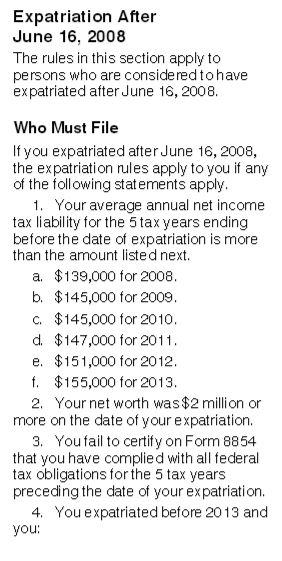
Accordingly, a “long term” LPR who meets either the US$2M asset test, or average income tax liability test (currently

US$157,000 for the year 2014), will necessarily become a “covered expatriate” even if they can satisfy the
Certification Requirement of Section 877(a)(2)(C).
**
**
**
Accordingly, it is important for each “long-term” LPR to understand clearly the current and future U.S. tax consequences to (i) them – the “mark-to market” tax, and (2) tax on “covered gifts” and “covered bequests” to U.S. persons. Importantly, understanding these consequences should be long before the LPR ceases to be a LPR for tax purposes; irrespective of the immigration law consequences.
Canadian Perspective of U.S. Senator Who Renounced Citizenship
The following article has little to do, directly, with the U.S. tax and legal consequences of renouncing U.S. citizenship. It is an opinion piece reflecting a Canadian perspective of renouncing Canadian citizenship.
http://thehill.com/blogs/congress-blog/foreign-policy/318061-nothing-against-the-united-states-until-now-
Nothing against the United States, until now
Sen. Ted Cruz (R-Texas) will renounce his Canadian citizenship.
“I have nothing against Canada,” insists Cruz. “But I’m an American by birth and as a U.S. senator; I believe I should be only an American.”
[U.S. News & World Report issued a story on 11 June 2014 of the renunciation of Senator Cruz’s Canadian citizenship]
That’s a perfectly logical, rational perspective.
It is one shared by many Canadians, only in reverse. They have lived their entire lives as Canadians only. They were born to Canadian parents temporarily working or studying in United States. Like Cruz, they returned to their country of citizenship as small children. Some were born in United States only because it was the closest hospital for their mother to give birth.
Like Cruz, they had no idea they had citizenship of another country. They never claimed U.S. citizenship. They never had a U.S. passport or Social Security number and never worked in United States. Until recently, they had “nothing against” United States.
Suddenly, the U.S. Congress, U.S. Treasury and Internal Revenue Service turned their lives topsy-turvy..
These “accidental Americans” only recently learned IRS expects them to file income tax returns each year. Most owe no U.S. tax because they pay taxes to Canada, where they have lived their entire lives. Yet accounting and legal costs are prohibitive due to the complexity of the U.S. tax code, especially for non-resident aliens.
In addition to annual IRS returns, these Canadians are expected file a Foreign Bank Account Report (FBAR), outlining all “foreign” bank and credit union accounts, insurance policies, mutual funds, retirement savings and other assets and investments they have in Canada. If they don’t, they could face draconian penalties of up to 50 percent for each account or $100,000, whichever is greater.
Fortunately, the Canadian government resists that absurdity. Canada’s Finance Minister Jim Flaherty has made it clear Canada Revenue Agency (CRA) does not and will not collect penalties for IRS for any Canadian citizen or resident. Nor will CRA collect any tax liability for IRS for a Canadian citizen, even if the person was also a U.S. citizen at the time of the tax liability.
As Flaherty has stated numerous times, “Canada is not a tax haven. People do not flock to Canada to avoid paying taxes.”
That’s not enough to keep IRS away from the business of Canada, Canadian banks or Canadian citizens and residents. Beginning in 2015, IRS expects Canadian banks to report on assets held by “US persons” living in Canada under the U.S. Foreign Account Tax Compliance Act (FATCA). If banks refuse, U.S. will impose huge financial penalties. If Canadian citizens and residents refuse to give consent for personal information to be released to IRS, FATCA demands Canadian banks declare these honest, law-abiding citizens “recalcitrant” and close their legal Canadian accounts.
Flattery calls this intrusion into Canada “unwarranted” and “extraterritorial.”
These accounts are not “foreign.” They are not “offshore.” They are held in Canada where citizens and residents live, work, earn an income, bank and pay taxes. Many are retirement savings of seniors.
FATCA clearly violates Canadian banking, privacy and human rights laws and Canada’s constitution and Charter of Rights and Freedoms, as well as laws of other countries. Congress, IRS and U.S. Treasury have shown disdain for other countries as they inflict their atrocious demands on the globe.
Who are “US persons” living in Canada?
*Canadian citizen, but “acccidental Americans” born in United States to Canadian parents.
*Canadian citizens who were told clearly and firmly by United States Consulates decades ago they were “permanently and irrevocably” relinquishing U.S. citizenship by becoming Canadian citizens.
*Dual Canadian-American citizens who took pride in U.S. heritage—before FATCA, FBAR and IRS entered their responsible Canadian lives;
*Canadian-born citizens with one parent born in U.S.;
*Canadians who returned home after working in U.S. on a green card;
*and Canadian “snowbirds” who support the U.S. economy by spending winters in southern states
If Canadians and others around the world want to renounce U.S. citizenship to protect their private financial information from U.S. snooping, IRS expects five years of income tax returns, destructive penalties and a possible exit tax.
Senator Cruz, Canada respects your decision to renounce your Canadian citizenship. When it is granted, I assure you Canada will not stalk you for information about your private finances and will not demand taxes or penalties from you.
Senator Cruz, will you and your Congressional colleagues do the same to protect Canadians and others around the world from outrageous demands of the IRS and U.S. Treasury?
Swanson is a retired human resources manager, writer and blogger. Born and raised in Pennsylvania, she has been a Canadian citizen for 40 years.
Who is a “long-term” lawful permanent resident (“LPR”) and why does it matter?
The answer to the above question will only matter, for purposes of “tax expatriation” if the LPR plans on living and moving outside the U.S. The law defines a “’long-term resident’ as any individual (other than a citizen of the United States) who is a lawful permanent resident of the United States in at least 8 taxable years during the period of 15 taxable years.” See, IRC Section 877 (e)(2.
Importantly, there are key concepts of who satisfies these requirements, which is not as simple as it seems on its face. See, for instance Section 7701(b)(6) with specific rules for individuals who live in a country with a U.S. income tax treaty. Importantly, the definition of a lawful permanent resident for tax purposes (as defined in Section 7701(b) ) is not identical to the definition for immigration law purposes.
The importance of LPR status for tax purposes in the expatriation context is crucial. Its the saying “black or white” or “night or day” when thinking about the U.S. “expatriation” tax consequences to LPRs. In short, a LPR who never becomes a “long-term resident” as that technical term is defined in IRC Section 877 (e)(2) can avoid the various taxes that arise from otherwise being a “covered expatriate”. The future heirs and beneficiaries who receive assets from this LPR (who never was a “long-term resident?) can also avoid a major tax; currently 40% of the value of the gift or bequest. See, Revisiting the consequences of becoming a “covered expatriate” for failing to comply with Section 877(a)(2)(C).
The reason it is so important, is that if a LPR never becomes a “long-term resident”, he or she can never cause themselves to “expatriate” as that term is defined in IRC Section 877A(g)(2).
If a LPR never can “expatriate” under the tax law, he or she can never become subject to a range of adverse (some would say draconian) tax consequences that apply. See the following post for a further explanation of the various adverse tax consequences: Why “covered expat” (“covered expatriate”) status matters, even if you have no assets! The “Forever Taint”!
If there is no way in these circumstances for the LPR to “expatriate” there can be no “mark to market” tax and no future tax on covered gifts or covered bequests. See, Oops…Did I “Expatriate” and Never Know It: Lawful Permanent Residents Beware! International Tax Journal, CCH Wolters Kluwer, Jan.-Feb. 2014, Vol. 40 Issue 1, p9
Obviously, this is a very good result for a LPR to never become a “long-term resident”. Planning for it is another task; particularly given the personal living arrangements of each particular individual.
The determination of if or when one becomes a “long-term resident” is highly complex, due to different cross-provisions in the tax law. Specifically, Section 7701(b)(6) has a provision that can have unintended consequences for the unwary LPR. See, for instance, LPR status can be abandoned for tax purposes (since 2008 tax law changes) by merely leaving and moving outside the U.S. in some cases?
529 College Plans – Funded by Former USCs and LPRs (“Long-Term” LPRs)
There is a basic tax planning opportunity for U.S. taxpayers who wish to fund the costs of higher education for family or friends. These are referred to as “529 Plans” with reference to the tax code section – IRC Section 529. In short, a 529 trust is established and funded with contributions for the benefit of named beneficiaries.
The principle benefit of a 529 plan, is that the income earned from the investments inside the 529 trust fund are exempt from U.S. income taxation.
There are multiple plans that are operated by various institutions, principally in conjunction with various States in the United States. Qualifying higher education expenses also apply to about 350 non-U.S. institutions that currently qualify for distributions out of a 529 Plan; e.g., University of Cambridge, University of Dublin Trinity College, University of Edinburgh, University of Oslo, The University of York, University of Wollongong, etc.
Unfortunately, non-U.S. citizens who are not resident in the U.S. generally are not eligible to establish and form a new 529 plan.
These “529 Plans” fall expressly into the category of a “specified tax deferred account” under the law. See, IRC Section 877A(e)(2).
In short, the law causes the entire amount in the 529 Plan to be treated as distributed to the “covered expatriate” the day before the expatriation date, although no early distribution tax will apply. If a 529 Plan has $500,000, that will represent taxable income to the “covered expatriate” to the extent of the tax-free growth in the plan. For instance, if the individual funded $200,000 into this plan, in this example, and he or she is subject to the 39.6% tax rate upon “expatriation”, this means there will be US$118,800 less to pay for college and universities (i.e., $500,000 less the $200,000 invested; leaving $300,000 X 39.6% = US$118,800 of tax).
This is yet another example, of how and why it is so important to avoid “covered expatriate” status; if permitted by the law in any particular circumstances. See, Certification Requirement of Section 877(a)(2)(C) – (5 Years of Tax Compliance) and Important Timing Considerations per the Statute, also see Can the Certification Requirement of Section 877(a)(2)(C) be Satisfied “After the Fact”?
Careful thought should be taken for the range of considerations and U.S. tax consequences that can befall a former USC or long-term LPR.