Why Section 7701(a)(50) is so important for those who “relinquished” citizenship years ago (without a CLN). . .
So you relinquished your citizenship years ago and therefore you think you somehow escape the current expatriation tax provisions? The U.S. federal government views their hands are tied in what the statute says.
Is it Constitutional?
Practitioners and indeed IRS attorneys struggle with the various “expatriation” tax provisions that have been added by Congress. First, there were the rules from 1966. The first “expatriation tax” law was not adopted until 1966 as part of the The Foreign Investors Tax Act of 1966 (“FITA”) – The Origin of U.S. Tax Expatriation Law (Posted on April 6, 2014).
Next, 1996 amendments kept the basic regime but added a number of key concepts. The changes in the law in 2004 made significant changes. See, Timeline Summary of Changes in Tax Expatriation Provisions Since 1996, (Posted on April 9, 2014)
Finally the 2008 revisions made wholesale changes and introduced a completely new set of taxes under Section 2801. See, Joint Committee Reports – 2008 Report re: HEROES Act – Mark to Market Regime – New Section 877A
I have recently presented a set of proposed rules (via the International Tax Committee of the State Bar of California, Taxation Section) to the IRS and Treasury regarding Section 2801 and the inheritance tax and tax on gifts from “covered expatriates.” Those comments will be published soon by TaxAnalysts.
The reason this issue is so important, are the adverse long-term consequences of not satisfying Section 877(a)(2)(C), which include the “forever taint” of Section 2801 (covered gifts and covered bequests). See, The “Hidden Tax” of Expatriation – Section 2801 and its “Forever Taint.”, (Posted on April 10, 2014).
In addition if there are unrealized gains that get triggered from the “mark to market” rules, they will come due; all tied to the date of expatriation.
The sad consequence of the revisions in 2008, is that Section 7701(a)(50) was adopted and has a very clear timing rule about when a person “. . . cease[s] to be treated as a United States citizen. . . ” It is not the same as for immigration law purposes.
The plain reading of the language of the statute is quite clear and provides in its entirety as follows:
- (50) Termination of United States citizenship
- An individual shall not cease to be treated as a United States citizen before the date on which the individual’s citizenship is treated as relinquished under section 877A (g)(4).
- Under regulations prescribed by the Secretary, subparagraph (A) shall not apply to an individual who became at birth a citizen of the United States and a citizen of another country.
Section 7701(a)(50)(A) is clear as it references 877A(g)(4) that clearly states that the term “relinquishment of citizenship” (at least for tax purposes – Title 26 purposes) does not have the same meaning as “relinquishment” for immigration law purposes.
Rather, each of the dates set forth in the tax statute to determine “relinquishment” are dates that are not retroactive to the actual loss of citizenship date for immigration law purposes. The tax law defines the “ . . . citizen shall be treated as relinquishing his United States citizenship on the earliest of—
- (A) the date the individual renounces his United States nationality before a diplomatic or consular officer of the United States pursuant to paragraph (5) of section 349(a) of the Immigration and Nationality Act (8 U.S.C. 1481 (a)(5)),
- (B) the date the individual furnishes to the United States Department of State a signed statement of voluntary relinquishment of United States nationality confirming the performance of an act of expatriation specified in paragraph (1), (2), (3), or (4) of section 349(a) of the Immigration and Nationality Act (8 U.S.C. 1481 (a)(1)–(4)),
- (C) the date the United States Department of State issues to the individual a certificate of loss of nationality, or
- (D) the date a court of the United States cancels a naturalized citizen’s certificate of naturalization.?
To put this statute in practice, let us assume a dual national living in Country X, goes to the U.S. Embassy or Consulate in Country X in the year 2014 (May 4, 2014, to be exact) to request a relinquishment of citizenship back in time, i.e., to the “relinquishing act” for immigration law purposes. He or she is able to convince the U.S. Department of State that the relinquishing act was in December of 1989. The CLN that is later issued, reflects the December 1989 date. Unfortunately, the tax statutes referenced above, clearly state the earliest date of “relinquishment of citizenship” occurs on the date the dual national went to the U.S. Department of State, i.e., on May 4, 2014.
Not a day earlier than 4 May 2014.
Section 7701(a)(50)(B) allows the Treasury to adopt regulations modifying this rule, for a limited class of “expatriates” who were dual nationals from birth. To date, no regulations were issued, although proposed regulations under section 2801 are forthcoming.
This is what some have called an “absurd result”; but is indeed a plain reading of the statute. The Treasury Department generally feels their hands are tied, because of the plain language of the statute.
Is such a provision even Constitutional under the principles articulated by the U.S. Supreme Court in Cook vs. Tait? In that case, at least the individual was a U.S. citizen. In the hypothetical set out above, the individual lost their U.S. citizenship in 1989. How can Congress hence impose U.S. taxation and reporting requirements on such an individual from the year 1989 through the May, 2014?
See the summary of current law below:
U.S. taxation of citizens has a long history going back to 1861 and the Civil War.4 The concept of citizenship based taxation was upheld by the U.S. Supreme Court in the 1920s.5 See Cook v. Tait,6 where a U.S. citizen resided permanently and was domiciled in Mexico City with his Mexican citizen wife and the Court found that U.S. taxation of his Mexican source income was indeed constitutional. Notwithstanding the long history of U.S. citizenship based taxation, the authors view it as an anachronism in the 21st century since it is particularly difficult to administer and cannot be enforced effectively overseas.7
The complete proposal can be read at “Tax Simplification: The Need for Consistent Tax Treatment of All Individuals (Citizens, Lawful Permanent Residents and Non-Citizens Regardless of Immigration Status) Residing Overseas, Including the Repeal of U.S. Citizenship Based Taxation,” by Patrick W. Martin and Professor Reuven Avi-Yonah, 2013.
T.S. Eliot – Famous Former U.S. Citizens (Tax Rates Then & Now)
Thomas Stearns Eliot, who was better known as “T.S. Eliot” left the U.S. in the 1920s. He was recognized as one of the great writers of the early and middle 1900s. He published poetry, wrote plays and literature and was a social critic of his time.
T.S. Eliot received the Nobel Price for Literature.
He follows the lines of many other famous former U.S. citizens, in that he was not born on either the East Coast or West Coast of the U.S. He was born and raised in St. Louis, Missouri. Josephine Baker was also born in St. Louis, Missouri and Tina Turner in Tennessee, both famous individuals who shed their U.S. citizenship.
He either relinquished or renounced his U.S. citizenship as he became a naturalized British citizen in 1927. At the time, there were no adverse U.S. tax consequences for shedding U.S. citizenship. The first “expatriation tax” law was not adopted until 1966 as part of the The Foreign Investors Tax Act of 1966 (“FITA”) – The Origin of U.S. Tax Expatriation Law (Posted on April 6, 2014)
The highest U.S. federal income tax rate in 1927 was 25%. See, Personal Exemptions and Individual Income Tax Rates, 1913-2002. There was no Social Security tax at that time, as the Social Security programs were enacted in the Social Security Act of 1935.
Today’s highest marginal income tax rate is 39.6%, and the combined employer/employee portion of federal social security and medicare tax is 15.3%.
???????????????? ?Please click here to view the above in Chinese.?
The List is Out – and Its 1,001 Former U.S. Citizens for the 1st Quarter 2014
The IRS published today the list of former U.S. citizens for the first quarter of 2014 and it can be reviewed here. It’s a record for any first quarter by 47%.
This is a record pace from any prior year, considering the entire year of 2013 had a record pace of 2,999 former U.S. citizens for the entire year. The 1,001 listed persons in the first quarter of 2014 is a 47% increase over the 679 former citizens published in the same period a year ago. No other first quarter list had more than 500.
There are a number of interesting questions that are created by this trend.
- Does the IRS have access to the data for former lawful permanent residents? That information is not published under the statute (Section 6039G), which only covers U.S. citizens. Does the Department of Homeland Security track former LPR – names, addresses, etc.?
- Will the IRS simply select the list of published former citizens for audits? The complete set of lists going back to the mid-1990s can be reviewed here. Quarterly Publications.
- How many former citizens are not included in this quarterly list? The statute provides the names are compiled from data received from the U.S. Department of State and the federal agency principally responsible for immigration, among others..
- How many of these former citizens will be subject to the US$10,000 penalty under Section 6039G(c)?
- How will the IRS collect tax and penalty assessments against individuals who live exclusively outside the U.S.?
There has been a clear trend of a growing list of former U.S. citizens. As more “Accidental Americans” learn they are U.S. tax residents by virtue of their U.S. citizenship, I think the trend will continue. The longer term consequences will be interesting as they unfold.
???????????????? ?Please click here to view the above in Chinese.?
LPR status can be abandoned for tax purposes (since 2008 tax law changes) by merely leaving and moving outside the U.S. in some cases?
Lawful permanent residents may erroneously think they have not “expatriated” for U.S. tax purposes, as long as they have not returned it to the U.S. Citizenship and Immigration Services (USCIS) – i.e., formally abandoned their green cards. Unfortunately, for these individuals, they can be in for a rude awakening regarding the application of IRC Section 7701(b)(6) that was added by Congress in 2008.
The relevant portion of the statute provides as follows:
- An individual shall cease to be treated as a lawful permanent resident of the United States if such individual commences to be treated as a resident of a foreign country under the provisions of a tax treaty between the United States and the foreign country, does not waive the benefits of such treaty applicable to residents of the foreign country, and notifies the Secretary of the commencement of such treatment.
This statutory language has three tests for when the individual is no longer a LPR for federal tax purposes:
- The individual is treated as a resident of a foreign country under the provisions of a tax treaty;
- The individual does not waive the benefits of the treaty, and
- Notifies the Secretary of the commencement of such treatment.

Each of the above tests seem to be satisified by any “green card” holder who files IRS Form 1040NR as a non-resident, when they live in a country with a U.S. income tax treaty. A list of treaty countries is to follow in a later post.
There can be a host of unintended consequences to the individual who falls into this category; i.e., who ceases to be a “lawful permanent resident” under the federal tax law. The expatriation provisions of Section 877A and 2801 (among others) can be implicated, along with many other provisions of the law. See, Accidental Americans” – Rush to Renounce U.S. Citizenship to Avoid the Ugly U.S. Tax Web” International Tax Journal, CCH Wolters Kluwer, Nov./Dec. 2012, Vol. 38 Issue 6, p45.
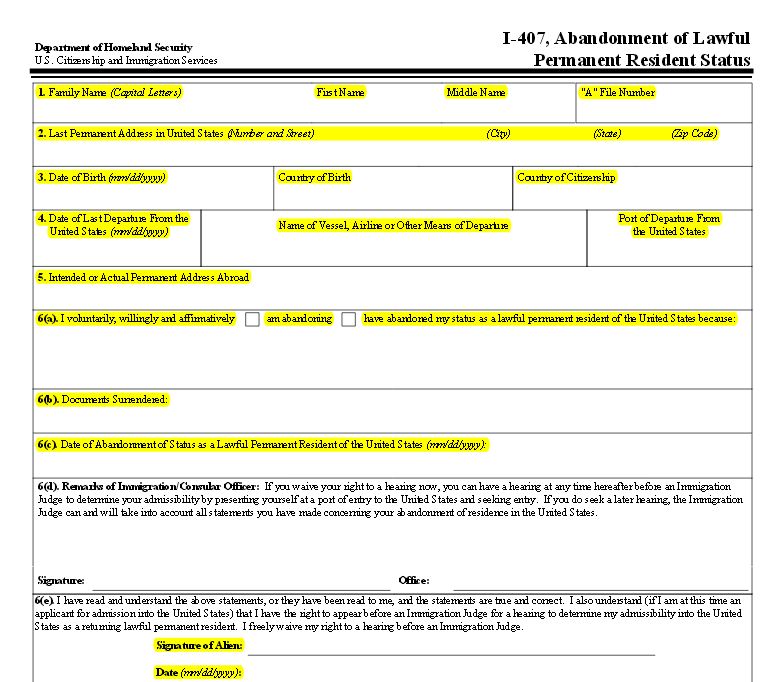
For those who wish to formally abandon their LPR, there is a specific DHS/USCIS form (I-407) that is used for this purpose:
Read the Q&A format here.
Revisiting the consequences of becoming a “covered expatriate” for failing to comply with Section 877(a)(2)(C).
There are many unanswered questions about the tax  consequences of Sections 877 and 877A. The language in the statute is not clear as to its meaning for those who file incomplete, fail to file, or fail to “timely file” IRS Form 8854. Be careful to understand the meaning and how the IRS interprets the law.
One of the greatest risks for anyone who thinks they will not be a “covered expatriate” because of the asset test or income tax liability test, is the certification requirements set forth in Section 877(a)(2)(C).
Anyone who renounces their citizenship at the Embassy or Consulate will find that process relatively easy. See forms. However, no one at the U.S. Department of State will provide tax advice or try to interpret the meaning of Section 877(a)(2)(C). Indeed, the Foreign Affairs Manual used to read to the person taking the oath, simply provides the standard overview language of “special tax consequences” arising form the renunciation.
Even the most economically modest individual, with little assets or income, can fall into this trap for the unwary – Section 877(a)(2)(C). The statute is spelled out below –
- This section shall apply to any individual if—
- (A) the average annual net income tax . . . is greater than $124,000,
- (B) the net worth of the individual as of such date is $2,000,000 or more, or
- (C) such individual fails to certify under penalty of perjury that he has met the requirements of this title for the 5 preceding taxable years or fails to submit such evidence of such compliance as the Secretary may require.
*
What happens to the former U.S. citizen or “long-term resident” (former lawful permanent resident who abandoned his or her “green card”) if they –
- Did not fully complete or file the information set forth in IRS Form 8854?
- Did not convert the values of the assets and liabilities from the foreign currency where they were held into U.S. dollars?
- What if the former USC or long-term resident does not file a dual-status return for the part of the taxable year that includes the day before the expatriation date?
- What if the tax returns (and hence IRS Form 8854) are filed beyond their normal filing dates required? See filing dates in –IRS Beats the Drums – Re: Foreign Assets, Just Days Before April 15 Posted on April 12, 2014
- What if the date of relinquishment (not renunciation) is a date prior to the year when the last tax return is required to be filed pursuant to IRS Notice 2009-85? For instance, what if the relinquishment date is October 1, 2009 (as reflected by the final Certificate of Loss of Nationality from the U.S. Department of State) and the former USC has to decide how and when to file in the year 2014?
*
This is worth understanding well, before rushing off to take the oath of renunciation at the U.S. Embassy or the U.S. Consulate.
Does IRS Notice 2009-85 regarding expatriation have the “force of law”?
The above statement may sound quite provocative, until one explores in more detail some of the basic principles identified by the U.S. Supreme Court.
IRS Notice 2009-85 is the guidance issued by the IRS after Section 877A was adopted in 2008 and attempts to address a number of issues regarding the mark to market rules. This IRS Notice is a type of so-called “IRB” guidance (Internal Revenue Bulletin). Other IRS guidance that falls into this “IRB” guidance category includes revenue rulings and revenue procedures.
Two key Supreme Court cases, Mayo Clinic and Home Concrete and the 3rd Circuit Cohen decision, among many others, help articulate when such IRS authority is valid, and when it can be successfully challenged by taxpayers. A thoughtful law review article by Kristin Hickman, Unpacking the Force of Law, articulates in much detail the law in this regard and when IRS guidance, specifically including IRS Notices are subject to other U.S. laws, including the Administrative Procedures Act (“APA”).
Below is a list of some of the provisions of IRS Notice 2009-85 that seem to fall outside the language of the statute:
What are the consequences if a former USC or LPR does not comply with one or more of the above requirements that are only set forth in a Notice and not the statute?
Can the IRS make a determination that the taxpayer is a “covered expatriate”, even if they otherwise do not meet the asset or tax liability thresholds?
There is no “timely filed” requirement in the statute or even an inference in it, as to the time and effective nature of notifying the IRS?
Can the IRS successfully argue that the certification requirement of Section 877(a)(2)(C) has not been satisfied and the individual is a “covered expatriate” if IRS Form 8854 is not “timely filed” as defined by the IRS in the Notice?
Must a taxpayer necessarily agree to “such other treatment as the Secretary determines” appropriate, even if such determination is contrary to the terms of an applicable income tax treaty? Can the Secretary unilaterally override the terms of an income tax treaty negotiated between two countries?
These and other questions remain as a result of IRS Notice 2009-85.
???????????????? ?Please click here to view the above in Chinese.?
The “Hidden Tax” of Expatriation – Section 2801 and its “Forever Taint.”
The principle focus of most discussions about the U.S. “expatriation tax” is typically on the “mark to market” rules for income tax purposes.
However, the law has two different types of taxes. First, there is the “mark to market” tax on phantom income from the deemed sale of worldwide assets. Second, and often not considered in detail, if at all, there is a tax on the recipient of “covered gifts” or “covered bequests” of 40% of the value of the property received. See, Joint Committee Reports – 2008 Report re: HEROES Act – Mark to Market Regime – New Section 877A (55 pages)
It is this second tax under Section 2801 on gifts and bequests that is the focus of this discussion – which I call the “forever taint”!
Most individuals think the mark-to-market tax upon expatriation is only applicable to rich, wealthy or otherwise individuals with high levels of income and unrealized gains. See, Accidental Americans” – Rush to Renounce U.S. Citizenship to Avoid the Ugly U.S. Tax Web” International Tax Journal, CCH Wolters Kluwer, Nov./Dec. 2012, Vol. 38 Issue 6, p45.
This is often the case, as far as the logic goes as it relates to the former U.S. citizen or LPR and the application (or not) of the “mark to market” tax. Accordingly, many of these former U.S. citizen and LPRs think they should not be concerned if they do not have significant assets with lots of unrealized gain. Unfortunately, the lack of attention to Section 2801 can be very nearsighted.
The idea that only wealthy individuals with assets should be concerned about being a “covered expatriate” is misplaced. The former U.S. citizen or LPR should not lose sight of the U.S. tax costs to their future beneficiaries of their estate, trusts they fund in the future, or future gifts. For instance, if the spouse or one or more of the children are U.S. citizens (or even unborn grandchildren or great grandchildren), there might be an unforeseen tax to pay many years in the future. The tax under Section 2801 is currently 40% of the gross value of the “covered gift” or “covered bequest.” The recipient pays this tax, not the former U.S. citizen or LPR. Plus, the rate of this tax at 40% of the gross value, is always much higher than the “mark-to’market” income tax (only applicable to the income or gain – and not the full value of the property) as the person leaves the U.S.
The application of Section 2801 requires anyone contemplating renouncing (or proving a prior relinquishment) of citizenship to strategically consider the long-term consequences to his or her family and friends.
For instance, trusts formed under the laws outside the U.S., which are funded by a “covered expatriate” that may benefit future generations, which include a U.S. citizen or resident, will have to pay the tax – currently 40%. This tax lives on forever, as long as there are assets from the former U.S. citizen or LPR that have been funded or set aside for family or friends who are “U.S. persons” in the tax sense.
To demonstrate an extreme example, a husband/wife U.S. citizens who have $3M of cash (as their only assets) when they renounce citizenship, will have no “mark to market” tax to pay, as there will be no phantom income. Cash has no unrealized gain. However, if the former citizens then grow a successful business while living in their home country, such that all wealth of this business was created as non-U.S. persons outside the U.S., any future gifts or bequests to U.S. persons would be subject to a 40% tax at current tax rates. For instance if this same person grows the company so he and his wife’s complete estate is worth US$10M at their deaths, and then bequeaths these assets to their three dual national (including U.S. citizen) children, the children will have to pay US$4M in taxes under current rates. This is true even if none of the children live in the U.S.
This would be a very bad tax result, since if they had remained U.S. citizens, there would be no U.S. estate taxes to them under current law and the children would have received the US$10M free from all U.S. federal taxation.
Finally, this “forever taint” could live on for multiple generations. For instance, in the above example, if the former U.S. citizens funded the US$10M in trust for the benefit of their children, grandchildren and great-grandchildren, all of whom have dual citizenship (including U.S.), these descendents will be paying the tax under Section 2801, even if some of these family members are yet to be born on the date (i) the trust is funded, or (ii) the death of husband and wife. This is the “forever taint.”
While the expatriate might be delighted they have no future U.S. income tax obligations during their lifetimes, if they have friends and family who will be beneficiaries of their estate, they should keep their eye on Section 2801 and its “forever taint”.
???????????????? ?Please click here to view the above in Chinese.?
Timeline Summary of Changes in Tax Expatriation Provisions Since 1996
Today’s law is a “mark to market” deemed disposition of worldwide assets combined with a 40% tax on the receipt of “covered” inheritances and gifts by U.S. persons. The initial tax expatriation law that began in 1966 through its changes in 1996 and then 2004 was quite different, with a 10 year period of taxation after expatriation.
Below is a brief summary of the key changes (and when) that were made to the tax expatriation provisions, although the first law adopted in 1966 The Foreign Investors Tax Act of 1966 (“FITA”) – The Origin of U.S. Tax Expatriation Law is not reflected:

???????????????? ?Please click here to view the above in Chinese.?
The 1996 Reed Amendment – The Immigration Law with “No Teeth” and “No Bite”
U.S. immigration lawyers around the world often cite the 1996 revision in the immigration law that was introduced by then Representative Reed (now Senator Reed). The provision found at INA 212(a)(10)(E) (8 U.S.C. § 1182(a)(10)(E)) is often referred to as the Reed Amendment. It provides as follows:
- (E) Former citizens who renounced citizenship to avoid taxation
- Any alien who is a former citizen of the United States who officially renounces United States citizenship and who is determined by the Attorney General to have renounced United States citizenship for the purpose of avoiding taxation by the United States is inadmissible.
Not surprisingly, immigration lawyers often become alarmed at such provision, if their client can be deemed “inadmissible”; i.e., not be allowed back into the U.S. What if you want to travel to the U.S.?
Fortunately, the Reed Amendment is –
(a) now irrelevant under the current “mark-to-market” expatriation tax provisions, since the motivation of why someone renounces their U.S. citizenship, be it due to the complexity of the U.S. tax laws or otherwise, is not applicable any longer (i.e., the term tax “avoidance” does not appear anywhere in Section 877A); and
(b) has never been invoked by the federal government to bar reentry of a former U.S. citizen in its history (even when it was relevant from the mid 1990s through the following two decades).
The subjective test of “tax avoidance” that existed in the 1996 tax expatriation provisions were eliminated in 2004.
There are a number of legal reasons why the government has never invoked this provision, notwithstanding calls by influential Senators in some cases to have its provision invoked. See, Reed Asks Homeland Security to Enforce Law on Ex-Citizen Tax
Hence, it is a provision with “no teeth” and “no bite.”
For more details, see –
GAO Report – (Year 2000) Tax-Motivated Expatriation: Enforcement of IRS and Immigration Act Provisions
Joint Committee Reports – 2003 Report re: Section 877 Revisions (550 page report)
Joint Committee Reports – 2008 Report re: HEROES Act – Mark to Market Regime – New Section 877A (55 pages)
???????????????? ?Please click here to view the above in Chinese.?
The Foreign Investors Tax Act of 1966 (“FITA”) – The Origin of U.S. Tax Expatriation Law
Today’s “tax expatriation” provisions which are based upon “mark-to-market” concepts of a “deemed/fictional sale” of worldwide assets, look quite different from the original law. The first version was adopted by The Foreign Investors Tax Act of 1966 (“FITA”). FITA introduced a number of specific tax concepts applicable to non-residents.
In addition, it created the first concept of “tax expatriation” for former U.S. citizens, that remained unchanged until the amendments in the law in 1996. There was no reference to lawful permanent residency (or former LPRS) in the 1966 FITA.
The basic concept of the statute remained largely unchanged from the 1996 revisions compared to the original FITA 1966 version, which then I.R.C. § 877(a)(1) provided in relevant part as follows:
“[e]very nonresident alien individual who,
within the 10-year period
immediately preceding the
close of the taxable year,
lost U.S.citizenship,
unless such loss did not
have for one of its principal
purposes the avoidance of
taxes . . . shall be taxable
for such taxable year . . . .”
**
These old rules imposed U.S. tax on gains for a 10 year period after the former U.S. citizen became a nonresident alien. The tax rate applicable was the normal U.S. rate and it was levied on gains from the sale of U.S. property, specifically stock and debt in U.S. companies. Those items of income were treated as U.S. source income for that purpose.
The big difference in the 1996 revisions, was the creation of a presumption of a “principal purpose of tax avoidance” that had to be rebutted by submitting a private letter ruling request to the IRS.
For a somewhat provocative look at the law and its history, see, CATCH ME IF YOU CAN: RELINQUISHING CITIZENSHIP FOR TAXATION PURPOSES AFTER THE HEART ACT By: Yu Hang Sunny Kwong
???????????????? ?Please click here to view the above in Chinese.?