The List is Out – and Its 1,001 Former U.S. Citizens for the 1st Quarter 2014
The IRS published today the list of former U.S. citizens for the first quarter of 2014 and it can be reviewed here. It’s a record for any first quarter by 47%.
This is a record pace from any prior year, considering the entire year of 2013 had a record pace of 2,999 former U.S. citizens for the entire year. The 1,001 listed persons in the first quarter of 2014 is a 47% increase over the 679 former citizens published in the same period a year ago. No other first quarter list had more than 500.
There are a number of interesting questions that are created by this trend.
- Does the IRS have access to the data for former lawful permanent residents? That information is not published under the statute (Section 6039G), which only covers U.S. citizens. Does the Department of Homeland Security track former LPR – names, addresses, etc.?
- Will the IRS simply select the list of published former citizens for audits? The complete set of lists going back to the mid-1990s can be reviewed here. Quarterly Publications.
- How many former citizens are not included in this quarterly list? The statute provides the names are compiled from data received from the U.S. Department of State and the federal agency principally responsible for immigration, among others..
- How many of these former citizens will be subject to the US$10,000 penalty under Section 6039G(c)?
- How will the IRS collect tax and penalty assessments against individuals who live exclusively outside the U.S.?
There has been a clear trend of a growing list of former U.S. citizens. As more “Accidental Americans” learn they are U.S. tax residents by virtue of their U.S. citizenship, I think the trend will continue. The longer term consequences will be interesting as they unfold.
???????????????? ?Please click here to view the above in Chinese.?
Countries with U.S. Income Tax Treaties & Lawful Permanent Residents (“Oops – Did I Expatriate”?)
The U.S. has income tax treaties with multiple countries. My post from yesterday briefly explains how a LPR living in one of these countries may become a “covered expatriate” if the three conditions of the statute, IRC Section 7701(b)(6) that was added into the law in 2008 are satisfied. See, LPR status can be abandoned for tax purposes (since 2008 tax law changes) by merely leaving and moving outside the U.S. in some cases. Posted on April 28, 2014
Importantly, a LPR who resides in one of these countries where he or she has income tax residency in the treaty country, can inadvertently “expatriate” for U.S. federal income, estate, gift and inheritance taxes. See, Oops…Did I “Expatriate” and Never Know It: Lawful Permanent Residents Beware! International Tax Journal, CCH Wolters Kluwer, Jan.-Feb. 2014, Vol. 40 Issue 1, p9
The list of those countries with income tax treaties are as follows and can be reviewed at IRS website:
A
Armenia
Australia
Austria
Azerbaijan
B
Bangladesh
Barbados
Belarus
Belgium
Bulgaria
C
Canada
China
Cyprus
Czech Republic
D
Denmark
E
Egypt
Estonia
F
Finland
France
G
Georgia
Germany
Greece
H
Hungary
I
Iceland
India
Indonesia
Ireland
Israel
Italy
J
Jamaica
Japan
K
Kazakhstan
Korea
Kyrgyzstan
L
Latvia
Lithuania
Luxembourg
M
Malta
Mexico
Moldova
Morocco
N
Netherlands
New Zealand
Norway
P
Pakistan
Philippines
Poland
Portugal
R
Romania
Russia
S
Slovak Republic
Slovenia
South Africa
Spain
Sri Lanka
Sweden
Switzerland
T
Tajikistan
Thailand
Trinidad
Tunisia
Turkey
Turkmenistan
U
Ukraine
Union of Soviet Socialist Republics (USSR)
United Kingdom
United States Model
Uzbekistan
V
Venezuela
Revisiting the consequences of becoming a “covered expatriate” for failing to comply with Section 877(a)(2)(C).
There are many unanswered questions about the tax  consequences of Sections 877 and 877A. The language in the statute is not clear as to its meaning for those who file incomplete, fail to file, or fail to “timely file” IRS Form 8854. Be careful to understand the meaning and how the IRS interprets the law.
One of the greatest risks for anyone who thinks they will not be a “covered expatriate” because of the asset test or income tax liability test, is the certification requirements set forth in Section 877(a)(2)(C).
Anyone who renounces their citizenship at the Embassy or Consulate will find that process relatively easy. See forms. However, no one at the U.S. Department of State will provide tax advice or try to interpret the meaning of Section 877(a)(2)(C). Indeed, the Foreign Affairs Manual used to read to the person taking the oath, simply provides the standard overview language of “special tax consequences” arising form the renunciation.
Even the most economically modest individual, with little assets or income, can fall into this trap for the unwary – Section 877(a)(2)(C). The statute is spelled out below –
- This section shall apply to any individual if—
- (A) the average annual net income tax . . . is greater than $124,000,
- (B) the net worth of the individual as of such date is $2,000,000 or more, or
- (C) such individual fails to certify under penalty of perjury that he has met the requirements of this title for the 5 preceding taxable years or fails to submit such evidence of such compliance as the Secretary may require.
*
What happens to the former U.S. citizen or “long-term resident” (former lawful permanent resident who abandoned his or her “green card”) if they –
- Did not fully complete or file the information set forth in IRS Form 8854?
- Did not convert the values of the assets and liabilities from the foreign currency where they were held into U.S. dollars?
- What if the former USC or long-term resident does not file a dual-status return for the part of the taxable year that includes the day before the expatriation date?
- What if the tax returns (and hence IRS Form 8854) are filed beyond their normal filing dates required? See filing dates in –IRS Beats the Drums – Re: Foreign Assets, Just Days Before April 15 Posted on April 12, 2014
- What if the date of relinquishment (not renunciation) is a date prior to the year when the last tax return is required to be filed pursuant to IRS Notice 2009-85? For instance, what if the relinquishment date is October 1, 2009 (as reflected by the final Certificate of Loss of Nationality from the U.S. Department of State) and the former USC has to decide how and when to file in the year 2014?
*
This is worth understanding well, before rushing off to take the oath of renunciation at the U.S. Embassy or the U.S. Consulate.
Does IRS Notice 2009-85 regarding expatriation have the “force of law”?
The above statement may sound quite provocative, until one explores in more detail some of the basic principles identified by the U.S. Supreme Court.
IRS Notice 2009-85 is the guidance issued by the IRS after Section 877A was adopted in 2008 and attempts to address a number of issues regarding the mark to market rules. This IRS Notice is a type of so-called “IRB” guidance (Internal Revenue Bulletin). Other IRS guidance that falls into this “IRB” guidance category includes revenue rulings and revenue procedures.
Two key Supreme Court cases, Mayo Clinic and Home Concrete and the 3rd Circuit Cohen decision, among many others, help articulate when such IRS authority is valid, and when it can be successfully challenged by taxpayers. A thoughtful law review article by Kristin Hickman, Unpacking the Force of Law, articulates in much detail the law in this regard and when IRS guidance, specifically including IRS Notices are subject to other U.S. laws, including the Administrative Procedures Act (“APA”).
Below is a list of some of the provisions of IRS Notice 2009-85 that seem to fall outside the language of the statute:
What are the consequences if a former USC or LPR does not comply with one or more of the above requirements that are only set forth in a Notice and not the statute?
Can the IRS make a determination that the taxpayer is a “covered expatriate”, even if they otherwise do not meet the asset or tax liability thresholds?
There is no “timely filed” requirement in the statute or even an inference in it, as to the time and effective nature of notifying the IRS?
Can the IRS successfully argue that the certification requirement of Section 877(a)(2)(C) has not been satisfied and the individual is a “covered expatriate” if IRS Form 8854 is not “timely filed” as defined by the IRS in the Notice?
Must a taxpayer necessarily agree to “such other treatment as the Secretary determines” appropriate, even if such determination is contrary to the terms of an applicable income tax treaty? Can the Secretary unilaterally override the terms of an income tax treaty negotiated between two countries?
These and other questions remain as a result of IRS Notice 2009-85.
???????????????? ?Please click here to view the above in Chinese.?
The “Hidden Tax” of Expatriation – Section 2801 and its “Forever Taint.”
The principle focus of most discussions about the U.S. “expatriation tax” is typically on the “mark to market” rules for income tax purposes.
However, the law has two different types of taxes. First, there is the “mark to market” tax on phantom income from the deemed sale of worldwide assets. Second, and often not considered in detail, if at all, there is a tax on the recipient of “covered gifts” or “covered bequests” of 40% of the value of the property received. See, Joint Committee Reports – 2008 Report re: HEROES Act – Mark to Market Regime – New Section 877A (55 pages)
It is this second tax under Section 2801 on gifts and bequests that is the focus of this discussion – which I call the “forever taint”!
Most individuals think the mark-to-market tax upon expatriation is only applicable to rich, wealthy or otherwise individuals with high levels of income and unrealized gains. See, Accidental Americans” – Rush to Renounce U.S. Citizenship to Avoid the Ugly U.S. Tax Web” International Tax Journal, CCH Wolters Kluwer, Nov./Dec. 2012, Vol. 38 Issue 6, p45.
This is often the case, as far as the logic goes as it relates to the former U.S. citizen or LPR and the application (or not) of the “mark to market” tax. Accordingly, many of these former U.S. citizen and LPRs think they should not be concerned if they do not have significant assets with lots of unrealized gain. Unfortunately, the lack of attention to Section 2801 can be very nearsighted.
The idea that only wealthy individuals with assets should be concerned about being a “covered expatriate” is misplaced. The former U.S. citizen or LPR should not lose sight of the U.S. tax costs to their future beneficiaries of their estate, trusts they fund in the future, or future gifts. For instance, if the spouse or one or more of the children are U.S. citizens (or even unborn grandchildren or great grandchildren), there might be an unforeseen tax to pay many years in the future. The tax under Section 2801 is currently 40% of the gross value of the “covered gift” or “covered bequest.” The recipient pays this tax, not the former U.S. citizen or LPR. Plus, the rate of this tax at 40% of the gross value, is always much higher than the “mark-to’market” income tax (only applicable to the income or gain – and not the full value of the property) as the person leaves the U.S.
The application of Section 2801 requires anyone contemplating renouncing (or proving a prior relinquishment) of citizenship to strategically consider the long-term consequences to his or her family and friends.
For instance, trusts formed under the laws outside the U.S., which are funded by a “covered expatriate” that may benefit future generations, which include a U.S. citizen or resident, will have to pay the tax – currently 40%. This tax lives on forever, as long as there are assets from the former U.S. citizen or LPR that have been funded or set aside for family or friends who are “U.S. persons” in the tax sense.
To demonstrate an extreme example, a husband/wife U.S. citizens who have $3M of cash (as their only assets) when they renounce citizenship, will have no “mark to market” tax to pay, as there will be no phantom income. Cash has no unrealized gain. However, if the former citizens then grow a successful business while living in their home country, such that all wealth of this business was created as non-U.S. persons outside the U.S., any future gifts or bequests to U.S. persons would be subject to a 40% tax at current tax rates. For instance if this same person grows the company so he and his wife’s complete estate is worth US$10M at their deaths, and then bequeaths these assets to their three dual national (including U.S. citizen) children, the children will have to pay US$4M in taxes under current rates. This is true even if none of the children live in the U.S.
This would be a very bad tax result, since if they had remained U.S. citizens, there would be no U.S. estate taxes to them under current law and the children would have received the US$10M free from all U.S. federal taxation.
Finally, this “forever taint” could live on for multiple generations. For instance, in the above example, if the former U.S. citizens funded the US$10M in trust for the benefit of their children, grandchildren and great-grandchildren, all of whom have dual citizenship (including U.S.), these descendents will be paying the tax under Section 2801, even if some of these family members are yet to be born on the date (i) the trust is funded, or (ii) the death of husband and wife. This is the “forever taint.”
While the expatriate might be delighted they have no future U.S. income tax obligations during their lifetimes, if they have friends and family who will be beneficiaries of their estate, they should keep their eye on Section 2801 and its “forever taint”.
???????????????? ?Please click here to view the above in Chinese.?
Timeline Summary of Changes in Tax Expatriation Provisions Since 1996
Today’s law is a “mark to market” deemed disposition of worldwide assets combined with a 40% tax on the receipt of “covered” inheritances and gifts by U.S. persons. The initial tax expatriation law that began in 1966 through its changes in 1996 and then 2004 was quite different, with a 10 year period of taxation after expatriation.
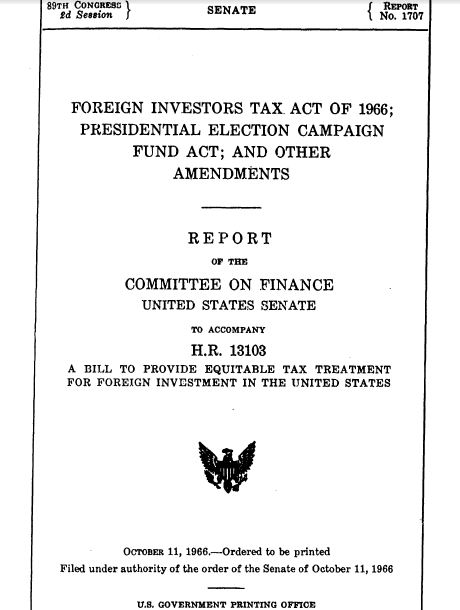
Below is a brief summary of the key changes (and when) that were made to the tax expatriation provisions, although the first law adopted in 1966 The Foreign Investors Tax Act of 1966 (“FITA”) – The Origin of U.S. Tax Expatriation Law is not reflected:

???????????????? ?Please click here to view the above in Chinese.?
The Foreign Investors Tax Act of 1966 (“FITA”) – The Origin of U.S. Tax Expatriation Law
Today’s “tax expatriation” provisions which are based upon “mark-to-market” concepts of a “deemed/fictional sale” of worldwide assets, look quite different from the original law. The first version was adopted by The Foreign Investors Tax Act of 1966 (“FITA”). FITA introduced a number of specific tax concepts applicable to non-residents.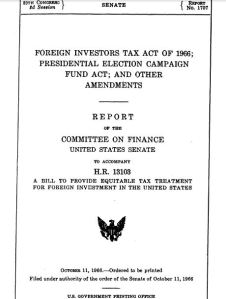
In addition, it created the first concept of “tax expatriation” for former U.S. citizens, that remained unchanged until the amendments in the law in 1996. There was no reference to lawful permanent residency (or former LPRS) in the 1966 FITA.
The basic concept of the statute remained largely unchanged from the 1996 revisions compared to the original FITA 1966 version, which then I.R.C. § 877(a)(1) provided in relevant part as follows:
“[e]very nonresident alien individual who,
within the 10-year period
immediately preceding the
close of the taxable year,
lost U.S.citizenship,
unless such loss did not
have for one of its principal
purposes the avoidance of
taxes . . . shall be taxable
for such taxable year . . . .”
**
These old rules imposed U.S. tax on gains for a 10 year period after the former U.S. citizen became a nonresident alien. The tax rate applicable was the normal U.S. rate and it was levied on gains from the sale of U.S. property, specifically stock and debt in U.S. companies. Those items of income were treated as U.S. source income for that purpose.
The big difference in the 1996 revisions, was the creation of a presumption of a “principal purpose of tax avoidance” that had to be rebutted by submitting a private letter ruling request to the IRS.
For a somewhat provocative look at the law and its history, see, CATCH ME IF YOU CAN: RELINQUISHING CITIZENSHIP FOR TAXATION PURPOSES AFTER THE HEART ACT By: Yu Hang Sunny Kwong
???????????????? ?Please click here to view the above in Chinese.?
Did she “relinquish” or “renounce” U.S. citizenship? – Tina Turner –
There are important legal differences between “renouncing” and “relinquishing” U.S. citizenship. Specifically, the federal tax consequences that follow from one versus the other can be quite important. The principle point is the “timing” of when USC status terminates.
The federal tax reporting can be quite different for those who “relinquish” or “renounce” U.S. citizenship. For related background information see the following:
*
*
*
*
More posts to following regarding “relinquishing” or “renouncing” U.S. citizenship.
Certifying Under Penalty of Perjury – Meeting the Requirements of Title 26 for Preceding 5 Taxable Years
The statutory language of Section 877(a)(2)(C) provides that the individual will be a “covered expatriate” if he or she ” . . . fails to certify under penalty of perjury that he has met the requirements of this title for the 5 preceding taxable years or fails to submit such evidence of such compliance as the Secretary may require.”
The reference to “this title” is to Title 26, which is commonly known as the “Internal Revenue Code” and covers all provisions of federal tax law and taxes, including income, estate, gift, excise, employment, alcohol and tobacco, etc. The complexity of the law is discussed below at the bottom of this post.
This provision is commonly forgotten by two groups of individuals.
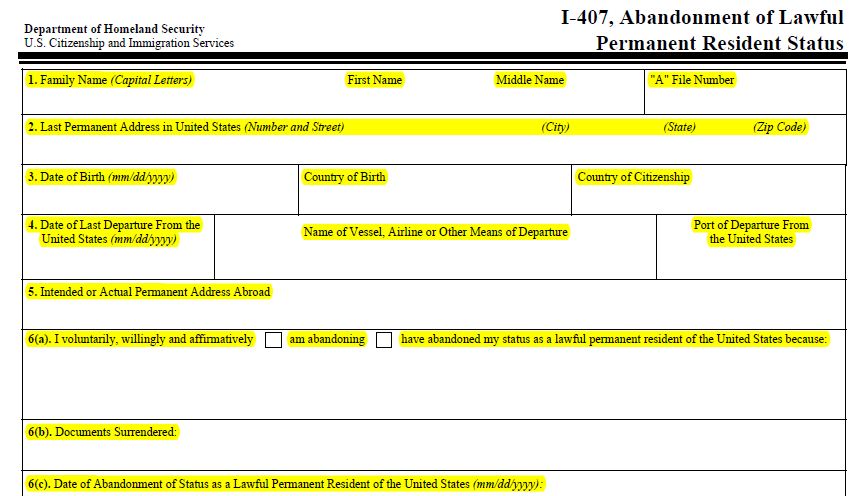
1. Lawful permanent residents (“LPRs”) who abandon their status formally by filing Form I-407 or 
by application of a U.S. income tax treaty and IRC Section 7701(b)(6). See, U.S. TAX TREATIES AND SECTION 6114: WHY A TAXPAYER’S FAILURE TO “TAKE” A TREATY POSITION DOES NOT DENY TREATY BENEFITS
2. U.S. Citizens (“USCs”) who renounce or relinquish their U.S. citizenship status; via the U.S. Department of State.

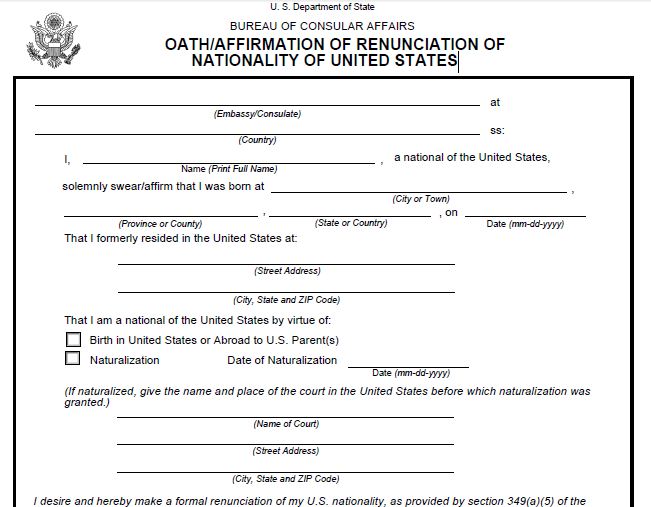
Filing Form DS-4080, Oath of Renunciation of the Nationality of the United States is a requirement for renunciation.
Under current law, both of these groups of individuals need to certify they have “met the requirements” of the tax law for the five preceding years. How can any taxpayer feel comfortable they have met the requirements of such a complex law?
What steps does an individual in one of the above categories need to take to help assure they have met this requirement? See, USCs and LPRs Living Outside the U.S. – Key Tax and BSA Forms for a basic overview of the foreign earned income law and forms, foreign tax credit law and forms and information reporting requirements under Title 26.
The Taxpayer Advocate Report identifies many of the complexities of this tax law, Title 26:
1. The Current Tax Code Imposes Huge Compliance Burdens on Individual
Taxpayers and Businesses.
Consider the following:
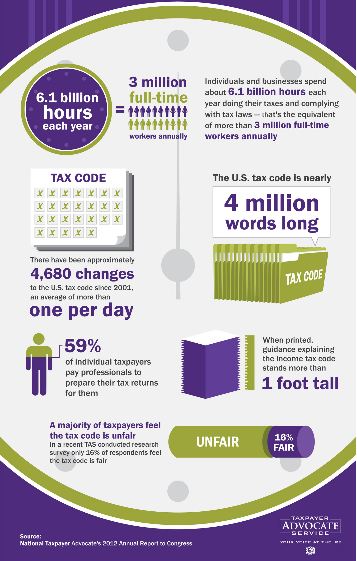
?? According to a TAS analysis of IRS data, individuals and businesses spend about 6.1 billion hours a year complying with the filing requirements of the Internal Revenue Code.7 And that figure does not include the millions of additional hours that taxpayers must spend when they are required to respond to IRS notices or audits.
?? If tax compliance were an industry, it would be one of the largest in the United States. To consume 6.1 billion hours, the “tax industry” requires the equivalent of more than three million full-time workers.8
?? Compliance costs are huge both in absolute terms and relative to the amount of tax revenue collected. Based on Bureau of Labor Statistics data on the hourly cost of an employee, TAS estimates that the costs of complying with the individual and corporate income tax requirements for 2010 amounted to $168 billion — or a staggering 15 percent of aggregate income tax receipts.9
?? According to a tally compiled by a leading publisher of tax information, there have been approximately 4,680 changes to the tax code since 2001, an average of more than one a day.10
?? The tax code has grown so long that it has become challenging even to figure out how long it is. A search of the Code conducted using the “word count” feature in Microsoft Word turned up nearly four million words.11
?? Individual taxpayers find return preparation so overwhelming that about 59 percent now pay preparers to do it for them.12 Among unincorporated business taxpayers, the figure rises to about 71 percent.13 An additional 30 percent of individual taxpayers use tax software to help them prepare their returns,14 with leading software packages costing $50 or more. For 2007, IRS researchers estimated that the monetary compliance burden of the median individual taxpayer (as measured by income) was $258.15

???????????????? ?Please click here to view the above in Chinese.?
The dangers of becoming a “covered expatriate” by not complying with Section 877(a)(2)(C).
Probably the most misunderstood concept in the U.S. tax expatriation law provisions is Section 877(a)(2)(C) for several reasons.
1. People of modest means with modest to little income and little to no assets can fall into this category.
2. Most individuals think the mark-to-market tax upon expatriation is only applicable to rich, wealthy or otherwise individuals with high levels of income. See, Accidental Americans” – Rush to Renounce U.S. Citizenship to Avoid the Ugly U.S. Tax Web” International Tax Journal,CCH Wolters Kluwer, Nov./Dec. 2012, Vol. 38 Issue 6, p45
3. Lawful permanent residents (“LPRs”) can inadvertently fall into this category without doing anything, other than living principally in a country outside the U.S., which has a U.S. income tax treaty. See, Oops…Did I “Expatriate” and Never Know It: Lawful Permanent Residents Beware! International Tax Journal, CCH Wolters Kluwer, Jan.-Feb. 2014, Vol. 40 Issue 1, p9. At the end of this post is a list of the countries with U.S. income tax treaties.
4. Few individuals understand exactly what must be included and reported in IRS Form 8854 to be able to satisfy the certification requirement above. For more details, see What are the consequences of becoming a “covered expatriate” for failing to comply with Section 877(a)(2)(C)?
The relevant provisions of Section 877(a)(2)(C) are highlighted below:
- This section shall apply to any individual if—
- (A) the average annual net income tax . . . is greater than $124,000,
- (B) the net worth of the individual as of such date is $2,000,000 or more, or
- (C) such individual fails to certify under penalty of perjury that he has met the requirements of this title for the 5 preceding taxable years or fails to submit such evidence of such compliance as the Secretary may require.
Failure to certify truthfully about compliance with U.S. tax law for 5 years, as set forth above in the statute, means the individual necessarily will be a “covered expatriate.” Does this mean that if a U.S. citizen who renounces citizenship or a LPR who abandons their green card, will necessarily be a “covered expatriate” if they fail to follow IRS Notice 2009-45 “Guidance for Expatriates Under Section 877A”?
What steps will the IRS take if someone intentionally does not comply with the certification requirement? Will they become a target of a criminal investigation, and under what circumstances? What could be the focal point of IRS Criminal Investigations of Former U.S. Citizens and Lawful Permanent Residents?
There are many pending and open questions not answered by current law, as the U.S. Treasury has yet to publish regulations under Section 877A, 877 or 2801.
APPENDIX – Countries with Income Tax Treaties with the United States