Key Take Aways from Senate Investigations re: Foreign Banks and “Offshore Tax Evasion”: U.S. Citizens Residing Overseas have Become a Focus of the Government.
Instead of the government finding U.S. citizens living outside of the United States, as a low priority, the Senate Permanent Subcommittee on Investigations focused extensively on Swiss accounts opened by these individuals. The full report can be read REPORT: Offshore Tax Evasion:The Effort to Collect Unpaid Taxes on Billions in Hidden Offshore Accounts (February 26, 2014)
Some key excerpts of that report are as follows (at page 4):
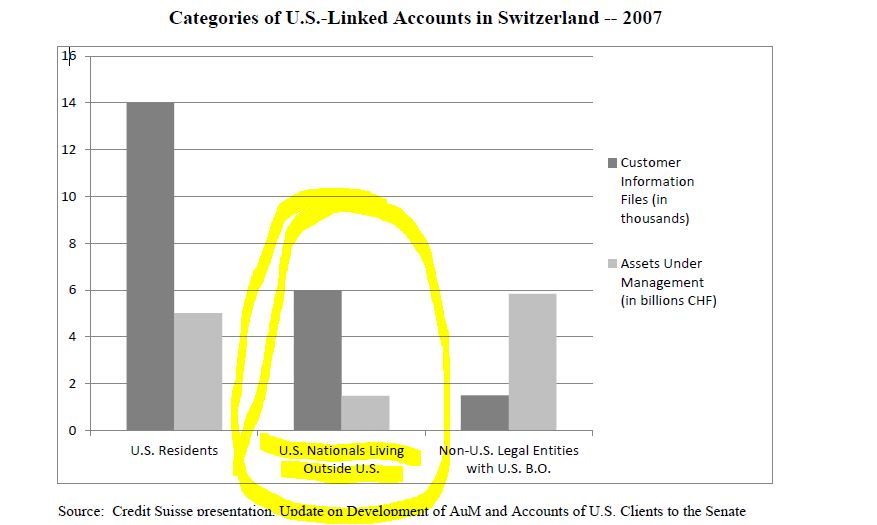
. . . focused primarily on Swiss accounts held by U.S. residents, ignoring the over 6,000 accounts opened by U.S. nationals living outside of the United States. . . . It was not until 2012, that the bank expanded the Exit Projects to include a review of the thousands of Swiss accounts opened by U.S. nationals living outside of the United States.. . .
In addition, the report is replete with statistical data of accounts held by U.S. nationals living outside the U.S., such as the following:
Instead of concluding that the complex U.S. laws are leading to non-compliance by U.S. citizens residing outside the U.S. (per the Taxpayer’s Advocate Report), it seems to conclude to the contrary and the report highlights the virtues of the OVD program in non-compliance as generally willful with millions of U.S. citizens living outside the U.S. who are not in compliance, per the following statement (at page 22):
“The OVDP continues to provide valuable information for the United States in its efforts
to combat offshore tax abuse, although it is far from clear that effective use is being made of the
information generated. For taxpayers, it continues to offer a useful alternative to report
undeclared offshore accounts that, potentially, number in the millions. According to the Taxpayer Advocate, “While 7.6 million U.S. citizens reside abroad and many more U.S. residents have FBAR filing requirements, the IRS received only 807,040 FBAR submissions in 2012,” signaling “significant information reporting noncompliance.”69 2013 Annual Report to Congress — Volume One, Taxpayer Advocate Service, “OFFSHORE VOLUNTARY DISCLOSURE: The IRS Offshore Voluntary Disclosure Program Disproportionately Burdens Those Who Made Honest Mistakes,” at 229.
This report seems to get off track by not distinguishing between normal U.S. citizens who are living out their lives in their country of residence, as opposed to U.S. nationals who are intentionally attempting to evade taxes, filing false documents, not filing returns, or otherwise intentionally violating U.S. law. All of these 7.6 million U.S. nationals living around the world are being lumped together by the government with U.S. resident citizens, irrespective of the facts of each individual and family.
This is a bit of a Bombshell – If the IRS Criminal Investigation (“CI”) is investigating U.S. citizens renouncing their citizenship?
It is reported the IRS CI is interested in the reasons that U.S. citizens renounce their citizenship. Jaime Arora, IRS Criminal Investigation Division Looking Into U.S. Citizenship Renunciations, 2014 TNT 41-8 (3/3/14). The article is nonspecific about what the IRS is looking for and the consequences might be if they found something.
Still, there are tax requirements for renouncing citizenship in certain cases. I won’t go into them now, but link to blogs on the subject here.
I can imagine that mishandling the various forms and representations required for renunciation, including the tax forms and representations, could be a crime under various federal statutes — tax and nontax — and, at last if something was done wrong related to taxes, conceivably the renunciation conduct could refresh statutes of limitations for tax crimes that might have otherwise expired.
Importantly, why someone renounces their U.S. citizenship under the current tax law (IRC Section 877A) is not relevant as to the tax consequences to the individual who renounced. This is very different from the law that was passed in 1996. These rules changed in 2004 and yet again in 2008 to create an objective set of taxation rules. For this reason, it would be very odd for the IRS CI to be investigating (at least recent expatriates) former U.S. citizens to determine why, i.e., the reasons, they renounced U.S. citizenship.
???????????????? ?Please click here to view the above in Chinese.?
Hearings – Permanent Subcommittee on Investigations – re: Offshore Tax Evasion: The Effort to Collect Unpaid Taxes on Billions in Hidden Offshore Accounts – February 26, 2014
Will the IRS be assisting the Justice Department to prosecute U.S. citizens who have lived abroad most (if not all) of their lives?
Will the IRS be assisting the Justice Department to prosecute U.S. citizens who have lived abroad most (if not all) of their lives?
**
The on-going focus of of the government, including the purported “Billions in Hidden Offshore Accounts” by the Permanent Subcommittee on Investigations, begs the questions, where are these billions of assets by U.S. taxpayers?
**
Will this be the premiss used by the IRS and Justice Department to try to prosecute U.S. citizens residing overseas?
Law abiding U.S. citizens who have spent most (if not all) of their lives overseas are put in an untenable position vis–à–vis the U.S. federal government regarding U.S. tax and tax filing obligations.
**
See what the government has to say
**
Offshore Tax Evasion: The Effort to Collect Unpaid Taxes on Billions in Hidden Offshore Accounts
The Treasury Inspector General wrote the following in a 2009 report (of which none of these numbers have seriously been questioned, supported or analyzed) – – titled
A Combination of Legislative Actions and Increased IRS Capability and Capacity Are Required to Reduce the Multi-Billion Dollar U.S. International Tax Gap
Synopsis
The IRS estimated that the entire tax gap for Tax Year 2001 was $345 billion. However, the IRS has not developed an estimate for the international tax gap. Non-IRS estimates of the international tax gap range from $40 billion to $123 billion. While there might be overlap between the IRS tax gap estimate and the international tax gap, it is doubtful that the $345 billion estimate includes the entire international tax gap.
The primary reason for this conclusion is that identifying hidden income within international activity is very difficult and time–consuming.[4] Furthermore, the IRS did not measure for the international tax gap component in the Individual National Research Project (NRP) estimate for the Tax Year 2001 tax gap. Therefore, it is unlikely that hidden offshore income is comprehensively included in the IRS tax gap estimates. In fact, the IRS’s Research, Analysis and Statistics (RAS) organization reasoned that because of cost, staffing, and technical limitations, an NRP type of direct measurement is unfeasible. However, in an attempt to learn more, the IRS has other initiatives underway.
???????????????? ?Please click here to view the above in Chinese.?
Does former IRS official have it right when he says ““The new whistle-blower provisions Congress enacted a couple of years ago have the potential to be a real disaster for the tax system,” he said in the interview. “I believe that it is unseemly in this country to encourage people to turn in their neighbors and employers to the I.R.S., as contemplated by this particular program. The I.R.S. didn’t ask for these rules; they were forced on it by the Congress.”
???????????????? ?Please click here to view the above in Chinese.?
Should the IRS modify its offshore voluntary disclosure program for U.S. citizens residing overseas? IRS is reconsidering the effectiveness of its offshore voluntary disclosure program. Should it be modified?
Should the IRS modify its offshore voluntary disclosure program for U.S. citizens residing overseas? IRS is reconsidering the effectiveness of its offshore voluntary disclosure program. Should it be modified?
According to Tax Analyst’s “The IRS is reexamining its offshore voluntary disclosure program and considering making modifications to it, according to Michael Danilack, deputy commissioner (international), IRS Large Business and International Division.”
U.S. citizens who have lived most all of their lives overseas should not be subject to the same scrutiny and inflexibility that currently exists for U.S. taxpayers residing in the U.S. Important differences exist, mostly because of the lack of U.S. citizens residing overseas to understand the complex U.S. tax law system applicable to them; in addition to the country’s tax laws and requirements in their country of residence.
The de-facto U.S. income tax residency regime is a residence based regime for several reasons. First, the National Taxpayer Advocate estimates there are between 5-7 million U.S. citizens residing overseas. Second, only a small portion of these taxpayers apparently even file U.S. income tax returns. The IRS taxpayer statistics office showed that only 334,851 U.S. taxpayers filed a foreign earned income exclusions (for the year 2006, which is the latest year available from the IRS office of tax statistics). How many of these taxpayers are not even U.S. citizens? The details of U.S. tax returns filed with foreign earned income exclusions can be read here.
Each country’s filings are set out below (notice only 6,112 returns were filed from Mexico, where the largest number of U.S. citizens reside in any particular country; with Canada as the second most populated with U.S. citizens):
| All geographic areas |
334,851 |
| North America, total |
36,179 |
| Canada |
30,067 |
| Greenland |
0 |
| Mexico |
6,112 |
| Latin/South America, total |
13,911 |
| Argentina |
751 |
| Brazil |
2,696 |
| Chile |
902 |
| Colombia |
1,870 |
| Costa Rica |
1,662 |
| Panama |
1,032 |
| Peru |
419 |
| Venezuela |
705 |
| Other Latin and South American countries |
3,876 |
| Caribbean, total |
7,323 |
| Bahamas |
1,089 |
| Bermuda |
1,758 |
| Cayman Islands |
970 |
| Dominican Republic |
1,093 |
| Other Caribbean countries |
2,414 |
| Europe, total |
99,732 |
| Austria |
1,361 |
| Belgium |
1,881 |
| Czech Republic |
1,091 |
| Denmark |
1,754 |
| Finland |
354 |
| France |
9,653 |
| Germany |
21,513 |
| Greece |
1,484 |
| Hungary |
604 |
| Ireland |
1,896 |
| Italy |
5,199 |
| Luxembourg |
219 |
| Netherlands |
3,263 |
| Norway |
1,215 |
| Poland |
735 |
| Portugal |
387 |
| Russia |
2,495 |
| Spain |
2,453 |
| Sweden |
1,399 |
| Switzerland |
7,093 |
| Turkey |
1,199 |
| United Kingdom |
28,409 |
| Other European countries |
4,078 |
| Africa, total |
9,697 |
| Algeria |
* 241 |
| Angola |
398 |
| Egypt |
1,658 |
| Kenya |
992 |
| Nigeria |
906 |
| South Africa |
923 |
| Other African countries |
4,576 |
| Asia, total |
138,795 |
| Afghanistan |
5,912 |
| China |
12,430 |
| Hong Kong |
10,792 |
| India |
4,214 |
| Indonesia |
1,786 |
| Iraq |
18,325 |
| Israel |
8,986 |
| Japan |
23,529 |
| Malaysia |
1,160 |
| Philippines |
2,313 |
| Saudi Arabia |
5,109 |
| Singapore |
3,636 |
| South Korea |
6,668 |
| Taiwan |
6,588 |
| Thailand |
3,643 |
| United Arab Emirates |
7,423 |
| Other Asian countries |
16,284 |
| Oceania, total |
9,724 |
| Australia |
6,420 |
| New Zealand |
2,518 |
| Other Oceania countries |
787 |
| All other countries |
19,490 |
???????????????? ?Please click here to view the above in Chinese.?
Should IRS use Department of Homeland Security to Track Taxpayers Overseas Re: Civil (not Criminal) Tax Matters? The IRS works with Department of Homeland Security with TECs Database to Track Movement of Taxpayers
The Department of Homeland Security (DHS) uses the TECS database, which was originally managed and created by the Treasury Department as the Treasury Enforcement Communications System. This database allows the U.S. federal government to track the movement of people, funds and various transactions. It is now being used by the IRS to feed taxpayer data to the TECS as described in the IRS Internal Revenue Manual –
http://www.irs.gov/irm/part9/irm_09-004-002.html
9.4.2.4.1 (08-09-2004) Treasury Enforcement and Communication System
- The Treasury Enforcement and Communication System (TECS) is used extensively by the law enforcement community. This subsection discusses the information available on TECS. Items discussed include:
- description and purpose of TECS
- responsibilities for TECS
- information available from TEC
9.4.2.4.1.1 (03-15-2007) Description and Purpose of Treasury Enforcement and Communication System
- Treasury Enforcement and Communication System (TECS) is a computerized information system designed to identify individuals and businesses suspected of, or involved in, violation of Federal law. Treasury Enforcement and Communication System is also a communications system permitting message transmittal between Treasury law enforcement offices and other Federal, national, state, and local law enforcement agencies. The TECS provides access to the FBI’s National Crime Information Center (NCIC) and the National Law Enforcement Telecommunication Systems (NLETS) with the capability of communicating directly with state and local enforcement agencies. The NLETS provides direct access to state motor vehicle departments.
9.4.2.4.1.2 (08-09-2004) Responsibilities for the Treasury Enforcement and Communication System
- The responsibility for TECS lies both in Headquarters (HQ) and the field offices. The following subsections provide a brief description of these responsibilities.
9.4.2.4.1.2.1 (03-09-2012) Associate Director, Warrants and Forfeitures
- The Associate Director, Warrants and Forfeitures will be responsible for ensuring that all TECS entries meet authorized disclosure criteria.
- All fugitive entries will be made through HQ and all non-fugitive entries will be made through or authorized by the Associate Director, Warrants and Forfeitures.
- Headquarters is also responsible for conducting and coordinating periodic training for TECS operators, as well as providing operating instructions, including the TECS Operating Manual, at all locations, and additional instructions as needed.
9.4.2.4.1.2.2 (03-09-2012) Resident Agent in Charge, Scheme Development Center
- Each Resident Agent in Charge (RAC), Scheme Development Center (SDC), will be responsible for:
- designating TECS users and coordinating their training
- performing queries for field offices upon request, and reporting the results upon receipt of a TECS reply (either a HIT or a No Record) by telephone, transmission of the TECS hard-copy reply to the field office, or by attachment of the hard-copy reply to the primary investigation (PI) being evaluated
9.4.2.4.1.2.3 (08-09-2004) Special Agent in Charge
- The Special Agent in Charge (SAC) in each field office will be responsible for:
- designating a TECS Systems Control Officer (SCO) to assist other users and compliance functions in obtaining authorized data
- designating TECS users and coordinating their training
- disseminating written instructions to field office personnel regarding TECS query requests within the general guidelines as stated in this section
- providing HQ with a mailing list for their field office of direct distribution recipients of wanted circulars
9.4.2.4.2 (08-09-2004) Information Available From Treasury Enforcement and Communication System
- All information retrieved from TECS must be stamped OFFICIAL USE ONLY.
- The US Customs Financial Intelligence Branch (FIB) Financial Information Database provides information via TECS as follows:
- Form 4789, Currency Transaction Reports (CTR)
- Reports of Foreign Bank and Financial Accounts (FBAR), Treasury Form 90-22.1
- Form 8362, Currency Transaction Reports by Casinos (CTRC)
- Suspicious Activity Reports (SARs), Form TDF 90-22.47
See Also –
http://www.dhs.gov/xlibrary/assets/privacy/privacy-pia-cbp-tecs-sar-update.pdf