Famous Americans who Renounced U.S. Citizenship – Elizabeth Taylor!
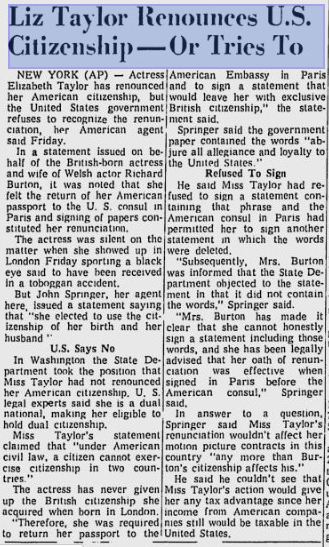
The specific facts surrounding the citizenship of Elizabeth Taylor may never become public knowledge. She was not born in the U.S. and hence did not receive U.S. citizenship via the 14th Amendment. She was born in London, England in 1932 to U.S. citizen parents and hence obtained derivative U.S. citizenship via her parents.
Ms. Taylor apparently tried to renounce in Paris at one point, unsuccessfully when married to Richard Burton around the time she won the Oscar for Who’s Afraid of Virginia Woolf?.
There were various newspaper reports published in the 1960s about how she first attempted to renounce (unsuccessfully) and then later successfully renounced while married to Richard Burton.
Elizabeth Taylor reportedly reacquired her U.S. citizenship later in 1977 when then married to John Warner who served six terms in the U.S. Senate and was the Secretary of Navy and now practices law.



???????????????? ?Please click here to view the above in Chinese.?
The dangers of becoming a “covered expatriate” by not complying with Section 877(a)(2)(C).
Probably the most misunderstood concept in the U.S. tax expatriation law provisions is Section 877(a)(2)(C) for several reasons.
1. People of modest means with modest to little income and little to no assets can fall into this category.
2. Most individuals think the mark-to-market tax upon expatriation is only applicable to rich, wealthy or otherwise individuals with high levels of income. See, Accidental Americans” – Rush to Renounce U.S. Citizenship to Avoid the Ugly U.S. Tax Web” International Tax Journal,CCH Wolters Kluwer, Nov./Dec. 2012, Vol. 38 Issue 6, p45
3. Lawful permanent residents (“LPRs”) can inadvertently fall into this category without doing anything, other than living principally in a country outside the U.S., which has a U.S. income tax treaty. See, Oops…Did I “Expatriate” and Never Know It: Lawful Permanent Residents Beware! International Tax Journal, CCH Wolters Kluwer, Jan.-Feb. 2014, Vol. 40 Issue 1, p9. At the end of this post is a list of the countries with U.S. income tax treaties.
4. Few individuals understand exactly what must be included and reported in IRS Form 8854 to be able to satisfy the certification requirement above. For more details, see What are the consequences of becoming a “covered expatriate” for failing to comply with Section 877(a)(2)(C)?
The relevant provisions of Section 877(a)(2)(C) are highlighted below:
- This section shall apply to any individual if—
- (A) the average annual net income tax . . . is greater than $124,000,
- (B) the net worth of the individual as of such date is $2,000,000 or more, or
- (C) such individual fails to certify under penalty of perjury that he has met the requirements of this title for the 5 preceding taxable years or fails to submit such evidence of such compliance as the Secretary may require.
Failure to certify truthfully about compliance with U.S. tax law for 5 years, as set forth above in the statute, means the individual necessarily will be a “covered expatriate.” Does this mean that if a U.S. citizen who renounces citizenship or a LPR who abandons their green card, will necessarily be a “covered expatriate” if they fail to follow IRS Notice 2009-45 “Guidance for Expatriates Under Section 877A”?
What steps will the IRS take if someone intentionally does not comply with the certification requirement? Will they become a target of a criminal investigation, and under what circumstances? What could be the focal point of IRS Criminal Investigations of Former U.S. Citizens and Lawful Permanent Residents?
There are many pending and open questions not answered by current law, as the U.S. Treasury has yet to publish regulations under Section 877A, 877 or 2801.
APPENDIX – Countries with Income Tax Treaties with the United States
Which countries do most Lawful Permanent Residents (“LPRs”) reside in – if they are not living in the U.S.?
This is a very important question for purposes of the “tax-expatriation” rules that can apply to LPRs who leave the U.S. and live predominantly in another country. This is particularly important if the individual lives in a country with a U.S. income tax treaty.
See the article – Oops…Did I “Expatriate” and Never Know It: Lawful Permanent Residents Beware! International Tax Journal, CCH Wolters Kluwer, Jan.-Feb. 2014, Vol. 40 Issue 1, p9.
For statistical information of LPRs and their country of origin, see, Rytina, Nancy; Estimates of the Legal Permanent Resident Population in 2012, Office of Immigration Statistics (July 2013). p 3.
Country of Birth
Mexico was the leading country of origin of the LPR population in 2012 (see Table 4). An estimated 3.3 million or 25 percent of LPRs came from Mexico. The next leading source countries were China (0.6 million) and the Philippines (0.6 million), followed by India (0.5 million) and the Dominican Republic (0.5 million). Forty-two percent of LPRs in 2012 were born in one of these five coun-tries. The 10 leading countries of origin, which also include Cuba, Vietnam, El Salvador, Canada, and the United Kingdom, repre-sented 55 percent of the LPR population.

???????????????? ?Please click here to view the above in Chinese.?
Should the U.S. government consider it a positive development that about 3,000 citizens renounced in 2013?
 Some view this number to be a statistical blip; considering there are some 13.3 million lawful permanent residents (“LPRs”) many of whom are trying to become U.S. citizens. See, Rytina, Nancy; Estimates of the Legal Permanent Resident Population in 2012, Office of Immigration Statistics (July 2013).
The 200% increase in U.S. citizenship renunciations in 2013 compared to 2012 is still yet a fraction of those persons who are wishing to become U.S. citizens.
If all the 13.3 million LPRs plan on becoming U.S. citizens, this represents a mere 0.02% of those renouncing citizenship. Assume just 1/2 of the LPRs above are planning on becoming U.S. citizens, this still represents only 0.04% of those renouncing citizenship.
Bottom Line: There is a big line of people trying to become U.S. citizens versus a very small line of people trying to shed their U.S. citizenship.
???????????????? ?Please click here to view the above in Chinese.?
This is a good article on NPR – Why More Americans Are Renouncing U.S. Citizenship
This is put both in the Media section and elevated to a specific post – as it is a thoughtful article.
This radio article notes that Americans who live overseas are renouncing their U.S. citizenship in record numbers. The renunciation has been a sudden spike from a domino affect from the following:
1. UBS aided tax evasion scheme that broke in 2009;
2. Congressmen believed that tens of billions could be collected;
3. FATCA was adopted in 2010 – to identify all American account holders throughout the world;
4. Foreign banks cancelled accounts throughout Europe; and
5. The U.S. is unusual in that it taxes its U.S. citizens wherever they are in the world.
???????????????? ?Please click here to view the above in Chinese.?