USCs and LPRs Who Are Having Their Non-U.S. Accounts Closed: Is it hype or is it real?

Is it hype or is it real?

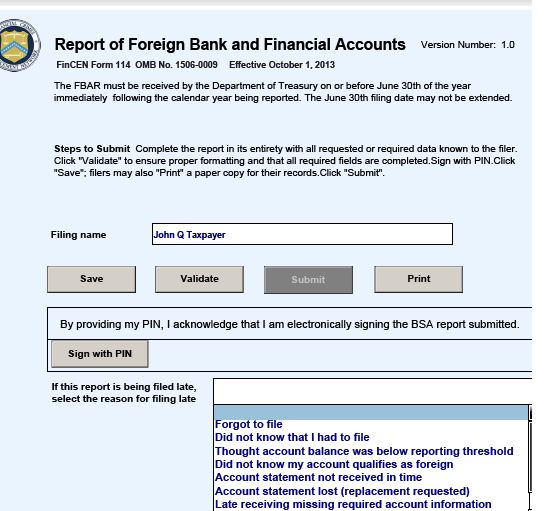
It’s difficult to know with certainty how accurate are the various claims that U.S. citizens overseas are having their accounts closed by foreign financial institutions. If it has happened to you, of course you will know it.  See for instance the following reports, just to name a few:FBAR 114 electronic
Wall Street Journal: Expats Left Frustrated as Banks Cut Services Abroad Americans Overseas Struggle With Implications of Crackdown on Money Laundering and Tax Evasion (11 Sept 2014)

Wall Street Journal – Opinion (Colleen Graffy): How to Lose Friends, Citizens and Influence; The U.S. Foreign Account Tax Compliance Act seeks to co-opt foreign banks as long-arm enforcement

Association of Americans Resident Overseas: Americans Abroad are Denied Access to Banking and Investment Opportunities

Time Magazine: Swiss Banks Tell American Expats to Empty Their Accounts

The Huffington Post (Aug 2014) – Expatriate Tax Sense or Broad-Brush Overreach: The U.S. Foreign Account Tax Compliance Act (FATCA)

The New York Times (April 2013) Overseas Finances Can Trip Up Americans Abroad

and

American Citizens Abroad which compiles various news accounts of accounts being closed. 

Anecdotally, I have certainly seen it in my practice, in places such as Hong Kong, London, Geneva and Zurich, but I can’t say I have seen it as a widespread practice.  Indeed, for those individuals with large investment accounts (e.g., greater than US$1M, the banks seem to accommodate, or at least require them to move their assets to their U.S. affiliate or branch).  I suspect those with smaller accounts of less than US$100,000, are seeing a broader brush stroke closing these accounts.

For good practical advice about maintaining or opening foreign accounts, I recommend you read:

American Citizens Abroad: Maintaining Bank Accounts in the United States While You Are Living Abroad – Recommended steps for overseas Americans to follow  if a U.S. bank refuses either to open an account or to maintain an account because of the client’s foreign address
**

I can say that what I have seen in practice is a widespread plan by individuals to close foreign financial accounts and relocate the assets to a U.S. financial institution.  This is not the decision of the financial institution, but rather the individual.  The reason is not FATCA, per se, but a desire to reduce the compliance costs of filing and reporting on these foreign accounts. See,  Nuances of FBAR – Foreign Bank Account Report Filings – for USCs and LPRs living outside the U.S.

Multiple tiers of reporting of foreign assets is now required and it can cost a small fortune to have a good international tax adviser who is aware of these reporting requirements.  See,  USCs and LPRs residing outside the U.S. – and IRS Form 8938 [Specified Foreign Financial Assets]IRS Form 8938 Specified Foreign Financial Assets - Highlighted Marker

For those with significant assets and numerous accounts, the professional fees and costs of reporting accurately these accounts can become exorbitant (especially when the risks of potentially devastating civil penalties are weighed into the mix).  See,  Why the Zwerner FBAR Case is Probably a Pyrrhic Victory for the Government – for USCs and LPRs Living Outside the U.S. (Part II)

At the end of the day, the practical affect I have seen (anecdotally) is a widespread desire to close foreign accounts and move them to the U.S.; not because of FATCA, but because of the costs and compliance and risk (more than just perceived – considering the IRS now regularly threatens large multiple year 50% willfulness penalties for those who did not file an FBAR) of being penalized by the IRS.

I find this ironic, since there is no legal restriction for a USC to hold foreign accounts and indeed a USC or LPR residing outside the U.S., will generally find it easier from a lifestyle and personal financial management perspective to have an account in their home country.  The affect, however, is that U.S. financial institutions are receiving these assets and investments.

I will post a survey this week to ask individuals if they have had their non-U.S. bank accounts closed.

Read the Q&A format here.

The dangers of becoming a “covered expatriate” by not complying with Section 877(a)(2)(C).

Probably the most misunderstood concept in the U.S. tax expatriation law provisions is Section 877(a)(2)(C) for several reasons.

1.  People of modest means with modest to little income and little to no assets can fall into this category.

2.  Most individuals think the mark-to-market tax upon expatriation is only applicable to rich, wealthy or otherwise individuals with high levels of income.  See, Accidental Americans” – Rush to Renounce U.S. Citizenship to Avoid the Ugly U.S. Tax Web” International Tax Journal,CCH Wolters Kluwer, Nov./Dec. 2012, Vol. 38 Issue 6, p45

3.  Lawful permanent residents (“LPRs”) can inadvertently fall into this category without doing anything, other than living principally in a country outside the U.S., which has a U.S. income tax treaty. See, Oops…Did I “Expatriate” and Never Know It: Lawful Permanent Residents Beware! International Tax Journal, CCH Wolters Kluwer, Jan.-Feb. 2014, Vol. 40 Issue 1, p9.  At the end of this post is a list of the countries with U.S. income tax treaties.

4.  Few individuals understand exactly what must be included and reported in IRS Form 8854 to be able to satisfy the certification requirement above.  For more details, see What are the consequences of becoming a “covered expatriate” for failing to comply with Section 877(a)(2)(C)?

The relevant provisions of Section 877(a)(2)(C) are highlighted below:

  • This section shall apply to any individual if—
  • (A) the average annual net income tax . . . is greater than $124,000,
  • (B) the net worth of the individual as of such date is $2,000,000 or more, or
  • (C) such individual fails to certify under penalty of perjury that he has met the requirements of this title for the 5 preceding taxable years or fails to submit such evidence of such compliance as the Secretary may require.

Failure to certify truthfully about compliance with U.S. tax law for 5 years, as set forth above in the statute, means the individual necessarily will be a “covered expatriate.”   Does this mean that if a U.S. citizen who renounces citizenship or a LPR who abandons their green card, will necessarily be a “covered expatriate” if they fail to follow IRS Notice 2009-45 “Guidance for Expatriates Under Section 877A”?

What steps will the IRS take if someone intentionally does not comply with the certification requirement?  Will they become a target of a criminal investigation, and under what circumstances?  What could be the focal point of IRS Criminal Investigations of Former U.S. Citizens and Lawful Permanent Residents?

There are many pending and open questions not answered by current law, as the U.S. Treasury has yet to publish regulations under Section 877A, 877 or 2801.

APPENDIX – Countries with Income Tax Treaties with the United StatesEurope Map

Armenia
Australia
Austria
Azerbaijan
Bangladesh
Barbados
Belarus
Belgium
Bulgaria
Canada
Chile
China
Cyprus
Czech Republic
Denmark
Egypt
Estonia
Finland
France
Georgia
Germany
GreeceAsia Map - including Russia
Iceland
India
Indonesia
Ireland
Israel
Italy
Jamaica
Japan
Kazakhstan
Korea, Republic of
Kyrgyzstan
Latvia
Lithuania
LuxembourgNorth America Map
Malta
Mexico
Moldova
Morocco
Netherlands
New Zealand
Norway
Pakistan
Philippines
Poland
Portugal
Romania
Russia
Slovak Republic
Slovenia
South Africa
Spain
Sri Lanka
SwedenMiddle East Map
Switzerland
Tajikistan
Thailand
Trinidad and Tobago
Tunisia
Turkey
Turkmenistan
Ukraine
United Kingdom
Uzbekistan
Venezuela