
Renouncing USC or formally abandoning your LPR can have consequences that you may not have contemplated. For instance, many States in the United States will not issue or renew a driver’s license to a non-USC who has a certain immigration status.
As an example, Delaware will not issue a driver’s license to someone who has an A-1, A-2, B-2, B-1, or WB visa holder.
Other States, such as Texas have extensive requirements, depending upon the immigration status of the former USC or LPR.
California laws restrict many non-citizens from having a driver’s license. California does accept a Canadian passport or birth certificate as a valid document and proof of eligibility. Also a valid Mexican border crossing card (aka “laser visa”) with a valid I-94 is acceptable in California. See, California DMV.
Almost every State has a different set of unique rules. See, for instance, New Hampshire, New York, Florida, Washington State, Illinois and Washington, D.C. Illinois, for instance, has a law passed in 2013 that allows a driver’s license to be issued to an “undocumented” temporary visitor.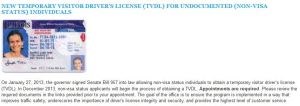
Washington State currently has one of the most liberal set of rules for obtaining a license; including acceptance of “multiple documents issued by: Mexican government [&] Guatemalan government”
Of course, if you are living almost exclusively outside the U.S., a driver’s license from a State within the United States, will certainly not be necessary. However, some U.S. insurance companies will not provide certain insurance coverage for non-citizens without a U.S. driver’s license. Losing your U.S. driver’s license may be little more than an inconvenience.
???????????????? ?Please click here to view the above in Chinese.?